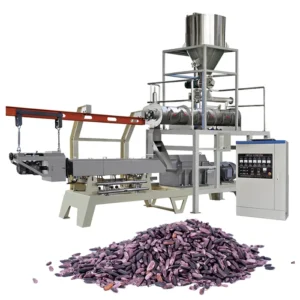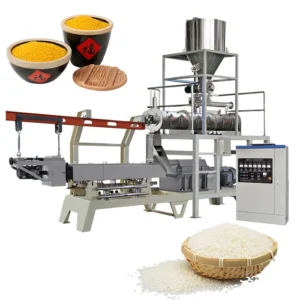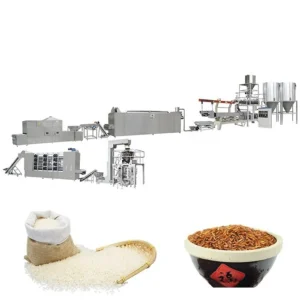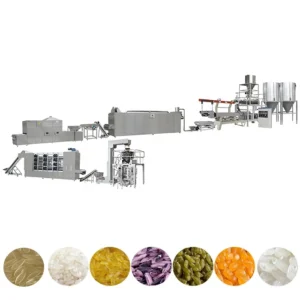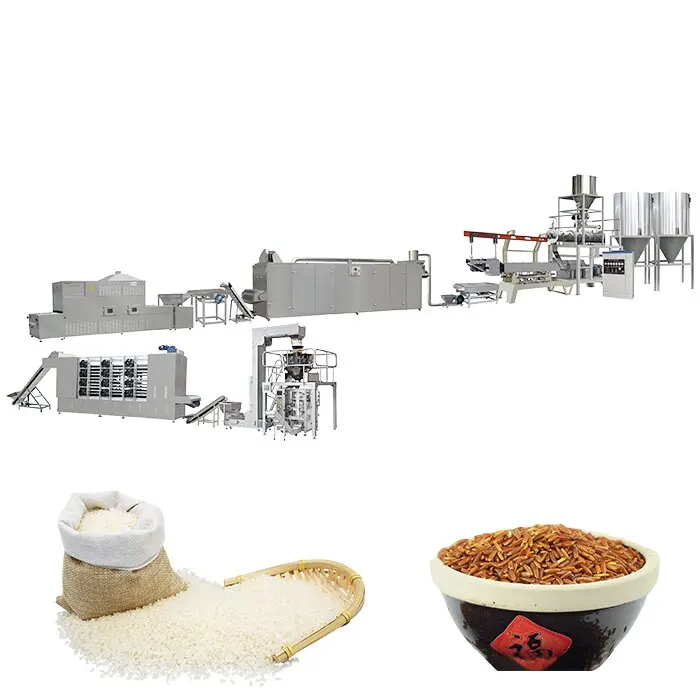
Throughput-matched station design — every mixer, extruder, dryer and packer in this line is sized against actual material output rather than nominal extruder rating, eliminating the bottleneck that typically hits when stations are sourced separately.
Technical Specifications
| Parameter | Value |
|---|---|
| Model | MT65 / MT70 / MT85 / MT75 / MT95 |
| Product Type | Fortified Artificial Rice Processing Line |
| Screw Type | Twin-screw (single or double screw feeding available depending on material) |
| Installed Power | 85 kW (MT65) / 120 kW (MT70) / 235 kW (MT85) / 180 kW (MT75) / 260 kW (MT95) |
| Power Consumption | 60 kW (MT65) / 85 kW (MT70) / 165 kW (MT85) / 135 kW (MT75) / 195 kW (MT95) |
| Output Capacity | 80–100 kg/h (MT65) / 100–120 kg/h (MT70) / 200–300 kg/h (MT85) / 300–500 kg/h (MT75) / 800–1000 kg/h (MT95) — basis not stated in source, confirm with raw material and moisture content |
| Overall Dimensions (L×W×H) | 28×1.2×2.2 m (MT65) / 30×1.5×2.2 m (MT70) / 34×3.5×4.3 m (MT85) / 32×3.5×4.3 m (MT75) / 36×3.5×4.3 m (MT95) |
| Control System | Frequency speed control, high automation |
| Lubrication | Automatic lubricating and cooling system |
| Heating Source (Dryer) | Electric or gas |
| Dryer Feature | Circulation drying with frequency motor-controlled mesh belt speed |
| Production Procedure | Mixing → Extruding → Vibrating → Low temperature drying → Cooling → High temperature roasting → Cooling → Packing |
| Basic Materials | Broken rice, corn, millet, wheat, oats, buckwheat, bean, starch; vitamins and minerals as partial ingredients |
| Assembly State | Complete line with supporting equipment |
| Certification | CE, ISO |
Application Suitability
| Application | Material or Output |
|---|---|
| Micro-nutrient fortified rice kernels for nutrition programmes | Broken rice and rice bran blended with vitamin and mineral premix |
| Artificial rice from grain by-products | Corn, millet, wheat, oats, buckwheat and bean flour |
| Value-added processing of broken rice | Fragmented rice kernels reconstituted into uniform grain-shaped kernels |
| Fortified food production for institutional supply | Starch base with added iron, zinc, folic acid and B-vitamin premix |
What "Rated Capacity" Leaves Out About Fortified Rice Lines
Output numbers on a spec sheet rarely tell you what the line will actually produce on your specific grain blend.
I watched a Middle East nutrition programme supplier commission a fortified artificial rice processing line that was quoted at a comfortable mid-range throughput. On pure rice flour the extruder held that rate without issue. The moment the formulation shifted to a high-fibre blend with added bran and mineral premix, expansion collapsed, kernels stuck to the die face, and the downstream dryer received a surge of wet, misshapen product it was never sized to handle. Two tonnes of raw material went to waste before the screw configuration was completely reworked and the dryer belt speed recalibrated [NEED_CITE: raw material formulation effect on extrusion throughput]. The capacity figure on the nameplate had been correct — for a different recipe entirely.
Matching Every Station to the Actual Extruder Output
A Fortified Artificial Rice Processing Line only performs as well as its weakest station. When the extruder pushes product at a rate the dryer cannot handle, moisture stays trapped inside the kernel and cracking appears during storage. When the cooler is undersized relative to the roaster, residual heat causes condensation inside the packing bag. Each station in this line — mixing, extruding, vibrating, low-temperature drying, cooling, high-temperature roasting, cooling again and packing — is specified against the extruder’s real output on the buyer’s grain formulation, not a generic throughput figure.
Screw Configuration Decides Whether the Kernel Holds Its Shape
The twin-screw extruder in this line uses a screw combination specified to the buyer’s raw material blend and target kernel geometry. Different grains gelatinise at different temperatures and shear thresholds. Broken rice behaves differently from buckwheat, and adding a vitamin-mineral premix changes the melt viscosity inside the barrel. A configuration that works on one formulation may produce hollow or split kernels on another. The automatic lubricating and cooling system keeps barrel temperature stable across long production runs, which is critical when fortified rice kernels must meet strict dimensional tolerances for government nutrition programmes [NEED_CITE: twin-screw extrusion parameters for starch-based food products].
Reading the Specs That Actually Matter
The installed power range across the five models — from 85 kW on the MT65 to 260 kW on the MT95 — reflects motor capacity for different barrel volumes and screw diameters. Power consumption figures are proportionally lower, indicating that thermal and mechanical energy is matched to each frame size rather than overspecified. The circulation dryer uses a frequency motor-controlled mesh belt, which lets the operator tune residence time to the kernel density coming off the extruder. This matters because a dense, mineral-loaded kernel dries slower than a pure starch kernel, and a fixed-speed belt would either scorch the surface or leave the core wet. The production procedure includes both low-temperature drying and high-temperature roasting as separate stages, which gives the operator independent control over moisture removal and final surface texture.
The Hidden Cost of Mismatched Line Components
When supporting equipment is sourced from separate vendors, nobody takes responsibility for the throughput gap between stations. The extruder supplier blames the dryer, the dryer supplier blames the extruder, and the buyer absorbs the downtime. On a fortified artificial rice processing line, a mismatch between extruder output and dryer capacity does not just slow production — it degrades the kernel. Wet kernels that sit too long on the belt develop surface cracks, and cracked kernels shatter during roasting and packing. The yield loss compounds across every shift [NEED_CITE: impact of equipment mismatch on food extrusion yield].
Why Sourcing the Full Equipment Range Here Reduces Commissioning Risk
Every station in this Fortified Artificial Rice Processing Line is supplied under one equipment catalogue, so throughput calculations are performed across the entire chain before production begins. The screw and die configuration is recorded against the buyer’s specific raw material blend rather than copied from a standard build. An in-house testing workshop runs trial batches on the buyer’s actual grain formulation before the line ships, so screw combinations and dryer settings are adjusted in the factory — not on the buyer’s floor during commissioning. Frequency speed control across extruder and dryer allows fine-tuning without mechanical changeover. Electrical schematics and voltage confirmation are locked to the buyer’s local utility standard before fabrication starts, avoiding the delays that surface when a control panel arrives wired for the wrong frequency.
Documentation & Verification
- Line layout and capacity calculation showing throughput at every station
- Screw and die configuration record matched to your grain blend
- Trial run report on your raw material from the in-house testing workshop
- Electrical schematic with voltage and frequency confirmed for your site
- CE declaration of conformity and ISO certificate for customs and regulatory clearance
- Operation and maintenance manual with wear parts list and replacement intervals
Installation, Commissioning & Support
- Foundation and floor space planning based on line dimensions up to 36×3.5×4.3 m
- Dedicated power circuit sized to the selected model’s installed power up to 260 kW
- Assembly and alignment of extruder, dryer and roaster modules on site
- First-run parameter setting for screw speed, feeder rate and dryer belt frequency
- Operator training covering formulation changeover and die cleaning procedures
- Wear parts list with screws, dies and barrel segments identified for reorder scheduling
What We Need to Configure Your Line
To size a Fortified Artificial Rice Processing Line correctly, share your target grain formulation including the percentage of broken rice, secondary grains and any vitamin-mineral premix. Provide your intended daily output and the number of shifts you plan to run. Confirm your local voltage, frequency and the control language your operators will need. If you have existing upstream milling or downstream packing equipment, let us know the interface requirements so the line can be matched to your current plant layout.
Frequently Asked Questions
Q: How does my raw material blend affect the line’s actual output capacity?
A: Output varies significantly between pure rice flour and high-fibre or mineral-enriched formulations. The capacity figures in the spec sheet are reference values. A trial run on your specific grain blend in the testing workshop confirms the achievable throughput before the line is built, so you receive a capacity number tied to your actual recipe.
Q: How are the extruder, dryer and packing stations matched to prevent bottlenecks?
A: Each station is sized against the extruder’s verified output on your raw material, not a nominal rating. The dryer belt speed, roaster residence time and packing rate are all calculated from the same throughput baseline, so no single station restricts the others during continuous production.
Q: What voltage and control options are confirmed before production starts?
A: Electrical schematics and voltage specifications are confirmed against your local utility standard during the proposal stage. Frequency, phase and control panel language are documented before fabrication, so the line arrives ready for connection without on-site rewiring or panel replacement.
Q: Is a trial run performed on my raw material before shipment?
A: Yes. The in-house testing workshop runs your actual grain formulation through the extruder and records screw speed, barrel temperature, die pressure and kernel quality. The trial report is shared with you before dispatch, and any screw or die adjustments are completed at the factory.
Q: What spare wear parts are included, and how are replacements supplied?
A: Each line ships with a documented wear parts list covering screws, dies and barrel segments. Replacement components are manufactured to the same configuration record as the originals, ensuring consistent kernel geometry across production runs without the need for re-commissioning.