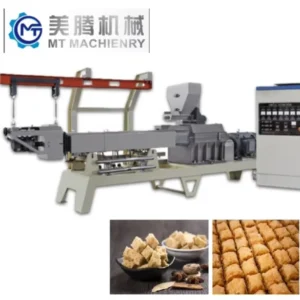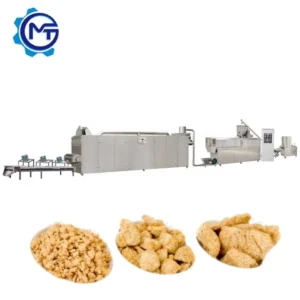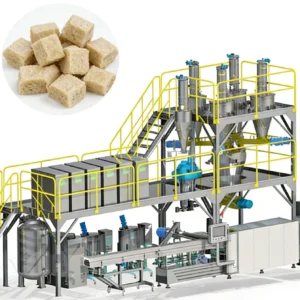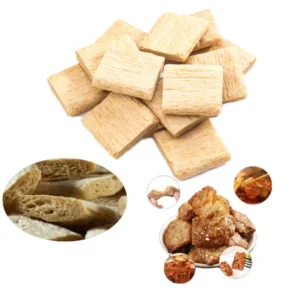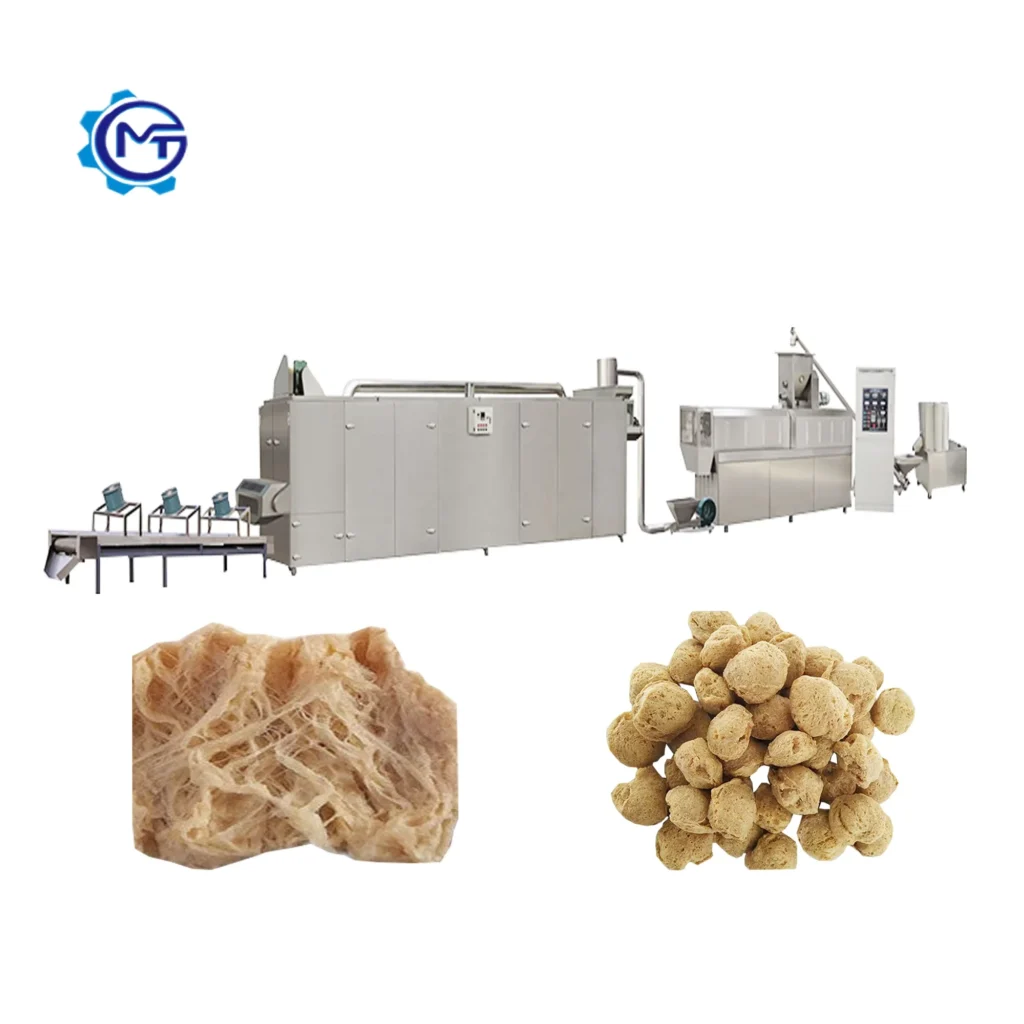
Screw Configuration Matched to Your Raw Material — each MT65 textured vegetable protein production line ships with a die and screw profile specified to the buyer’s soy or peanut meal formulation rather than a generic build.
Technical Specifications
| Parameter | Value |
|---|---|
| Model | MT65 |
| Product Type | Textured Vegetable Protein Production Line |
| Screw Type | Twin-screw |
| Installed Power | 85 kW |
| Real Power | 65 kW |
| Output Capacity | 150–200 kg/h (basis not stated in source — confirm raw material / moisture content / product format) |
| Overall Dimensions | 18000 × 1300 × 2300 mm |
| Line Stations | Raw material preparation → mixing → conveying → extrusion → conveying → drying → cooling → packing |
| Mixer Tank Volume | 150 kg |
| Mixer Rotary Speed | 385 rpm |
| Mixer Power | 4 kW |
| Mixer Dimensions | 1000 × 630 × 1100 mm |
| Dryer Effective Belt Length | 3.5 m |
| Dryer Belt Motor Power | 0.55 kW |
| Dryer Far Infrared Heater Power | 3.9 kW × 24 |
| Dryer Gas Consumption | 6.8 m³/h |
| Dryer Dimensions | 4500 × 1500 × 1600 mm |
| Contact Material | Food-grade stainless steel |
| Control System | Available with PLC or MCC control |
| Standards | CE, ISO |
| Warranty | 1 year |
Application Suitability
| Application | Material or Output |
|---|---|
| Textured soy protein for plant-based meat substitute | Low-temperature soybean meal, soy protein isolate |
| Plant-based meat analogue for ham and sausage | Defatted soy flour, peanut meal blends |
| TVP ingredient for canned and quick-frozen food | Soy and peanut protein at varied moisture levels |
| Fibrous meat-extender for fast food applications | Mixed plant protein formulations |
Why Nominal Capacity Figures Mislead TVP Buyers
A textured vegetable protein production line rated at a single output number rarely holds that rate on the buyer’s actual formulation.
I watched a South American customer bring home a twin-screw extruder that ran perfectly on our standard soy protein isolate during the factory trial. Back at his plant, he switched to a locally sourced defatted soy flour and the expansion collapsed — fibre strands would not form, and three days of scrap passed before we re-dialed the screw combination and die temperature over video call. Capacity claims only matter when they are tied to the exact raw material, moisture content, and target fibre density you intend to run [NEED_CITE: raw material variability in protein extrusion]. That is why the full equipment range on this catalogue lists each station’s figures separately so you can verify throughput matching before the line ships.
How Station-by-Station Output Prevents Bottlenecks
When you survey the full equipment range for a textured vegetable protein production line, the extruder is only one link. The mixer must batch fast enough to keep the extruder fed, the dryer must remove moisture at a rate that matches extruder discharge, and the cooler must bring product temperature down before packing. On the MT65 configuration, the mixer tank holds 150 kg per batch and the dryer belt stretches 3.5 m with 24 far-infrared heater elements, giving each station visible headroom relative to the extruder’s rated throughput.
Matching Dryer Energy Source to Your Utility Reality
Far-infrared electric heating and gas-fired options are both available on the dryer section. The electric array draws 3.9 kW across 24 elements, while the gas burner consumes roughly 6.8 m³ per hour. Buyers in regions where industrial electricity tariffs are high often lean toward gas, yet gas supply pressure and line sizing must be confirmed before the dryer is built [NEED_CITE: industrial gas supply standards for food processing equipment]. Listing both options in the catalogue lets you compare utility draw against your site conditions before committing to a configuration.
Reading the Extruder Power and Screw Numbers
The MT65 twin-screw extruder shows 85 kW installed and 65 kW real power — the gap reflects start-up surge and auxiliary drives rather than continuous draw. Twin-screw geometry generates the high-temperature, high-pressure, and high-shear environment needed to unfold and re-align protein molecules into continuous fibrous strands. Screw elements and die inserts are selected after reviewing the buyer’s formulation; a soy isolate aimed at chicken-breast texture demands a different compression ratio than a peanut-meal blend targeting ground-beef crumble. Barrel zones are individually heated so the temperature profile can be stepped from feed to die, controlling where gelatinisation and fibre alignment occur along the screw length.
The Hidden Cost of Skipping a Pre-Shipment Trial
Shipping an extruder without a documented trial run on the buyer’s own raw material is the single largest source of commissioning delay I have seen on protein lines. Fibre structure, expansion ratio, and colour all shift when the protein source or particle size changes, and those variables are invisible on a spec sheet. When trial data is missing, the first week at the buyer’s plant becomes an expensive experiment — screw elements are swapped, die orifices are re-drilled, and production schedules slip while raw material is consumed as scrap [NEED_CITE: commissioning delays in extrusion plant start-ups].
Why Buyers Source This Line Through Our Catalogue
Every station from the 4 kW mixer through the twin-screw extruder to the cooling conveyor is listed in one equipment range, so throughput is visible at each step. Screw and die configurations are recorded against the buyer’s raw material rather than pulled from a generic chart. The testing workshop runs customer-supplied protein meal before dispatch, producing a trial report that travels with the shipment. Food-grade stainless steel contact surfaces span the entire line, supporting hygiene audits at the destination plant. Line layout drawings and capacity calculations are issued during the proposal stage so floor space and utility routing are confirmed before fabrication begins.
Documentation & Verification
- Line layout drawing showing each station footprint for the MT65 arrangement
- Screw and die configuration record matched to your soy or peanut meal sample
- Factory trial run report on customer-supplied raw material before crating
- Machine specification sheet listing per-station power and dimensional data
- Electrical schematic confirming voltage, frequency, and control language
Installation, Commissioning & Support
- 18 m line length requires level concrete floor with anchor points at each station
- 85 kW installed load needs dedicated breaker panel sized for twin-screw start-up surge
- Far-infrared dryer elements inspected and resistance-tested before first production run
- PLC or MCC control language set to operator preference during commissioning week
- Wear parts list covering screw elements, die inserts, and mixer seals shipped with line
What to Include in Your First Inquiry
Send the exact protein source and particle size you plan to extrude, along with target product format — fibrous chunks, mince, or sliced sheet. Confirm your site voltage and frequency so the motor and heater circuits are wound correctly. If you already operate upstream milling or downstream packing equipment, share the interface dimensions so the conveyor heights align.
Frequently Asked Questions
Q: What machines are included in a complete MT65 textured vegetable protein production line?
A: The configuration covers a powder mixer, screw conveyor, twin-screw extruder, vibratory cooler conveyor, far-infrared dryer, and packing station. Each unit is listed with its own power and dimensional data so you can see where it sits in the sequence and how throughput passes from one station to the next.
Q: How do mixer, extruder, and dryer capacities align across different line models?
A: The mixer batches up to 150 kg per cycle, feeding the MT65 extruder whose output is rated at 150–200 kg/h pending raw material confirmation. The dryer belt runs 3.5 m with sufficient residence time to match that discharge rate, and the cooling conveyor handles the same flow before product reaches packing.
Q: Can individual stations be ordered separately to upgrade an existing partial line?
A: Yes. Each station in the catalogue is available on its own. You can replace an undersized dryer or add a cooling conveyor to an existing extrusion setup, provided the upstream output and floor space are verified against the new station’s dimensions.
Q: What utility information do I need before specifying the dryer heating source?
A: Confirm available gas pressure and pipe diameter if you prefer gas firing, or the amperage capacity on your electrical panel for the far-infrared electric option. The dryer draws either 6.8 m³/h of gas or 3.9 kW across 24 heater elements, and site supply must sustain that load continuously.