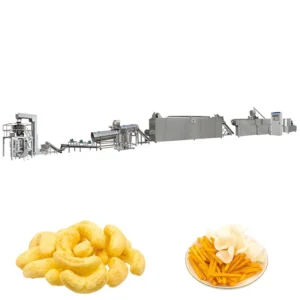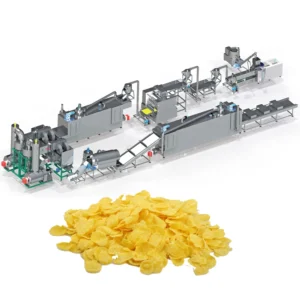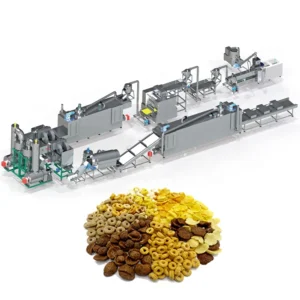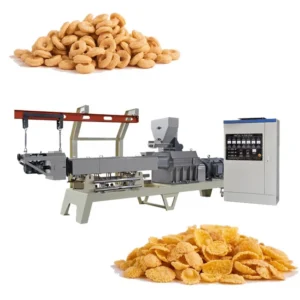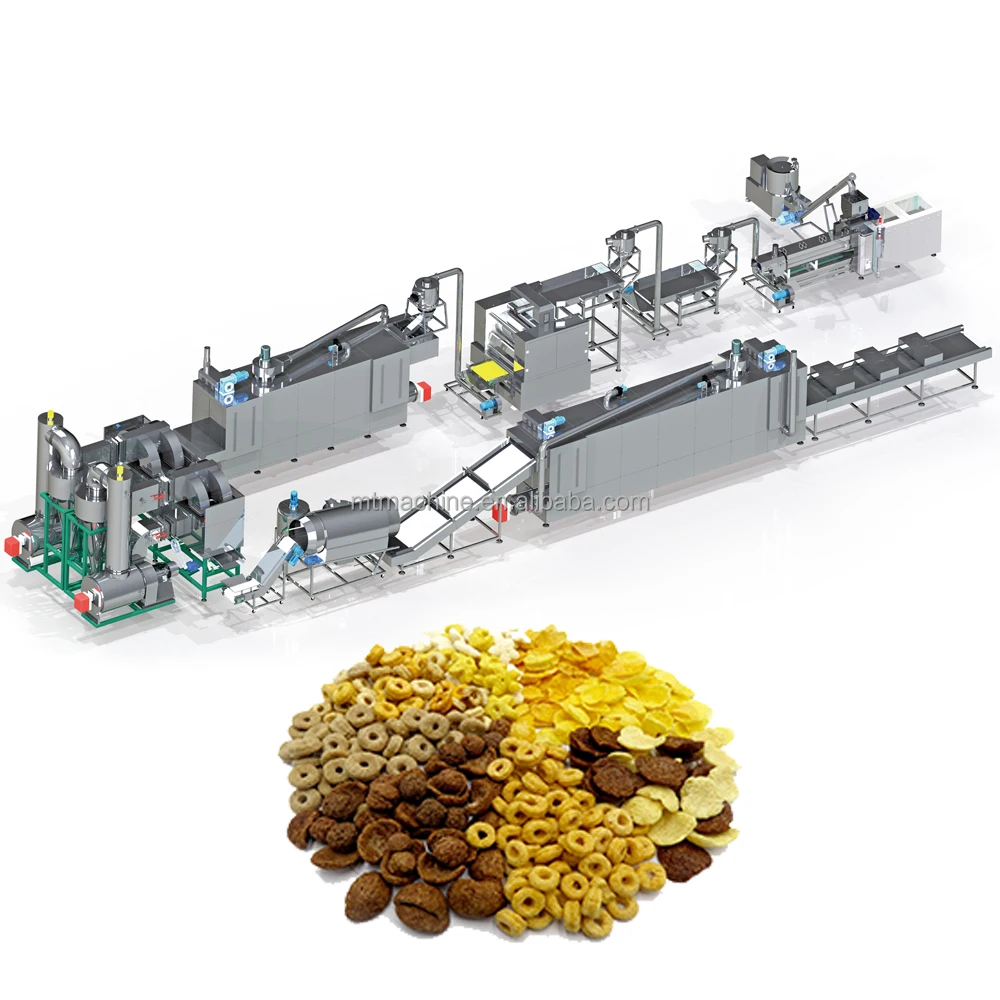
Matched throughput across every station — Our MT70, MT85, and MT75 corn flakes production lines are engineered so mixing, extruding, flaking, drying, and roasting capacities align precisely, eliminating the bottlenecks that arise when equipment is sourced from separate vendors.
Technical Specifications
| Parameter | Value |
|---|---|
| Product Type | Corn Flakes Production Line |
| Model | MT70 / MT85 / MT75 |
| Installed Power | 160 kW (MT70) / 190 kW (MT85) / 210 kW (MT75) |
| Power Consumption | 120 kW (MT70) / 140 kW (MT85) / 150 kW (MT75) |
| Output Capacity | 150–200 kg/h (MT70, basis to be confirmed) / 300–400 kg/h (MT85, basis to be confirmed) / 300–500 kg/h (MT75, basis to be confirmed) |
| Overall Dimensions | 41 × 1.5 × 2.2 m (MT70) / 43 × 1.5 × 3.2 m (MT85) / 45 × 1.5 × 3.5 m (MT75) |
| Screw Type | Twin Screw |
| Control System | PLC control system |
| Line Stations | Mixing, Extruding, Flaking, Drying, Hot Air Roasting, Sugar Coating (optional), Cooling, Packing |
| Flaking Machine | Hydraulic double rollers, double motors, infrared sensor temperature control |
| Hot Air Roasting Oven | Vibrating pan, conciliation burner, dual circulating fans, cyclone dust removal |
| Coating System | Double tumble sugar melting, elevator, coating drum, spraying nozzle (optional) |
| Heating Source (Dryer) | Gas / Electric |
| Standards | CE, ISO |
Application Suitability
| Application | Material or Output |
|---|---|
| Natural corn flakes production | Corn grits, corn flour |
| Sugar-coated breakfast cereals | Corn, rice, wheat blends with sugar coating |
| Multi-shape cereal formats | Rings, loops, stars, balls, tubes via interchangeable dies |
| Fortified breakfast cereals | Oat, barley powder with vitamin premix |
| Mixed grain flakes | Corn-rice, wheat-oat combinations |
What "300 kg/h" Really Means for Your Raw Material
Capacity ratings mean nothing unless verified against your specific formulation and moisture content.
I’ve watched lines promised at a certain throughput struggle when the buyer switched corn suppliers or adjusted moisture levels by a few percentage points. The extruder might handle the nominal load, but the flaker falls behind, the dryer can’t keep up, and suddenly you’re running at 60% of quoted capacity with flakes piling up between stations. [NEED_CITE: twin-screw extrusion capacity verification standards] That’s why our corn flakes machine full equipment range includes in-house trial runs on your exact raw material before we finalize screw configuration and die selection.
How Twin-Screw Design Handles Cereal Formulations
The twin-screw extruder in our breakfast cereal production line equipment provides the mixing intensity and residence time control that corn-based formulations demand. Corn grits require thorough gelatinization at specific moisture levels before they can be properly flaked, and the twin-screw configuration delivers consistent shear and heat transfer across varying batch compositions. When you’re running oat-barley blends or adding vitamin premixes, the intermeshing screws prevent ingredient segregation that single-screw designs struggle with.
Why the Flaker Can’t Be an Afterthought
Flake thickness directly determines roasting time and final texture, which means the flaking station must match extruder output precisely. Our hydraulic double-roller system with infrared temperature monitoring maintains consistent flake geometry even as ambient workshop conditions shift throughout production runs. The double motor arrangement allows independent roller speed adjustment, compensating for material viscosity changes that occur as the extruder processes different grain combinations. [NEED_CITE: flaking pressure and temperature control in cereal processing]
Reading the Specifications That Matter
The power consumption figures—120 kW for the MT70 up to 150 kW for the MT75—reflect actual operating draw rather than theoretical maximums, which matters when sizing your electrical supply. Overall line length stretches from 41 to 45 meters depending on model, so workshop layout planning must account for material flow from the mixer through to packing. The PLC control system standardizes temperature profiles and screw speeds across batches, reducing operator-dependent variation. Extruder heating zones work in concert with the hot air roasting oven’s dual circulating fans to achieve the surface blistering that defines quality corn flakes. The optional sugar coating system adds a tumble melter, elevator, and spray drum that can be integrated during initial installation or added as a future expansion.
The Cost of Mismatched Stations
I’ve seen corn flakes lines where the roaster was specified for peak extruder output but couldn’t handle the actual moisture load from the flaker, resulting in under-dried flakes that stuck to packaging or developed mold during storage. [NEED_CITE: post-drying moisture content and shelf stability] The extruder kept running, but the bottleneck moved to the roaster, and the producer ended up running half-speed or dumping product that didn’t meet crispness specifications. When one vendor supplies the entire corn flakes machine full equipment range, throughput calculations account for real-world material flow rather than optimistic nameplate ratings.
Why Source the Complete Line Here
Every station from batching to packing is capacity-matched under one supplier, so the MT85’s 300–400 kg/h extruder output feeds a flaker, dryer, and roaster sized for that same throughput. Screw configuration and die design are specified to your raw material and target product rather than copied from a generic build. The in-house testing workshop runs trials on your corn formulation before shipment, so screw speeds, barrel temperatures, and die geometry are already dialed in when the line arrives. Twin-screw expertise extends across pet food, aquatic feed, and cereal applications, meaning the engineering team understands how corn behaves differently from rice or wheat under extrusion shear. Pre-sales consultation covers line layout, utility planning, and voltage confirmation, reducing commissioning delays.
Documentation & Verification
- Line layout and capacity calculation showing throughput balance across mixing, extruding, flaking, drying, and roasting stations
- Screw and die configuration record matched to your corn grits or mixed grain formulation
- Trial run report on your raw material conducted in the testing workshop before shipment
- Electrical schematic with voltage and frequency confirmed for your target market
- CE declaration of conformity and ISO certificate for customs clearance and compliance
Installation, Commissioning & Support
- Foundation and utility planning accounts for the 41–45 meter line length and 160–210 kW installed power requirements
- Electrical supply verification for PLC control system voltage and frequency before equipment energization
- Flaking roller pressure calibration and infrared sensor setup during commissioning for consistent flake thickness
- Hot air roasting oven burner adjustment and dual fan balancing to achieve uniform surface blistering
- Operator training covers PLC interface navigation, screw speed adjustment, and troubleshooting protocols
- Wear parts inventory includes replacement screws, dies, and flaking rollers with recommended replacement intervals
What We Need to Configure Your Line
Provide your target corn flake specification—natural or sugar-coated, flake dimensions, and desired crispness level—along with your raw material source and typical moisture content. Share your daily production target so we can recommend the MT70, MT85, or MT75 based on verified throughput. Confirm workshop dimensions and ceiling height to ensure the 41–45 meter line footprint fits your space. Specify your local voltage, frequency, and preferred control language for the PLC system. Let us know if you need the sugar coating station now or prefer to add it later as market demand develops.
Frequently Asked Questions
Q: How do you verify the 150–500 kg/h capacity range against my specific corn formulation?
A: We conduct trial runs in our testing workshop using your actual corn grits or mixed grain blend at your specified moisture content. The results document achievable throughput with the screw configuration and die geometry we recommend, so the capacity figure you receive reflects your material rather than a generic rating.
Q: Which stations are included, and how is throughput balanced between extruder, flaker, dryer, and roaster?
A: The line covers mixing, extruding, flaking, drying, hot air roasting, optional sugar coating, cooling, and packing. Each station is sized for the extruder’s verified output on your material, so the flaker, dryer, and roaster handle the same throughput without creating bottlenecks or requiring buffer storage.
Q: What voltage, frequency, and control language options work for my market?
A: The PLC control system accommodates your local voltage and frequency specifications, which we confirm during the engineering phase before production begins. Control interface language is configurable based on your operator requirements, and electrical schematics are provided in your preferred format for local compliance.
Q: Can the sugar coating system be added later, or must it be specified at order?
A: The coating station—double tumble melter, elevator, coating drum, and spray nozzle—can be integrated during initial installation or added as a future expansion. Line layout planning accounts for the coating station footprint whether you include it immediately or reserve space for later addition.
Q: What spare wear parts should I stock, and what’s the replacement schedule?
A: Critical wear parts include extruder screws and dies, flaking rollers, and roaster oven components. We provide a wear parts list with recommended replacement intervals based on your production volume and material abrasiveness, and we maintain inventory for ongoing supply throughout the equipment lifecycle.