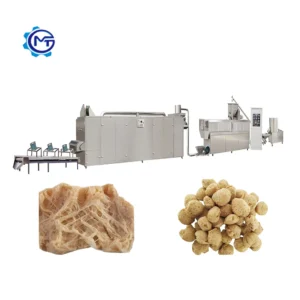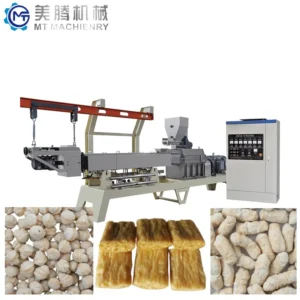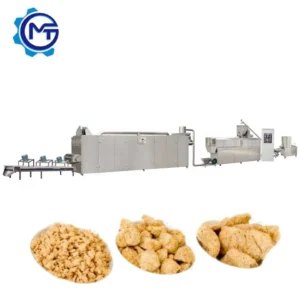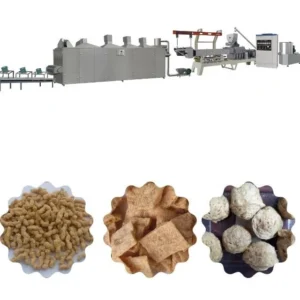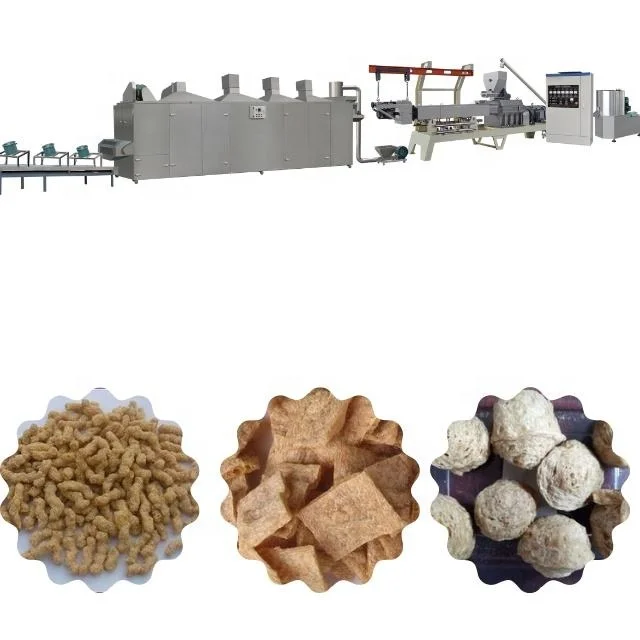
Station-by-station throughput matching — every unit from the powder mixer to the packing scale is sized against the MT65 single-screw extruder so the textured soya protein production line for sale runs without intermediate buffering or starvation.
Technical Specifications
| Parameter | Value |
|---|---|
| Model | MT65 |
| Product Type | Textured Soya Protein Production Line |
| Extruder Type | Single Screw |
| Rated Power | 85 kW |
| Real Power Draw | 65 kW |
| Output Capacity | 150–200 kg/h (basis not stated in source — confirm raw material formulation and moisture content) |
| Overall Dimensions (L × W × H) | 18000 × 1300 × 2300 mm |
| Construction Material | Stainless Steel (product-contact areas) |
| Control System | Available with PLC, MCC, or manual control (basis to be confirmed) |
| Certification | CE, ISO |
| Warranty | 1 Year Complete Warranty |
Application Suitability
| Application | Material or Output |
|---|---|
| Textured Vegetable Protein (TVP) chunks | Low-temperature soybean meal, peanut meal |
| Plant-based meat alternatives | Defatted soy flour blends formulated for fibrous structure |
| Soya meat for ham, sausage, and canned food | High-protein meal requiring defined bite and hydration |
| Quick-frozen food and fast-food ingredients | Uniformly sized, shelf-stable protein pieces |
Why a 150 kg/h Label Might Cost You Three Weeks of Commissioning
A nominal output number means nothing until it is tied to a specific recipe, moisture level, and die geometry.
I once watched a buyer in Southeast Asia take delivery of a single-screw line rated for soy chunks, only to find that their local meal had a noticeably different protein-to-fibre ratio than the standard test flour. The extruder barrel reached temperature, but the tissue structure collapsed inside the die, producing crumbs rather than fibres. Two weeks of screw pitch and temperature-profile adjustments followed before the line approached its nameplate throughput. Sourcing a textured soya protein production line for sale without first validating your raw material on the machine itself is how most commissioning delays start [NEED_CITE: typical commissioning delays caused by raw material variance].
Balancing Every Station to the Extruder
The single-screw extruder sits at the centre of the line, yet the stations before and after it determine whether it actually reaches steady state. A mixer that discharges too slowly starves the feed hopper, causing intermittent surge and uneven gelatinisation. A dryer whose belt speed or infrared zone length cannot handle the full extruder discharge forces the operator to throttle the screw RPM, defeating the purpose of buying a higher-capacity model. This textured soya protein production line for sale addresses the bottleneck risk by specifying each conveyor, dryer, and cooler against the real 65 kW power draw of the MT65, not the theoretical maximum.
Drying and Cooling: Where Fibre Structure Is Preserved or Lost
The high-temperature roaster on this line uses far-infrared heating elements distributed along the belt length. Gas consumption figures and belt dimensions are matched to the moisture content leaving the extruder die, so the TVP chunks dry from the inside out without case-hardening. If the surface dries faster than the core, the chunk cracks during cooling and produces fines that downstream packaging scales reject. Matching the cooler airflow volume to the dryer exit temperature keeps thermal shock within limits that preserve the chewy, meat-like bite buyers in the quick-frozen and canned food sectors require [NEED_CITE: drying curve requirements for textured soy protein chunks].
Reading the Power, Dimension, and Construction Numbers
The 85 kW rated power versus the 65 kW real power draw tells you the motor and heater banks have headroom for harder formulations, such as blends that include wheat gluten or pea protein isolate, without tripping the thermal overload. The 18 000 mm line length reflects the space needed for sequential mixing, extrusion, multi-pass drying, cooling, and packing; a shorter footprint almost always means a station has been compressed, usually the dryer, which shortens dwell time and leaves residual moisture above safe storage levels. Stainless-steel contact surfaces resist the mild acidity of soy meal and simplify wash-down between recipe changes, a requirement for plants running multiple chunk sizes on one shift.
What Happens When the Dryer or Cooler Is Undersized
A dryer that cannot keep pace with extruder output forces operators to lower screw speed, which reduces shear and drops the barrel temperature below the threshold needed for protein cross-linking. The result is a soft, crumbly chunk that rehydrates into mush. Downstream, a cooler with insufficient airflow leaves chunks warm when they enter the packing scale, causing condensation inside the bag and visible mould within weeks. Neither failure shows up in a factory test that runs for only a few hours; both appear once the line runs a full shift in a humid workshop [NEED_CITE: post-production moisture migration in packaged TVP].
Why Buyers Source This Line Here
Complete lines from batching to packing under one supplier mean throughput is calculated station by station rather than assembled from mismatched vendors. Screw configuration and die design are specified to the buyer’s actual meal sample, not copied from a generic soy build. An in-house testing workshop allows trial runs on your raw material before the line ships, so die geometry and barrel zones are locked down in Shandong rather than on your factory floor. Single-screw expertise across TVP, snack, and cereal applications ensures the MT65 barrel profile draws on cross-category lessons, such as moisture-injection techniques borrowed from breakfast-cereal lines. Pre-sales consultation, on-site installation, and ongoing maintenance support are handled by the same engineering team that ran the trial, keeping knowledge continuous from first sample to annual overhaul.
Documentation & Verification
- Line layout and capacity calculation showing every station matched to MT65 real power draw
- Machine specification sheet confirming single-screw type, 85 kW rated and 65 kW real power
- Electrical schematic and voltage confirmation aligned with your local supply standard
- Factory test record or trial run report produced on your soybean meal sample before dispatch
- Wear parts list covering screws, dies, and heater elements with OEM part codes
- CE declaration of conformity and ISO certificate for customs and local regulatory filing
Installation, Commissioning & Support
- Foundation plan accounts for the 18 000 mm line length and 2 300 mm headroom requirement
- Dedicated power circuit sized for 85 kW rated draw with voltage confirmed before shipment
- Stainless-steel sections arrive bolted; field welding is limited to utility hook-ups only
- First-run parameter setting includes barrel temperature profile and die gap adjustment on your meal
- Operator training covers screw-speed adjustment for different chunk sizes and moisture targets
- Initial spare set of screws, dies, and far-infrared heater elements shipped with the line
Preparing Your Inquiry
Send the specific soybean meal or peanut meal formulation you plan to run, including protein content and target moisture after drying. Note the daily output target and the number of shifts available, so the line configuration can be balanced against your actual schedule. Confirm the local voltage, frequency, and preferred control language so the MCC or PLC panel is wired and labelled before the machines leave the factory.
Frequently Asked Questions
Q: How do I pick the right extruder model for my output target?
A: The MT65 single-screw extruder is rated for 150–200 kg/h on standard formulations. If your target falls near or above that range, larger models are available with higher installed power. Share your recipe and daily tonnage so the line is configured to match.
Q: How are drying and packing stations sized to avoid bottlenecks?
A: The dryer belt length, infrared zone count, and cooler airflow are all calculated against the MT65 real 65 kW output. Packing scales are selected to handle peak discharge, so no station throttles the extruder during steady-state running.
Q: What voltage and control language options are available?
A: The control panel can be wired for your local voltage and frequency, and the PLC or MCC interface can be supplied in your preferred language. Confirm these details at quotation stage so wiring diagrams reflect your standard.
Q: Which spare wear parts should I order with the first shipment?
A: Screws, die plates, and far-infrared heater elements experience the highest wear. A recommended spare set is listed in the documentation package so replacements arrive with the line, avoiding downtime when the first change is due.
Q: Can I buy individual machines to expand my existing TVP line?
A: Yes. Each station — mixer, single-screw extruder, dryer, cooler, or packing scale — can be supplied separately. Provide your current line throughput so the new machine is matched to your existing conveyor speeds and control signals.