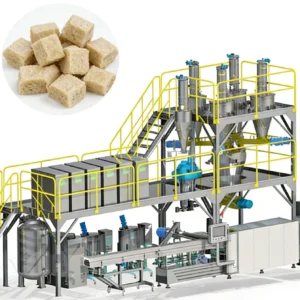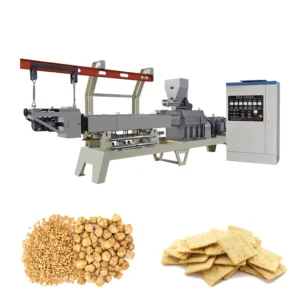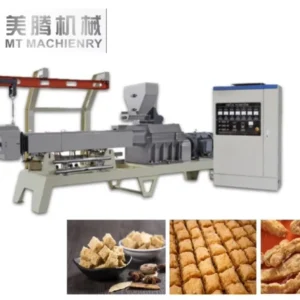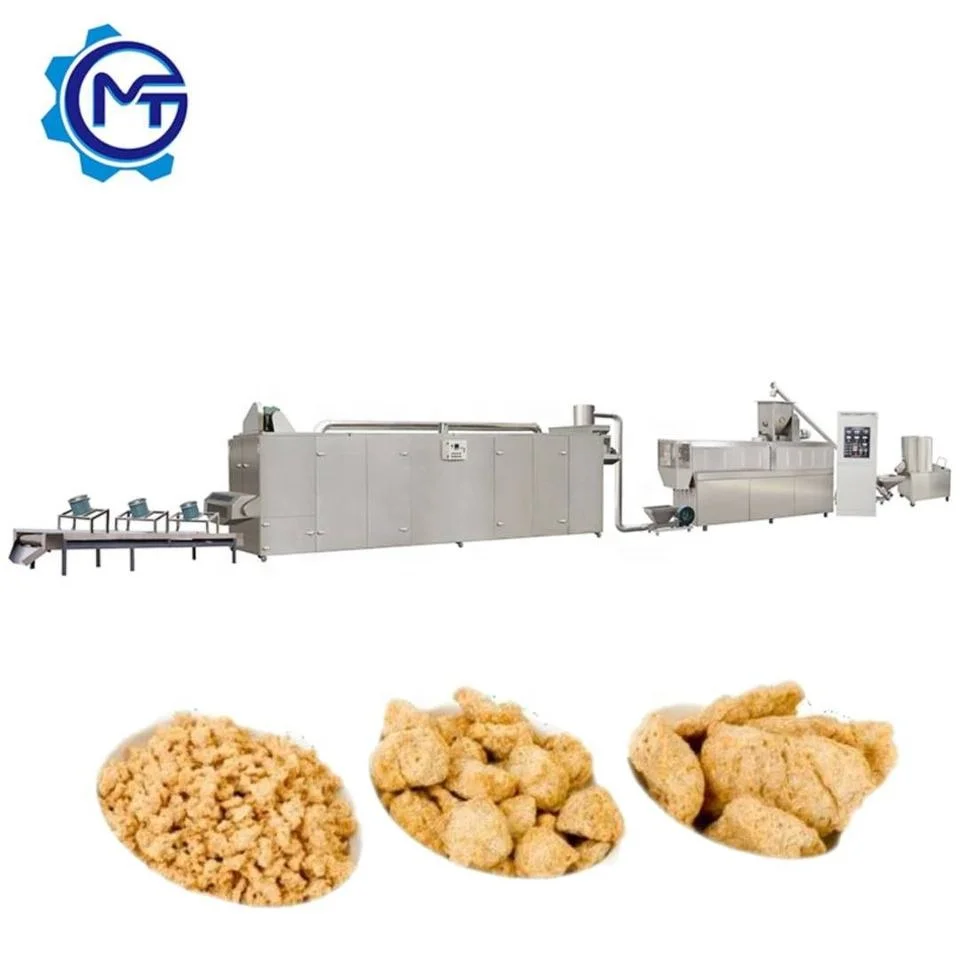
Integrated line design — Every station from the 150 kg powder mixer through the MT65 twin-screw extruder to the 3.5 m belt roaster is sized so throughput holds steady without one machine waiting on the next.
Technical Specifications
| Parameter | Value |
|---|---|
| Model | MT65 (MT70, MT85 variants available) |
| Product Type | Textured Soy Protein Extrusion Line |
| Screw Type | Twin-screw |
| Line Installed Power | 85 kW |
| Line Actual Power | 65 kW |
| Output Capacity | 150–200 kg/h (basis not stated in source — confirm raw material formulation, moisture content and target texture) |
| Overall Dimensions (Line) | 18000 × 1300 × 2300 mm |
| Double Screw Extruder Output | 200–250 kg/h (basis not stated in source — confirm raw material and die configuration) |
| Extruder Main Motor Power | 30 kW |
| Extruder Installed / Actual Power | 45.87 kW / 30–35 kW |
| Extruder Dimensions | 2800 × 830 × 1875 mm |
| Powder Mixer Output | 300–600 kg/h (basis not stated in source — confirm batch composition and moisture addition) |
| Powder Mixer Tank Volume | 150 kg |
| Powder Mixer Rotary Speed | 385 rpm |
| Powder Mixer Mixing Time | 10 min per batch |
| Powder Mixer Power | 4 kW |
| Powder Mixer Dimensions | 1000 × 630 × 1100 mm |
| High-temperature Roaster Effective Belt Length | 3.5 m |
| Roaster Far Infrared Heater Power | 3.9 kW × 24 |
| Roaster Belt Motor Power | 0.55 kW |
| Roaster Gas Consumption | 6.8 m³ (basis not stated in source — confirm gas type and calorific value) |
| Roaster Dimensions | 4500 × 1500 × 1600 mm |
| Cooling Machine Capacity | 200–300 kg/h (basis not stated in source — confirm product density and inlet temperature) |
| Cooling Machine Temperature Range | 0–260 °C (source value — verify against manufacturer catalog) |
| Construction Material | Stainless steel across all stations |
| Process Flow | Mixing → Conveying → Extrusion → Conveying → Drying → Cooling → Packing |
| Warranty | 1 year complete warranty |
| Standards | CE, ISO |
Application Suitability
| Application | Material or Output |
|---|---|
| Textured soy protein for ham and sausage fillers | Low-temperature soybean meal, defatted soy flour |
| Plant-based meat chunks for canned food | Soybean meal and peanut meal blends |
| Quick-frozen ready-meal soy meat pieces | Soy protein concentrate with starch carriers |
| Vegetarian patty and nugget base material | Soy and pea protein isolates with binding agents |
What "200 kg/h" Leaves Out About Your Soy Formulation
Nominal output numbers are only as reliable as the raw material they were measured on.
When I was still running trials on the factory floor, we once shipped a textured soy protein extrusion line to a Southeast Asian buyer after successful test runs on standard soybean meal. Once the line started on their site, we learned they were cutting the soy flour with pea protein isolate. The fibrous structure collapsed, and it took over a week of screw speed and barrel temperature adjustments to recover product texture. That textured soy protein extrusion line full equipment range only performs when every station is calibrated to what actually goes into the hopper [NEED_CITE: protein restructuring behaviour under varying moisture and shear conditions].
How Twin-Screw Shear Restructures Plant Protein
The twin-screw extruder in the MT65 line applies high temperature, high pressure, and high shear simultaneously. Under these conditions, the globular protein molecules in soybean meal or peanut meal unfold and realign into a fibrous, layered structure that mimics animal muscle tissue. The die geometry at the discharge end controls whether the output emerges as strips, chunks, or granules, directly determining downstream application.
Matching Every Station From Mixer to Cooler
A textured soy protein extrusion line full equipment range only works when capacity is balanced at each station. The powder mixer handles batches of up to 150 kg with a 10-minute cycle, feeding the extruder at a rate that prevents starvation or surge. The 3.5 m roaster belt then dries the extrudate to stable moisture, while the cooling section brings the product to safe packing temperature. If any one station runs faster or slower than its neighbour, the entire textured soy protein extrusion line full equipment range suffers from accumulation gaps or product degradation. [NEED_CITE: throughput matching principles in continuous food processing lines]
Reading the Specs That Matter for Protein Texture
The extruder main motor at 30 kW drives the twin screws through a gearbox that maintains torque at varying screw speeds; this torque range determines whether high-soy formulations can be processed without stalling. Barrel temperature profiling across multiple heating zones controls the degree of protein denaturation — too low and the fibrous structure never forms, too high and the material scorches before reaching the die. The mixer’s 385 rpm rotary speed is set to achieve uniform hydration of the meal without over-shearing, which would begin breaking protein bonds prematurely. Roaster far infrared heaters totalling 93.6 kW provide the radiant energy needed to drive moisture out of the fibrous matrix evenly across the belt width.
The Cost of Skipping Raw Material Trials
Buyers who accept a line configured on generic soybean meal specs and then run proprietary blends face extended commissioning, re-cut dies, and reformulated recipes under time pressure. Screw segments that work for pure soy meal may lack the compression ratio needed for a soy-pea blend, and the dryer belt speed may not remove enough moisture from denser formulations. These mismatches surface only after installation, when the supplier’s engineer has already left the site [NEED_CITE: commissioning delays from unverified raw material formulations].
Why Sourcing the Full Range From One Builder Matters
Every station in this textured soy protein extrusion line full equipment range is specified under a single line layout, so conveyor heights, belt speeds, and electrical interlocks align without field improvisation. Screw configuration and die design are matched to the buyer’s declared raw material formulation rather than copied from a generic build. Trial runs on the buyer’s actual soybean or peanut meal are conducted in an in-house testing workshop before the machines ship, providing a baseline texture report. Electrical schematics confirm voltage, frequency, and control language for the target market before production begins. Wear parts such as screw elements and die plates are documented and stocked so first replacements do not stall production.
Documentation & Verification
- Line layout and throughput calculation showing matched capacity at mixer, extruder, roaster, and cooler
- Screw and die configuration record tied to your soybean meal or peanut meal ratio
- Trial run report on your actual raw material produced in the testing workshop
- Electrical schematic confirming voltage, frequency, and control language for your market
- CE declaration of conformity and ISO certificate covering the full line scope
- Wear parts list with screw element and die plate specifications for reorder planning
Installation, Commissioning & Support
- 18 m line length requires level concrete floor with anchor points at extruder and roaster positions
- 85 kW installed power needs dedicated breaker panel with phase monitoring at the extruder main motor
- Stainless steel frames arrive assembled; roaster and cooling belt sections are bolted on site
- First production run sets barrel temperature zones and screw speed baseline for your formulation
- Operator training covers mixer batch timing, extruder torque monitoring, and roaster belt speed adjustment
- Screw elements and die plates shipped with initial spare set; reorder list included in manual
Preparing Your Inquiry
To move from catalogue browsing to a workable line proposal, share the exact soybean meal or peanut meal specification you plan to run, including protein percentage and target moisture after drying. Provide your available workshop length and ceiling height so the 18 m layout can be adapted, and confirm local voltage and frequency so the correct motor and heater ratings are selected.
Frequently Asked Questions
Q: How is output capacity verified on my specific soybean meal formulation?
A: We run a trial on your actual raw material in our in-house testing workshop before shipment. The test records extruder screw speed, barrel temperature profile, and die pressure, producing a baseline texture report that confirms achievable throughput under your conditions.
Q: What stations are included and how is throughput matched between them?
A: The line covers powder mixing, screw conveying, twin-screw extrusion, roasting, cooling, and packing. Each station is sized so its maximum throughput aligns with the extruder’s output, preventing bottlenecks or material accumulation between consecutive machines.
Q: What screw and die configurations are available for different protein textures?
A: Screw element arrangement — kneading blocks, reverse-flight segments, and conveying sections — is selected based on your target fibre density. Die plates with varying orifice diameter and land length produce strips, chunks, or granules matched to your end product.
Q: Is a trial run on my raw material performed before shipment?
A: Yes. Your soybean meal, peanut meal, or blend is shipped to our testing workshop where the extruder and a sample dryer run your formulation. You receive a written trial report with product photographs and process parameters before the full line is packed.
Q: What voltage, frequency and control language options are confirmed before production?
A: Electrical schematics are reviewed with you during order confirmation. Motor ratings, heater elements, and control panel labels are built to match your site supply and operator language, avoiding rewiring or relabelling after delivery.