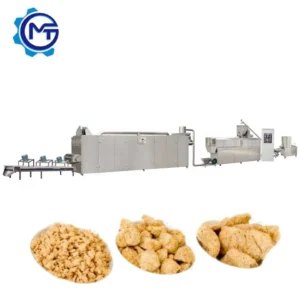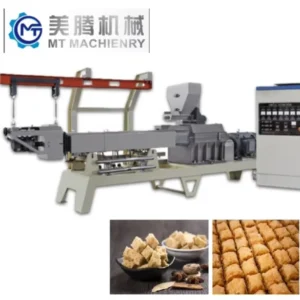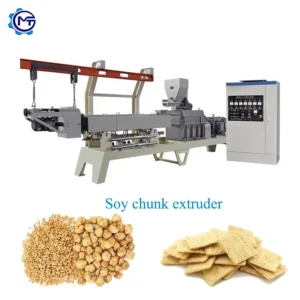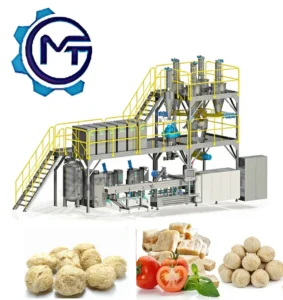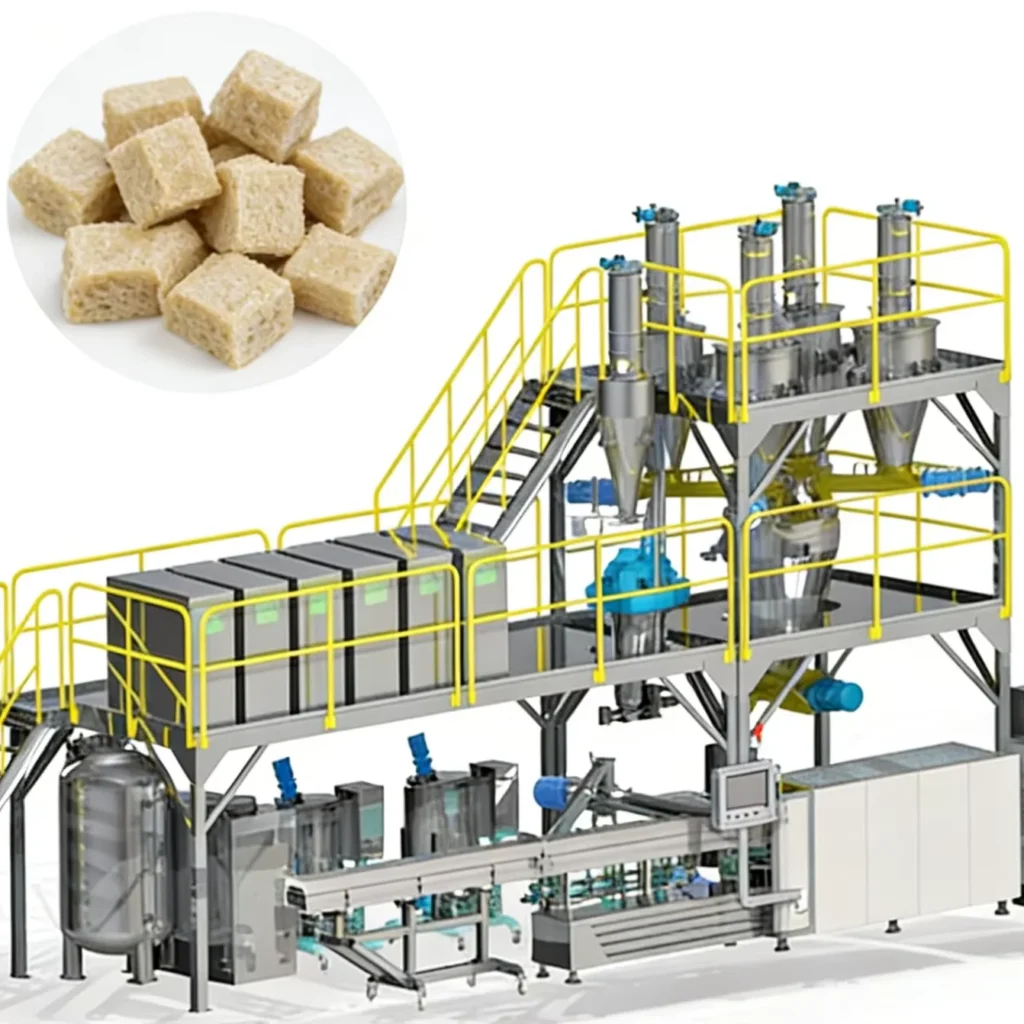
Matched Line Throughput — Every station from the mixer to the cooling machine is sized to the extruder’s actual output so no single unit gates your production rate.
Technical Specifications
| Parameter | Value |
|---|---|
| Product Type | Textured Soy Protein Extrusion Line |
| Screw Type | Twin Screw |
| Installed Power | 84 kW (MT65) / 160 kW (MT70) / 190 kW (MT75) / 210 kW (MT85) |
| Power Consumption | 59 kW (MT65) / 120 kW (MT70) / 140 kW (MT75) / 140 kW (MT85) |
| Output Capacity | 100–150 kg/h (MT65) / 150–200 kg/h (MT70, MT75) / 250–300 kg/h (MT85) (basis not stated in source) |
| Main Motor Power (Extruder) | 22 kW / 30 kW / 45 kW (source value — verify against manufacturer catalog) |
| Heating Power | 10 kW / 14 kW |
| Mixer Power | 4 kW / 7.5 kW / 15 kW |
| Mixer Contact Material | Stainless Steel 304 |
| Dryer Drive | Double Pitch Roller Chain |
| Control System | PLC and MCC |
| Certification | CE |
Application Suitability
| Application | Material or Output |
|---|---|
| Textured Vegetable Protein (TVP/TSP) | Defatted soy flour, low-temperature soy flakes |
| Soy Nuggets and Chunks | Soy protein isolate and concentrate blends |
| Meat Analogues | Plant-based protein formulations for patty and strip formats |
| Repurposed Snack/Cereal Lines | Adjusted screw and die configuration for alternative formats |
Why the Dryer Capacity Matters More Than the Extruder Nameplate
A plant based meat processing equipment for sale is only as fast as its slowest station.
I have walked into facilities where a high-capacity extruder was pushing product into a dryer that could not keep up, leaving wet, half-dried protein chunks piling up on the floor before the cooling stage. The extruder ran at full speed for twenty minutes, then the operator had to stop and wait for the dryer to catch up. Over a shift, that bottleneck erases whatever throughput advantage the bigger extruder promised [NEED_CITE: line throughput balancing in extrusion processing]. When evaluating any textured soy protein line, the drying surface area and residence time must be calculated against the extruder’s actual output on your specific formulation, not its nameplate rating.
Sizing Every Station to the Same Target
The sequence on this line runs from mixer through screw conveyor into the twin-screw extruder, then air conveyor to the multi-layer dryer and finally the cooling machine. Each station is specified so that its maximum handling capacity matches the extruder’s output range. The mixer batch size and cycle time align with continuous feeding requirements, and the dryer belt speed and layer count are configured to achieve the necessary moisture reduction within the residence time available at your target throughput.
Matching the Screw Profile to Your Protein Blend
The twin-screw extruder configuration changes depending on whether you are running defatted soy flour, a blend with pea protein, or a formulation with added wheat gluten. Screw element arrangement, barrel temperature zones, and die geometry all shift with the raw material’s starch-to-protein ratio and hydration behavior [NEED_CITE: screw configuration for different plant protein sources]. A setup optimized for pure soy may produce dense, under-expanded chunks when the formulation changes, which is why confirming your exact recipe before the screw profile is locked matters more than selecting a model number alone.
Reading the Spec Sheet Beyond the Motor Power
The main motor power across the range — from 22 kW to 45 kW — indicates the mechanical energy available for shear and mixing inside the barrel, but the installed power figures (84 kW to 210 kW) account for heating, feeding, and cutting systems as well. The heating power of 10 kW to 14 kW across multiple barrel zones controls gelatinization and protein texturization. For a buyer comparing plant based meat processing equipment for sale, the power consumption figures (59 kW to 140 kW) give a more realistic picture of operating cost than installed power alone. The stainless steel 304 contact material on the mixer ensures food-grade compliance at the batching stage, and the double pitch roller chain drive on the dryer is selected for continuous operation under the heat and moisture load of protein drying.
The Cost of Skipping a Trial Run
When a line ships without running your actual raw material through the extruder first, the real product development begins after installation — on your floor, with your utilities, and your production deadline already passing. I have seen buyers discover that their local soy flour source had a different fat content than the standard test material, causing the extrudate to tear instead of forming clean fibrous strands [NEED_CITE: raw material variability in soy protein extrusion]. The screw configuration that worked in the factory may need adjustment, and without a pre-shipment trial, those adjustments happen during commissioning when time pressure is highest.
What the Equipment Range Actually Covers
Meiteng supplies the complete station sequence rather than individual machines sourced separately, which means throughput calculations are done once across the entire line. The screw configuration and die design are specified to your raw material and target product format before production starts. An in-house testing workshop allows trial runs on your actual formulation before the line ships. The PLC and MCC control system is configured to your voltage and frequency requirements, and documentation includes the electrical schematic confirmed against your site utilities before manufacturing begins.
Documentation & Verification
- Line layout and capacity calculation showing throughput matched across every station
- Screw and die configuration record specified to your protein formulation
- Trial run report on your raw material from the in-house testing workshop
- Electrical schematic with voltage and frequency confirmed to your site supply
- CE declaration of conformity and ISO certificate for customs and compliance
- Wear parts list identifying screws, dies, and chains for first-year stocking
Installation, Commissioning & Support
- Overall line dimensions up to 45000×1500×3500 mm require floor space confirmation before delivery
- Power supply must accommodate up to 210 kW installed load with dedicated circuit protection
- Line ships in modular sections for assembly and alignment on your prepared foundation
- First-run parameter setting covers barrel temperature profile and screw speed for your formulation
- Operator training addresses screw and die changeover procedures for product format switching
- Recommended spare stock includes twin-screw elements, die plates, and dryer chain links
Before You Request a Quote
To configure a line that actually holds its rated output, I need to know your raw material specification — whether that is defatted soy flour, low-temperature soy flakes, or a blend with other plant proteins. Share your target product format, daily production volume, available floor space and ceiling height, and your local voltage and frequency. If you have existing upstream or downstream equipment that this line needs to integrate with, include those details as well.
Frequently Asked Questions
Q: How is line throughput verified across every station so no single machine becomes a bottleneck?
A: Each station — mixer, conveyor, extruder, dryer, and cooling machine — is sized using a capacity calculation that matches the extruder’s actual output on your formulation. The layout document shows the throughput at every transfer point so you can confirm no station is undersized before the line enters production.
Q: Which dryer fuel option suits my facility’s utility infrastructure?
A: The multi-layer dryer is available with electricity, gas, or other fuel heating depending on what your facility supports. During the quotation stage, your utility availability and local energy costs are reviewed to select the option that fits your operating conditions.
Q: How do I confirm the voltage, frequency and control language before production starts?
A: An electrical schematic and voltage confirmation document is prepared and sent to you for approval before manufacturing begins. The PLC interface language and MCC labeling are configured to match your operator requirements and local electrical standards.
Q: Can the same line be reconfigured for snacks or cereals by changing screw and die setup?
A: The twin-screw extruder accepts different screw element arrangements and die plates to shift from textured protein to puffed snack or cereal formats. The changeover requires a new screw configuration record and adjusted barrel temperature profile, both documented for your production team.