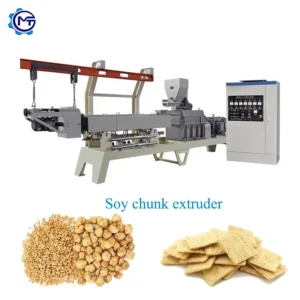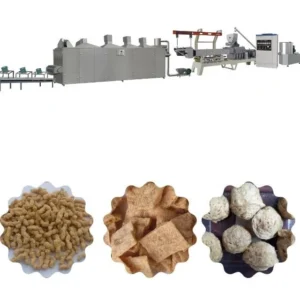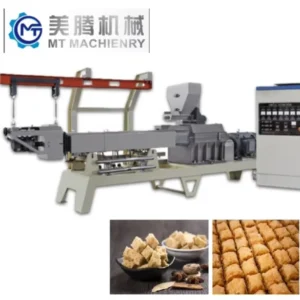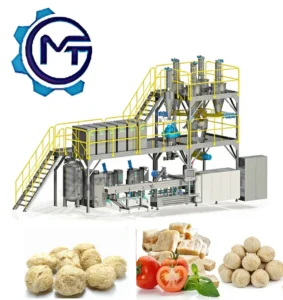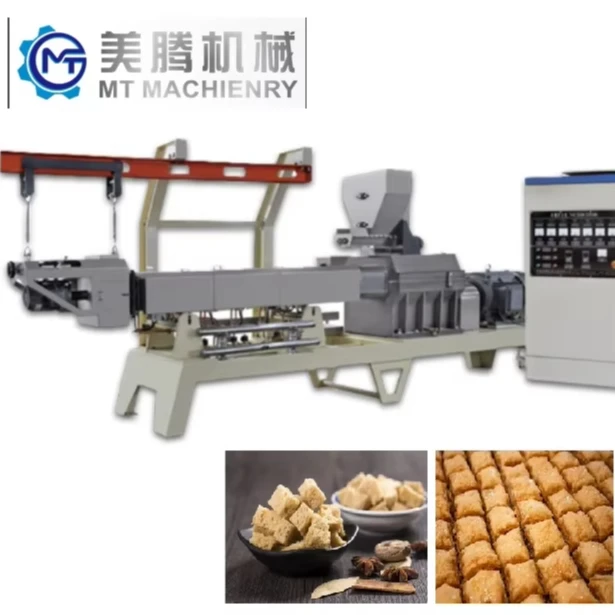
Integrated Extrusion-to-Packing Line Design — every station from the vertical mixer through the multi-layer dryer is sized against the twin screw extruder output so no single unit bottlenecks the plant based meat processing line equipment you invest in.
Technical Specifications
| Parameter | Value |
|---|---|
| Product Type | Twin Screw Extruder for Texturized Vegetable Protein (TVP) Production Line |
| Model | MT65 / MT70 / MT75 / MT85 |
| Installed Power | 84 kW (MT65) / 160 kW (MT70) / 190 kW (MT75) / 210 kW (MT85) |
| Power Consumption | 59 kW (MT65) / 120 kW (MT70) / 140 kW (MT75) / 140 kW (MT85) |
| Output Capacity | 100–150 kg/h (MT65), 150–200 kg/h (MT70 & MT75), 250–300 kg/h (MT85) (basis not stated in source — confirm raw material formulation and moisture content) |
| Overall Dimensions (L×W×H) | 40000×1200×2200 mm (MT65) / 41000×1500×2200 mm (MT70) / 43000×1500×3200 mm (MT75) / 45000×1500×3500 mm (MT85) |
| Screw Type | Twin Screw |
| Main Motor Power | 22 kW / 30 kW / 45 kW (mapping per model to be confirmed) |
| Rotary Cutting Motor | 0.75 kW |
| Feeding Motor | 0.75 kW |
| Pump Motor | 0.37 kW |
| Heating Power | 10 kW / 14 kW |
| Mixer Type | Vertical, stainless steel 304 mixing ruler, carbon steel shelf |
| Mixer Capacity | 20–30 kg / 70–80 kg / 170–180 kg per batch (cycle time to be confirmed) |
| Mixer Power | 4 kW / 7.5 kW / 15 kW |
| Dryer Drive | Double pitch roller chain, round-trip drying |
| Dryer Heat Source Options | Fuel / Gas / Electricity |
| Die Configuration | Interchangeable moulds for soya nuggets, TVP/TSP, soya chunks |
| Line Stations | Mixer → Screw Conveyor → Twin Screw Extruder → Air Conveyor → Multi-layer Dryer → Cooling Machine |
| Standards | CE (since 2014), ISO certified |
Application Suitability
| Application | Material or Output |
|---|---|
| Texturized vegetable protein (TVP/TSP) production | Defatted soya flour, low-temperature soya flakes |
| Soya nuggets and soya chunks | Soya protein concentrate with adjustable moisture |
| Soy protein blocks for plant-based meat substitutes | Blended soya and cereal protein formulations |
| Cereal and snack extrusion (reconfigured line) | Corn grits, rice flour, oat blends with screw and die change |
Why the Downstream Equipment Question Matters More Than Extruder Horsepower
A twin screw extruder for TVP production only delivers its rated output when every downstream station can keep pace.
I have watched buyers focus weeks of negotiation on motor power and screw diameter, then accept whatever dryer and cooling conveyor happens to be bundled in the quote. Months later, hot textured soy protein piles up at the extruder discharge because the cooling conveyor cannot carry it away fast enough. The material sticks, clumps, and has to be scrapped — the plant based meat processing line equipment is technically running, but actual saleable output drops sharply [NEED_CITE: throughput mismatch consequences in extrusion lines]. The fix is never a bigger extruder; it is a line where every station is calculated against the same throughput baseline.
How Station Matching Works Across the TVP Line
The vertical mixer feeds the screw conveyor at a rate calibrated to the extruder’s screw speed and die opening. If the mixer batch cycle is too slow, the extruder starves and barrel temperature fluctuates. If too fast, material bridges in the hopper. Each model from the MT65 to the MT85 is paired with a mixer capacity tier so that batch intervals align with continuous extrusion, keeping the plant based meat processing line equipment running without interruption.
Dryer Sizing and Heat Source Selection
After extrusion, the air conveyor delivers wet TVP into a multi-layer dryer driven by a double pitch roller chain in a round-trip path. Drying time, temperature profile, and belt speed must all match the extruder’s hourly discharge weight. Buyers can specify fuel, gas, or electric heating depending on local utility costs and plant infrastructure. A dryer that is undersized will leave the TVP surface tacky, causing downstream packing problems; one that is oversized wastes energy and can over-brittle the protein structure [NEED_CITE: dryer capacity matching principles in food extrusion].
Reading the Specs That Actually Shape Your Product
Screw length and barrel segmentation determine how long the soya protein stays under shear and heat, directly influencing fibre formation and bite texture. The interchangeable die moulds allow a single extruder platform to switch between soya nuggets, larger soya chunks, and fine TVP granules by swapping the die plate and adjusting the rotary cutter speed. Main motor power tiers — 22 kW through 45 kW — correspond to the torque required for different protein concentrations and moisture levels in the feed stock. The 0.75 kW feeding motor maintains a steady material flow into the barrel, which is critical because fluctuating feed rates produce inconsistent expansion and density across the batch.
The Hidden Cost of Ignoring Voltage and Control Language
One of the most common delays I see on overseas extrusion installations is not mechanical at all — it is electrical. The extruder arrives, the buyer’s electrician opens the panel, and the voltage does not match the local three-phase supply. Commissioning stalls for weeks while transformers are sourced or control components are rewired [NEED_CITE: voltage and frequency standards by export market]. A separate but equally disruptive issue is the control interface language: operators who cannot read the HMI prompts will run the barrel temperature and screw speed outside the intended window, degrading product texture and accelerating screw wear.
What You Actually Get When the Line Is Engineered as One Package
Meiteng builds the complete chain from vertical mixer through multi-layer dryer under one supplier, so throughput calculations are reconciled before any steel is cut. Screw configuration and die design are specified to the buyer’s raw material formulation and target product texture rather than copied from a generic build. The in-house testing workshop runs your actual defatted soya flour or soya flakes before shipment, producing a trial report that confirms fibre structure and expansion. Pre-sales consultation carries through to on-site installation, commissioning, and operator training on the specific control system fitted to your line. Spare wear parts — screws, dies, and cutting blades — are documented in the wear parts list so replacements are available when first needed.
Documentation & Verification
- Line layout and capacity calculation matching mixer, extruder, dryer, and cooler throughput
- Screw and die configuration record specifying your soya flour formulation and target nugget size
- Electrical schematic with voltage and frequency confirmation for your plant supply
- Trial run report on your raw material from the in-house testing workshop
- CE declaration of conformity and ISO certificate
- Operation and maintenance manual covering all line stations
Installation, Commissioning & Support
- Overall line length up to 45 metres requires clear floor span and level concrete foundation
- Installed power up to 210 kW demands dedicated three-phase circuit with confirmed voltage and frequency
- Multi-layer dryer and cooling machine arrive in modular sections for on-site assembly
- First production run supervised by Meiteng engineer to set barrel temperature profile and die clearance
- Operator training covers HMI navigation, screw speed adjustment, and emergency stop procedures
- Wear parts list identifies screws, dies, and cutting blades for planned replacement stock
What to Include in Your First Inquiry
Send your target product format — soya nuggets, chunks, or fine TVP granules — along with the raw material data sheet for your defatted soya flour or protein concentrate. Include your local three-phase voltage, frequency, and preferred control language. If you have existing upstream milling or downstream packing equipment, share the interface dimensions so the line layout can be drawn around them.
Frequently Asked Questions
Q: How is the output capacity verified, and what raw material formulation are the kg/h figures based on?
A: The published capacity ranges are model-specific but the raw material formulation and moisture content behind them are not stated in the source documentation. Before quotation, we run a trial on your actual defatted soya flour in our testing workshop and issue a report with confirmed throughput, fibre structure, and expansion ratio for your specific formulation.
Q: How do I match the dryer capacity and heat source to my extruder model?
A: The multi-layer dryer is sized so that belt speed, drying time, and temperature profile handle the full hourly discharge weight of your chosen extruder model. Heat source — fuel, gas, or electricity — is selected based on your plant’s utility infrastructure and local energy cost. The line layout proposal includes the matched dryer specification.
Q: Can the twin screw extruder switch between TVP, soya chunks, and cereal products?
A: Yes. The die plate is interchangeable, and the screw configuration can be adjusted to suit different raw materials and target textures. Switching from soya nuggets to a cereal snack format involves changing the die mould, reconfiguring the screw elements, and updating the barrel temperature profile on the control system.
Q: Is a trial run on my raw material possible before shipment?
A: Every line goes through a trial run in our in-house testing workshop using the buyer’s actual raw material. The resulting test report documents throughput, product appearance, fibre structure, and expansion, giving you a verified baseline before the equipment leaves the factory.