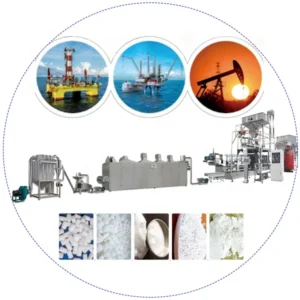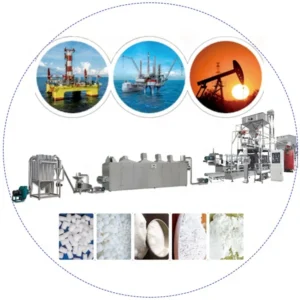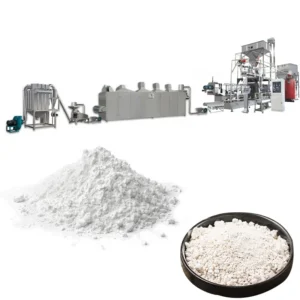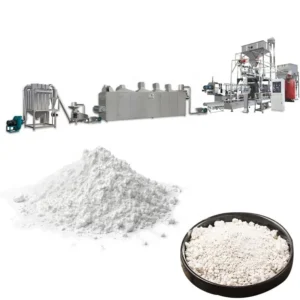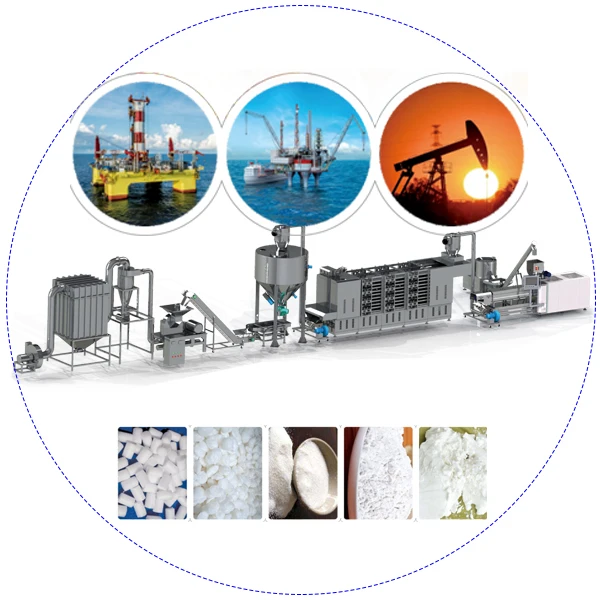
Matched Station Throughput — Every component from the twin screw extruder to the pulse grinder is sized so the modified starch processing line full equipment range runs without downstream starvation or upstream backup.
Technical Specifications
| Parameter | Value |
|---|---|
| Model | MT70 |
| Product Type | Modified Starch Processing Line |
| Screw Type | Twin screw |
| Output Capacity | 100–1500 kg/h (basis not stated in source — confirm raw material type and moisture content) |
| Rated Power | 45–200 kW |
| Voltage & Frequency | 220–440V, tri-phase (frequency to be confirmed: 50 Hz or 60 Hz) |
| Control System | Automatic operation (PLC / MCC option to be specified) |
| Net Weight | 1000–5000 kg |
| Assembly State | Complete processing line |
| Line Stations | Twin screw extruder, cooling conveyor, pulse grinder |
| Certification | CE (company-wide since 2014), ISO (company-wide) |
Application Suitability
| Application | Material or Output |
|---|---|
| Food-grade modified starch for sauces, bakery, and instant foods | Corn flour, rice flour |
| Industrial starch additives for oil drilling fluids | Corn flour, soybean flour |
| Paper coating and sizing starch production | Corn flour, nutritional grain flours |
Why Capacity Claims Collapse When the Raw Material Changes
A modified starch processing line full equipment range is only as reliable as the starch source it was configured for. Output numbers tied to one flour type do not transfer automatically to another.
I learned this the hard way on a project a few years back. A customer swapped corn starch for cassava starch in their formulation after the line was already built. The twin screw extruder could not reach the gelatinisation degree the process demanded, throughput dropped sharply, and the drying section downstream sat idle for most of the shift. The extruder was rated for a certain capacity on corn flour, but cassava starch behaves differently under shear and heat — lower gelatinisation temperature, different viscosity curve, different moisture tolerance. Nobody had re-verified the screw configuration or the barrel temperature profile for the new material. Since then, I insist on locking the raw material ratio before any production scheduling begins [NEED_CITE: starch gelatinisation behaviour differences across corn, cassava, and rice sources].
How the Twin Screw Extruder Handles Starch Modification
The MT70 uses a twin screw configuration where screw elements and barrel sections are selected to match the specific starch raw material. For corn flour targeting high-viscosity modified starch, the screw profile emphasises longer residence time and moderate shear to achieve full gelatinisation without degrading the polymer chains. For rice flour or soybean flour blends, the die design and compression ratio shift to account for different protein-to-starch ratios. This is where the modified starch processing line full equipment range earns its output claims — or fails to.
Matching Cooling and Grinding to Extruder Output
Extruded modified starch exits the barrel at high temperature and must stabilise before particle size reduction. The cooling conveyor uses low-power air drying to bring the material to a consistent moisture level, preventing clumping or uneven fracture in the pulse grinder. The grinder itself features cyclone discharge with dust collection, keeping the final particle size within specification and the workshop environment clean. If the cooling conveyor is undersized relative to the extruder, hot starch reaches the grinder and gums up the screens — a bottleneck that no amount of motor power can fix [NEED_CITE: thermal stabilisation requirements before starch grinding].
Reading the Specs That Actually Matter
The rated power range of 45–200 kW spans several motor configurations. A 45 kW drive may suffice for low-moisture corn flour at modest throughput, but rice flour blends with higher fat content demand more torque to push material through the barrel. The voltage specification covers 220–440V tri-phase, yet frequency must be confirmed separately — running a 50 Hz motor on a 60 Hz supply alters screw RPM and changes the entire shear profile inside the barrel. Net weight ranging from 1000–5000 kg reflects the difference between a basic extruder-cooler-grinder setup and a full line with additional conveying and batching stations. Control system options include automatic operation, with PLC or MCC available depending on the automation level the buyer’s facility requires.
What Happens When Stations Are Mismatched
I have seen lines where the extruder was correctly specified but the pulse grinder had a smaller throughput rating. The result was a buffer pile of cooled starch sitting on the conveyor, absorbing ambient moisture, and degrading in quality before it could be ground. The extruder operator would slow the feed rate to match the grinder, cutting actual output well below the quoted capacity. Downstream stations sitting idle while upstream equipment runs at partial load is one of the most common — and most expensive — failures in starch processing line design [NEED_CITE: throughput mismatch consequences in multi-station food processing lines].
Why Source the Entire Line from One Supplier
Screw configuration and die design are specified to the buyer’s actual raw material and target modification degree, not copied from a generic build. An in-house testing workshop runs trial production on the customer’s own corn flour or rice flour before shipment, so gelatinisation degree and particle size are verified in advance rather than discovered during commissioning. Every station — extruder, cooling conveyor, pulse grinder — is matched for throughput under one responsibility, eliminating the blame-shifting that happens when separate vendors supply separate machines. Pre-sales engineering covers line layout and utility planning, and on-site installation includes operator training specific to the starch product being manufactured.
Documentation & Verification
- Line layout drawing showing station-by-station throughput calculation for your starch type
- Screw and die configuration record matched to your corn or rice flour formulation
- Trial run report on your actual raw material before shipment from factory
- Electrical schematic with confirmed voltage, frequency, and control language
- Operation and maintenance manual covering extruder, conveyor, and grinder
- Wear parts list identifying screws, dies, and grinder screens by part number
Installation, Commissioning & Support
- Foundation plan accounts for the 1000–5000 kg line weight and vibration isolation at the grinder station
- Dedicated power circuit sized for the 45–200 kW motor range with voltage confirmed to local grid
- Extruder barrel alignment and screw element assembly verified on-site after transport
- First production run sets barrel temperature profile and feed rate for your starch formulation
- Operator training covers screw wear inspection and die changeover procedures
- Spare screw elements and grinder screens stocked against the wear parts list provided
What to Include in Your Inquiry
Specify the exact starch raw material — corn flour, rice flour, soybean flour, or a blend — along with the target modification type and final particle size. Confirm your facility’s voltage and frequency, the available floor space and ceiling height, and whether existing upstream batching or downstream packing equipment needs to integrate with the line. If you have a specific daily output target, state it alongside the raw material so the capacity calculation can be grounded in your actual production conditions rather than a generic rating.
Frequently Asked Questions
Q: How is output capacity verified for my specific starch raw material?
A: Capacity is verified through a trial run in the testing workshop using your actual corn flour, rice flour, or blend. The extruder screw speed, barrel temperature, and feed rate are adjusted until the target gelatinisation degree and throughput are achieved, and the results are documented in a trial run report before shipment.
Q: What screw configuration is selected for modified starch versus native starch?
A: Modified starch requires higher shear and longer residence time to break down granule structure and achieve the desired functional properties. The screw element arrangement, compression ratio, and die opening are selected to deliver that shear profile for your specific flour type and target modification.
Q: How are extruder, cooler and grinder capacities matched to prevent bottlenecks?
A: Each station is sized based on the verified extruder output on your raw material, with the cooling conveyor rated to handle the full discharge rate and the pulse grinder matched to the cooled throughput. The line layout document shows the capacity calculation at every station.
Q: What is the floor space requirement and station layout for a 500 kg/h line?
A: Floor space depends on the specific configuration — whether batching silos, additional conveying, or packing stations are included. The line layout drawing provided during the proposal stage shows exact dimensions, utility connection points, and operator access corridors for your confirmed equipment list.
Q: Can the control system support my local voltage and operator language?
A: The electrical system is configurable across 220–440V tri-phase, and frequency is confirmed during the specification stage to match your local grid. The control interface language is set to the operator’s preference before the PLC or MCC panel is programmed and tested at the factory.