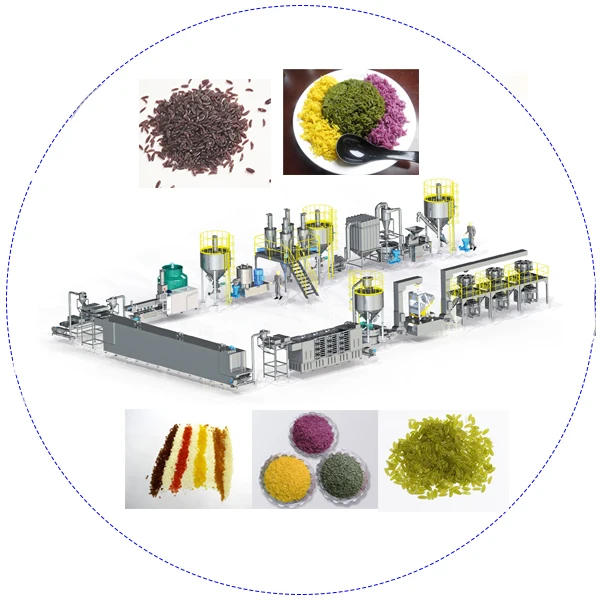
Throughput-matched stations — Every piece of equipment in this artificial fortified rice line, from the mixing system through extrusion, drying, roasting, cooling and packing, is sourced and balanced under one supplier so the rated capacity holds on your actual formulation rather than just on paper.
Technical Specifications
| Parameter | Value |
|---|---|
| Product Type | Artificial Fortified Rice Processing Line |
| Models Available | MT65, MT70, MT85, MT75, MT95 |
| Screw Type | Twin Screw |
| Installed Power | MT65: 85 kW | MT70: 120 kW | MT85: 235 kW | MT75: 180 kW | MT95: 260 kW |
| Power Consumption | MT65: 60 kW | MT70: 85 kW | MT85: 165 kW | MT75: 135 kW | MT95: 195 kW |
| Output Capacity | MT65: 80–100 kg/h | MT70: 100–120 kg/h | MT85: 200–300 kg/h | MT75: 300–500 kg/h | MT95: 800–1000 kg/h (basis not stated in source — confirm raw material formulation and moisture content) |
| Overall Dimensions | MT65: 28 × 1.2 × 2.2 m | MT70: 30 × 1.5 × 2.2 m | MT85: 34 × 3.5 × 4.3 m | MT75: 32 × 3.5 × 4.3 m | MT95: 36 × 3.5 × 4.3 m |
| Control System | Frequency speed control with high automation |
| Feeding System | Single or double screw feeding, selected by material type |
| Screw Material | Special wear-resistant alloy |
| Lubrication | Automatic lubricating system |
| Cooling | Integrated cooling system for extruder barrel |
| Drying Oven Heating Source | Electric or gas |
| Drying Oven Feature | Circulation drying with frequency motor-controlled mesh belt |
| Key Features | Automatic lubrication, integrated barrel cooling, circulation drying oven, frequency-controlled feeding and mesh belt |
Application Suitability
| Application | Material or Output |
|---|---|
| Fortified rice kernel production for nutrition programmes | Broken rice and rice bran blends enriched with vitamins and minerals before extrusion |
| Artificial rice manufacturing for commercial food markets | Starch-based formulations from corn, millet, wheat, oats, buckwheat and beans |
| Grain processing value addition | Rice, corn and multi-grain flours reformed into uniform kernel shapes |
| Infant and nutritional food production | Pre-gelatinised cereal blends with controlled expansion and density |
What "200 kg/h Output" Really Means When Your Formulation Changes
The capacity figure on the nameplate was measured on one specific rice-starch mix at one specific moisture level, and your blend will behave differently.
I have watched lines stall because the buyer assumed the quoted throughput would hold regardless of what they fed into the hopper. When you add rice bran, corn flour or vitamin premix to a broken-rice base, the viscosity inside the barrel shifts and the extruder cannot push the same mass through the die in the same time. If the downstream dryer was sized for the higher number, wet kernels pile up on the mesh belt, stick together, and you lose an entire shift sorting clumped product. [NEED_CITE: twin-screw extrusion throughput dependency on raw material moisture and formulation]
An artificial fortified rice making machine full equipment range that is throughput-matched across every station prevents this mismatch before the first bag of raw material is opened.
How Each Station Connects to the Next
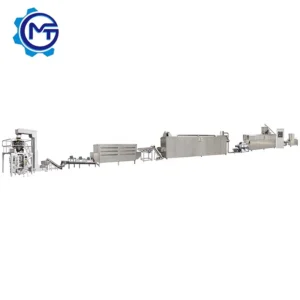
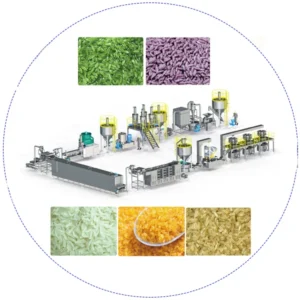
The production sequence runs mixing, extruding, vibrating, low-temperature drying, cooling, high-temperature roasting, cooling again, and packing. Each stage has to accept the output of the one before it at the same rate. If the vibrating screen is narrower than the extruder die plate, kernels accumulate at the transition chute and fracture before they reach the dryer. On the artificial fortified rice making machine full equipment range, every conveyor, screen and oven is specified against the chosen extruder model so material flow stays continuous without manual intervention.
Drying and Roasting Set the Final Kernel Quality
Low-temperature drying removes surface moisture gently to prevent case hardening, while the high-temperature roasting stage develops the colour and cooking behaviour that buyers in the retail rice market expect. The circulation drying oven uses a frequency motor-controlled mesh belt, which means belt speed is adjusted to match the moisture gradient of your particular formulation rather than running at a fixed rate. [NEED_CITE: circulation drying principles for extruded starch products] If the roaster capacity is undersized relative to the dryer output, kernels queue in the cooling conveyor, absorb ambient humidity and soften before they can be packed.
Reading the Power and Dimension Data Correctly
Installed power ranges from 85 kW on the MT65 to 260 kW on the MT95, but actual consumption sits lower — 60 kW to 195 kW respectively — because the heating zones and drive motors cycle. When planning your electrical room, size the main breaker for installed power, not average consumption, or the breaker trips during start-up surges. The MT85, MT75 and MT95 share a 3.5 m width footprint, while the MT65 and MT70 fit inside a 1.2–1.5 m corridor, which matters if you are installing inside an existing building with column spacing constraints. The twin-screw configuration provides the shear needed to gelatinise starch at the moisture levels typical of rice-based formulations, and the automatic lubricating system keeps the screw shaft sealed during long continuous runs.
When One Undersized Station Stops the Whole Line
I remember a shipment where the buyer sourced a third-party packing scale separately. The scale cycle time was slower than the cooling conveyor discharge, and within two hours kernels were spilling onto the factory floor. That is a problem no extruder parameter can fix. [NEED_CITE: production line bottleneck analysis in food extrusion plants] When any single station in an artificial fortified rice making machine full equipment range is procured from a different vendor without throughput verification, the weakest link dictates your real output — and the rest of the line idles.
Why Sourcing the Complete Range Matters Here
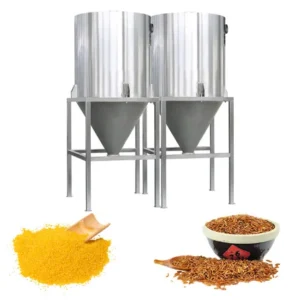
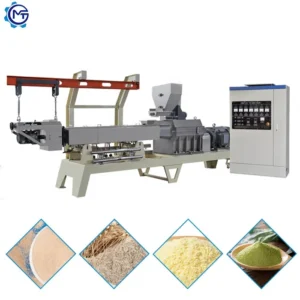
Every station on this line — mixer, twin-screw extruder, vibrating screen, drying oven, roaster, cooling conveyor and packing interface — is configured together so the capacity calculation accounts for your raw material, not a generic starch blend. Screw and die geometry is selected after reviewing your formulation sheet, and the in-house testing workshop runs your actual material before the line ships. Electrical schematics confirm voltage and frequency against your local utility standard, so the control panel speaks the right language on day one. CE and ISO documentation is issued against the complete line, not individual machines, which simplifies customs clearance in markets that inspect the whole production system.
Documentation & Verification
- Line layout and capacity calculation matched to your rice-starch formulation and target kernel size
- Screw and die configuration record specifying geometry for your raw material blend
- Trial run report produced on your actual material in the testing workshop before dispatch
- Electrical schematic confirming voltage, frequency and control language for your local supply
- Factory test record covering every station from mixer through packing interface
- CE declaration of conformity and ISO certificate issued for the complete line
Installation, Commissioning & Support
- Foundation plan accounts for the MT95’s 36 m line length and distributed load across drying and roasting ovens
- Main electrical supply sized to installed power with dedicated circuit for frequency-controlled drive motors
- Equipment arrives in modular sections with labelled connections for on-site assembly
- Commissioning includes screw speed, barrel temperature and mesh belt calibration on your material
- Operator training covers die changeover, automatic lubrication system checks and drying oven adjustment
- Wear parts list specifies screw elements, die plates and mesh belts with recommended replacement intervals
What to Prepare Before Requesting a Quotation
Send your raw material formulation including the ratio of broken rice, starch and any vitamin or mineral premix, along with the target kernel dimensions and daily output goal. Confirm your factory’s available floor length, ceiling height, and the local voltage and frequency standard so the electrical design matches from the start. If you have existing upstream milling or downstream bagging equipment, share the model and throughput so the artificial fortified rice making machine full equipment range can be matched to those boundary conditions.
Frequently Asked Questions
Q: What capacity can each model actually sustain on my specific rice-starch formulation?
A: Published capacity figures are measured on a reference formulation. Your blend of broken rice, bran, starch and vitamin premix will have different viscosity and moisture behaviour inside the barrel. We run your material in the testing workshop and record the sustainable throughput before finalising the line configuration and quotation.
Q: How do I confirm voltage, frequency and control language match my factory’s utility supply?
A: Before production begins, we request your local electrical standard and issue an electrical schematic for your approval. The control panel labels, PLC interface language and motor nameplates are all configured to match. This document is part of the shipping package so your electrician can verify on arrival.
Q: What is included in the complete line — are dryer, roaster, cooler and packing station all supplied?
A: Yes. The full range covers mixing, extruding, vibrating, low-temperature drying, cooling, high-temperature roasting, a second cooling stage and packing. Each station is throughput-matched to the extruder model you select so no single station bottlenecks the others during continuous production.
Q: Can I run a trial with my own raw material before the equipment ships?
A: The in-house testing workshop is equipped to process your actual formulation. We record extruder screw speed, barrel temperature profile, die selection and drying parameters, then provide a trial run report. Any adjustments to screw geometry or oven settings are made before the line leaves the factory.
Q: What spare wear parts are available and when will first replacement be needed?
A: The wear parts list covers screw elements, die plates and dryer mesh belts. Replacement intervals depend on your material abrasiveness and production hours. We include the list with estimated service life based on trial data so you can order spares before the first change is due.