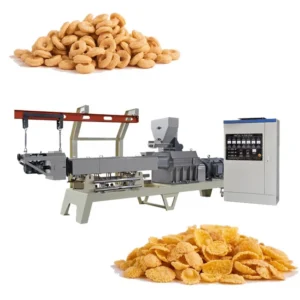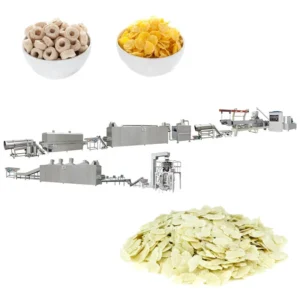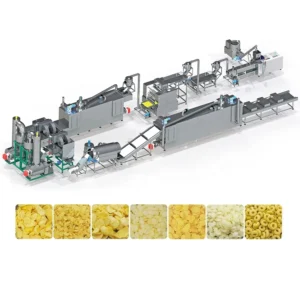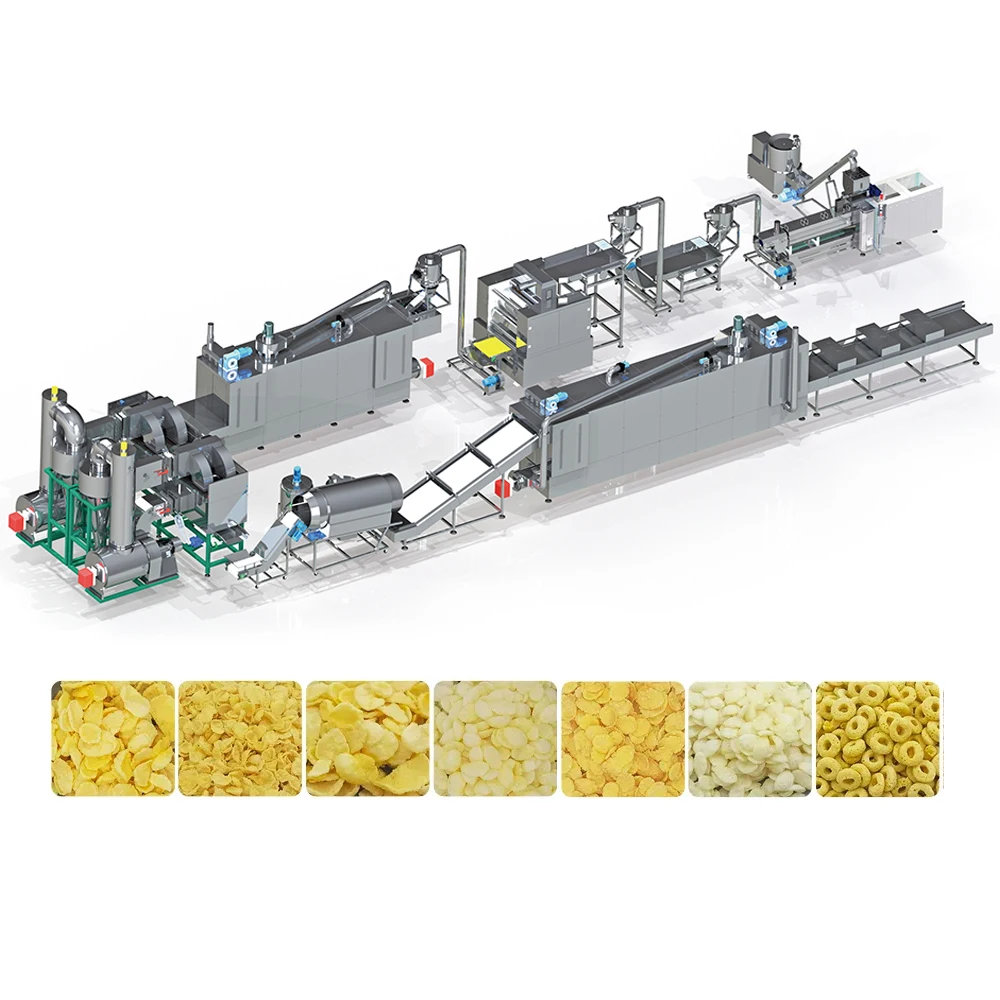
Throughput-Matched Stations — Every mixer, extruder, flaker, oven, and coating drum is sized so no single unit bottlenecks the corn flakes line.
Technical Specifications
| Parameter | Value |
|---|---|
| Model | MT-65 |
| Product Type | Twin Screw Corn Flakes Production Line |
| Screw Type | Co-rotating twin screw, sectional modules |
| Mixer Output | 10–30 kg per load |
| Mixer Power | 4 kW |
| Mixer Tank Size | φ600 × 500 mm |
| Screw Conveyor Power | 0.75 kW |
| Flaking Machine Roller Size | 510 × 310 × 1050 mm |
| Flaking Machine Power | 16.12 kW |
| Flaking Machine Dimension | 1550 × 1300 × 2000 mm |
| High-Temperature Oven Dimension | 4500 × 1400 × 1800 mm |
| Oven Heating Method | Gas-fired, both-side baking system |
| Sugar Spraying System Power | 28.75 kW |
| Sugar Spraying Drum Size | Ø600 × 2700 mm |
| Contact Material | Food-grade stainless steel |
| Voltage Options | 3-phase 380 V 50 Hz, 380 V 60 Hz, 415 V 60 Hz, 220 V 60 Hz (configurable) |
| Control System | Separate controller box for flaking machine; PLC and MCC available |
| Certification | CE |
Application Suitability
| Application | Material or Output |
|---|---|
| Traditional corn flakes | Corn grits, corn flour, nutritional additives |
| Multi-grain breakfast cereals | Rice, oat, wheat, and blended grain powders |
| Sugar and honey-coated cereal | Corn flakes or puffed shapes with syrup glazing |
| Shaped puffed cereal snacks | Rings, balls, stars, sticks via die changes |
What "Rated Capacity" Really Means on a Corn Flakes Line
A corn flakes line only holds its rated throughput when every station is balanced to the same output on your actual raw material.
I worked with a Southeast Asian buyer two years ago who signed a contract based on a brochure figure for a breakfast cereal corn flakes machine full equipment range. His local corn had noticeably higher fat content than the trial material. The extruded pellets stuck to the flaking rollers, dried into clumps, and real output dropped sharply. The extruder was never the problem — the mismatch between his material and the screw configuration was [NEED_CITE: material variability effects on extrusion throughput]. That experience reshaped how we approach every quotation: we run the buyer’s own grain in our testing workshop before locking the line layout.
How the Full Equipment Range Fits Together
A breakfast cereal corn flakes machine full equipment range starts at the flour mixer, where a 4 kW motor blends corn grits with water and additives in batches of 10 to 30 kg. The screw conveyor then feeds the MT-65 twin-screw extruder at a controlled rate. Co-rotating sectional screw modules handle gelatinisation, mixing, cooking, and forming in one continuous pass, discharging shaped pellets ready for flaking.
After the extruder, a dedicated flaking press with 510 × 310 mm rollers and an integrated cooling system presses each pellet into a uniform flake. The adjustable roller gap controls flake thickness. This station runs from a separate controller box, keeping flaking speed independent of extruder speed so operators can fine-tune without stopping the upstream process.
Drying, Coating, and Final Cooling — Where Throughput Imbalances Surface
The gas-fired high-temperature oven (4500 × 1400 × 1800 mm) bakes flakes from both sides for uniform crispness. A common issue across the industry is that a dryer sized for one moisture profile struggles when the recipe shifts, causing uneven drying that leads to breakage downstream [NEED_CITE: moisture migration issues in flaked cereal drying]. The sugar spraying system follows, using a Ø600 × 2700 mm drum with temperature-keeping rollers to distribute syrup evenly across the flake bed.
Finally, the cooling conveyor stabilises the coated flakes before packing. Every station in this breakfast cereal corn flakes machine full equipment range is selected so that the extruder does not outpace the dryer, and the coating drum does not bottleneck the line. When one vendor supplies and balances the entire catalogue, you avoid the scenario where a mismatched dryer or undersized coating drum chokes real output.
Reading the Key Specs for Your Production Context
The co-rotating twin-screw design in the MT-65 offers more shear and mixing action than a single-screw setup, which matters when you process grain blends with varying starch content — the sectional modules let us rearrange screw elements to match your recipe’s gelatinisation requirements. Roller gap on the flaking machine directly controls flake thickness, and a thinner flake demands a shorter oven residence time, so the gas oven’s both-side baking must be matched accordingly.
Voltage and frequency are configurable across 380 V 50 Hz, 415 V 60 Hz, and other common industrial standards. Confirming this before production prevents rewiring delays on site [NEED_CITE: voltage and frequency standards by export market]. Food-grade stainless steel on all contact surfaces meets hygiene requirements for breakfast cereal production, and the PLC and MCC control options allow integration with existing plant automation.
The Hidden Cost of Assembling Stations from Separate Vendors
When a buyer sources the extruder from one supplier and the dryer from another, neither party guarantees that throughput aligns across the gap. The extruder might push more wet flakes than the dryer can handle, forcing operators to slow the entire line. Similarly, a coating drum with insufficient volume creates a queue of uncoated product. These bottlenecks do not appear on paper quotations — they surface only after installation, when the line cannot sustain its promised output [NEED_CITE: throughput mismatch in multi-vendor food processing lines].
Why Source the Full Range Here
Complete lines from mixing through cooling under one supplier mean every station is throughput-matched before fabrication, not patched together on your factory floor. Screw configuration and die design are specified to your grain recipe and target flake shape, not copied from a generic template. Our in-house testing workshop runs your actual raw material before shipment, so product development happens before installation, not after.
Documentation covers the full breakfast cereal corn flakes machine full equipment range — electrical schematics, layout drawings, and wear parts lists for every station. Pre-sales consultation through installation, commissioning, and ongoing maintenance stays with one team that knows the complete line.
Documentation & Verification
- Line layout and capacity calculation showing throughput balance across every station
- Machine specification sheet for each unit with power, dimensions, and utility needs
- Electrical schematic with confirmed voltage and frequency for your market
- Trial run report on your grain recipe recorded before shipment
- Operation and maintenance manual with wear parts list for all stations
- CE declaration of conformity covering the complete line
Installation, Commissioning & Support
- Foundation plan provided for the high-temperature oven (4500 × 1400 × 1800 mm) and flaking press footprint
- Dedicated electrical circuits mapped for the 28.75 kW sugar spraying system and 16.12 kW flaking machine
- Stations arrive pre-assembled; final alignment and roller gap calibration completed on site
- First-run parameter setting covers extruder screw speed, oven temperature profile, and coating drum timing
- Operator training addresses die changes for shaped cereals and flake thickness adjustments
- Wear parts list supplied for screws, dies, and flaking rollers with reorder intervals
Planning Your Inquiry
To specify the right breakfast cereal corn flakes machine full equipment range, share your primary grain type, target flake thickness, and daily production goal. Include your local voltage and frequency, available workshop floor area and ceiling height, and whether you need sugar or honey coating integrated. If you have a specific grain blend, sending a sample for a workshop trial run helps us confirm screw configuration and line balance before quotation.
Frequently Asked Questions
Q: How is output capacity verified, and on which raw material is it based?
A: We verify capacity by running your actual grain in our testing workshop before finalising the line. Output depends on raw material composition, flake thickness, and target moisture, so we base figures on your specific recipe rather than a generic benchmark. A trial run report documents the results.
Q: Can individual stations be selected, or is the line only sold complete?
A: Each station — extruder, flaking press, oven, coating system, cooling conveyor — is available individually. However, throughput matching across the full range is confirmed most reliably when the line is specified as a set, reducing the risk of bottleneck stations.
Q: What voltage and control language options are available?
A: The line supports configurable voltage including 380 V 50 Hz, 415 V 60 Hz, and other industrial standards. Control language and PLC interface labels are confirmed during the specification stage to match your operators’ requirements before production begins.
Q: How are screw configuration and die matched to different recipes?
A: The MT-65 uses co-rotating sectional screw modules that we rearrange based on your grain blend and target shape. Different dies produce flakes, rings, balls, or sticks. We test your material in the workshop to validate the configuration before shipping.
Q: What utility requirements should we plan for?
A: The gas-fired oven requires a stable gas supply with adequate pressure. Electrical circuits must accommodate the full line load, including the 28.75 kW coating system and 16.12 kW flaking press. Compressed air is needed for pneumatic controls. Detailed utility specifications are provided with the layout drawing.