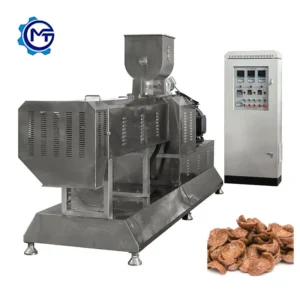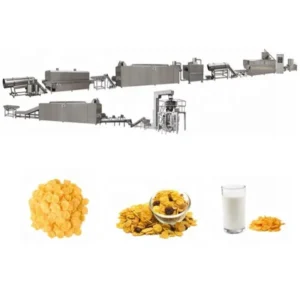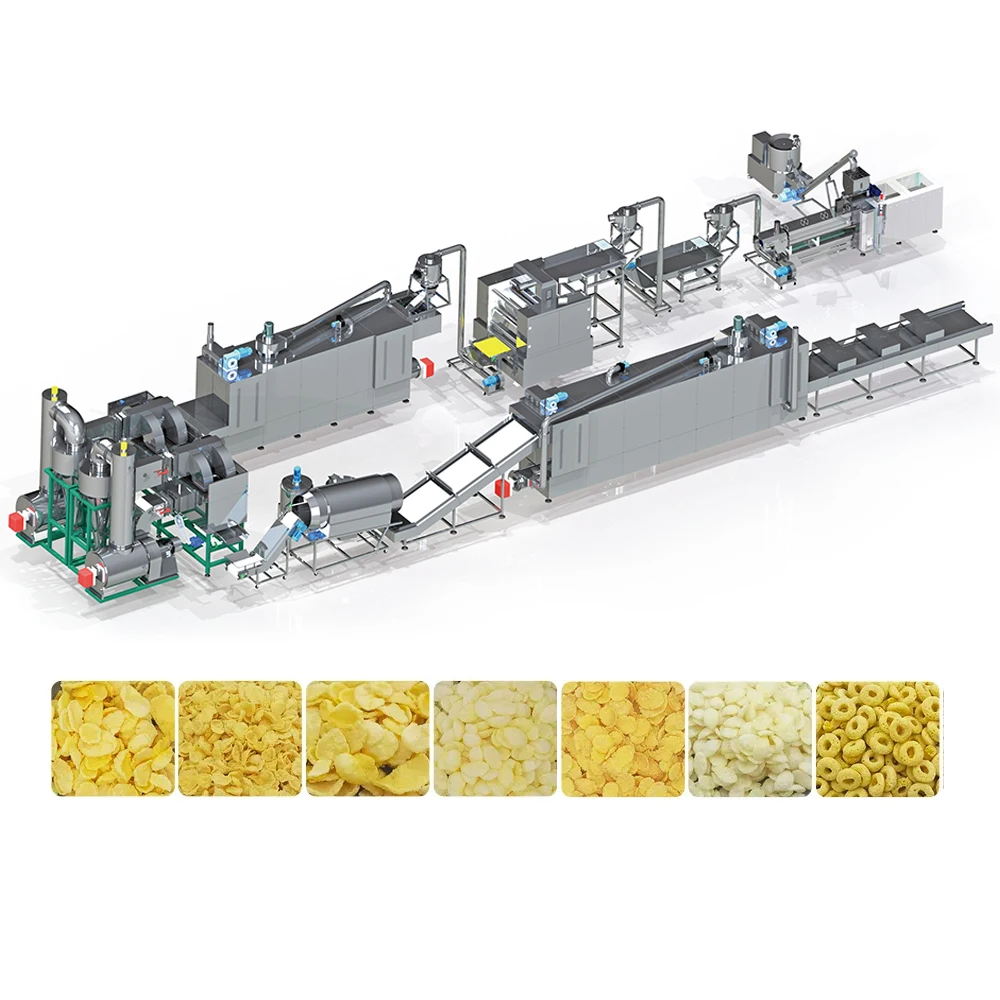
Complete Line Matching — Every station in this corn flakes line is sized against the extruder’s actual output on your specific grain blend, preventing downstream bottlenecks before they happen.
Technical Specifications
| Parameter | Value |
|---|---|
| Product Type | Corn Flakes Production Line |
| Available Models | MT70 / MT85 / MT75 |
| Extruder Type | Twin Screw |
| Installed Power | MT70: 160 kW; MT85: 190 kW; MT75: 210 kW |
| Power Consumption | MT70: 120 kW; MT85: 140 kW; MT75: 150 kW |
| Output Capacity | MT70: 150-200 kg/h (basis to be confirmed); MT85: 300-400 kg/h (basis to be confirmed); MT75: 300-500 kg/h (basis to be confirmed) |
| Overall Dimensions (L×W×H) | MT70: 41×1.5×2.2 m; MT85: 43×1.5×3.2 m; MT75: 45×1.5×3.5 m |
| Control System | PLC and MCC control |
| Flaking System | Hydraulic double-roller, dual-motor drive, infrared temperature sensor |
| Dryer Heating Source | Gas or Electric |
| Roasting Oven | Hot air, vibrating pan, conciliation burner, dual circulating fans, cyclone dust removal |
| Coating System | Double tumble sugar melter, elevator, coating drum, spraying nozzle |
| Basic Raw Materials | Corn, rice, wheat, oat, barley powder |
| Standards | CE, ISO |
Application Suitability
| Application | Material or Output |
|---|---|
| Natural corn flakes manufacturing | Corn grits and corn flour base |
| Sugar-coated breakfast cereals | Corn, wheat, or multi-grain extrudate with sugar or honey coating |
| Multi-grain cereal production | Blends of rice, oat, barley, and wheat flour |
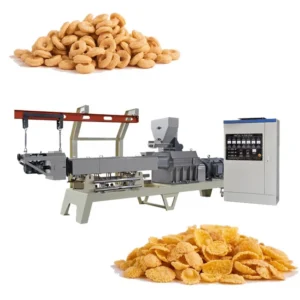
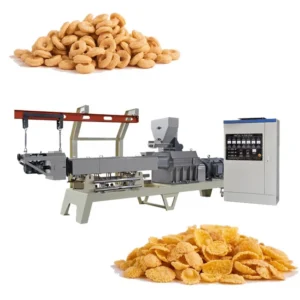
| Shaped breakfast cereals | Ball, tube, ring, star, heart, fruit loop via die and mould changes |
| Fortified cereal lines | Grain base with added vitamin and mineral premix |
What "Nominal Capacity" Leaves Out About Corn Flakes Lines
The number on the brochure rarely survives contact with your actual corn supply.
I have watched a Middle Eastern producer commission a breakfast cereal line rated for a specific throughput, only to find their local corn flour produced completely wrong expansion and density. Four days of adjustments followed before the line stabilized. The extruder was not the problem — the entire corn flakes machine full equipment range had been quoted on a generic grain profile rather than the buyer’s real material. When flaking rolls, dryer belt speed, and roasting oven residence time are all calculated from a catalog figure instead of verified output, every station downstream drifts out of sync [NEED_CITE: raw material variability in grain extrusion processes].
Matching Every Station to the Extruder’s Real Output
A corn flakes line is only as fast as its most constrained station. The twin-screw extruder sets the pace, but if the hydraulic flaking rolls cannot flatten the cooked grits at the same rate, product backs up and moisture windows close. This corn flakes machine full equipment range is configured so that flaking throughput, dryer belt length, roasting oven capacity, and coating drum volume all align with verified extruder output on the buyer’s grain blend.
How the Flaking and Roasting Stages Define Final Texture
Flaking is where corn flakes earn their name. The hydraulic double-roller system uses separate motors for each roller, allowing independent speed adjustment to control flake thickness. An infrared sensor monitors roller temperature continuously, because even slight thermal drift changes how the cooked grit flattens. Downstream, the hot air roasting oven uses a vibrating pan with conciliation burners and two circulating fans to produce the surface bubbles and crispness the market expects. Cyclone dust removal keeps the roasting environment clean [NEED_CITE: flake thickness and moisture relationship in cereal processing].
Reading the Specs That Actually Matter
Twin-screw extrusion gives operators independent control over shear, residence time, and temperature profile — essential when switching between corn, wheat, and oat bases that gelatinize at different rates. The installed power ratings across the three models reflect not just motor size but the total thermal and mechanical load of feeding, extruding, cutting, and heating systems running simultaneously. Power consumption figures sit noticeably below installed capacity, indicating headroom for startup surges and load variation. The PLC and MCC control architecture separates motor control from process logic, so a fault in the dryer does not cascade back into the extruder barrel zones. Automatic lubricating and cooling on the extruder protects screw surfaces during extended runs on abrasive grain mixes.
The Hidden Cost of Unmatched Line Stations
When the coating drum is sized for a catalog capacity but the extruder delivers less on your material, sugar syrup sits too long in the tumble and caramelizes unevenly. When the dryer is oversized, product over-dries before reaching the roasting oven, and the characteristic surface blistering never develops. These mismatches do not show up in a quotation — they surface during commissioning, when engineers spend days chasing a texture problem that is actually a throughput problem [NEED_CITE: throughput balancing in multi-stage food processing lines].
Why Source the Full Range from One Supplier
Every station in this line — mixing, extruding, flaking, drying, roasting, coating, cooling, packing — is specified together so throughput matches across the entire sequence. Screw configuration and die design are selected for the buyer’s raw material and target flake shape, not copied from a generic build. An in-house testing workshop runs trial production on customer-supplied grain before shipment, catching density and expansion issues early. Twin-screw expertise spans corn, wheat, oat, and multi-grain applications, so the line handles product diversification without major hardware changes. Pre-sales engineering covers layout, utility planning, and voltage confirmation before production begins.
Documentation & Verification
- Line layout drawing with capacity calculation matched to your grain blend
- Screw and die configuration record for your target flake shape
- Electrical schematic with confirmed voltage and frequency for your site
- Trial run report on your raw material from the testing workshop
- CE declaration of conformity and ISO certificate
- Wear parts list with recommended replacement intervals
Installation, Commissioning & Support
- Foundation and floor space plan based on the MT75 line footprint of approximately 45×1.5×3.5 m
- Dedicated power circuit sized to the model’s installed power, up to 210 kW
- Assembly and alignment of flaking rolls, dryer, and roasting oven on-site
- First-run parameter setting for barrel temperature zones and roller pressure
- Operator training on PLC interface, die changes, and sugar coating adjustment
- Spare screws, dies, and roller surfaces stocked for initial replacement cycle
- Scheduled maintenance intervals for automatic lubrication and cooling systems
What We Need to Configure Your Line
To build an accurate line proposal, share your primary grain material and any premix additions, your target daily output, and your available factory floor area with ceiling height. Confirm your local voltage and frequency, and let us know if you need the HMI in a specific language. If you can send a sample of your raw material, we will run a trial in our testing workshop before finalizing the configuration.
Frequently Asked Questions
Q: How is throughput matched between the extruder, flaker, dryer, and roaster across the line?
A: Each station is sized based on the extruder’s verified output on your specific grain blend, not on a nominal catalog figure. Belt speeds, roller widths, oven volume, and drum capacity are all calculated together so no single station becomes a bottleneck during continuous production.
Q: What stations are included in a natural corn flakes line versus a sugar-coated line?
A: Both lines share mixing, extruding, flaking, drying, roasting, cooling, and packing stations. The sugar-coated line adds a coating system with a double tumble sugar melter, elevator, coating drum, and spraying nozzle between the roaster and the cooler.
Q: How are the dryer and roasting oven configured for different utility supplies?
A: The dryer is available with gas or electric heating to match your site utilities. The roasting oven uses hot air circulation with a conciliation burner and dual circulating fans. Both are configured to your confirmed voltage and frequency before production.
Q: Can this line produce shapes beyond traditional corn flakes?
A: Yes. By changing the extruder die and mould, the line produces balls, tubes, rings, stars, hearts, and fruit loops from the same base equipment. The flaking station is bypassed for non-flake shapes, and downstream drying and roasting parameters are adjusted accordingly.
Q: How is the line layout adapted to different factory sizes?
A: The overall line length ranges from approximately 41 to 45 meters depending on model selection. Layout is customized to your factory floor plan, with station positioning adjusted for available ceiling height, utility connection points, and material flow direction.