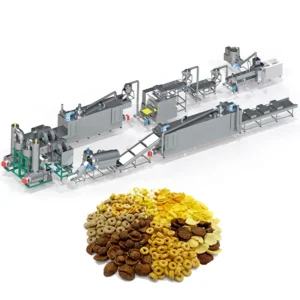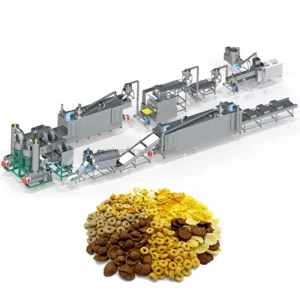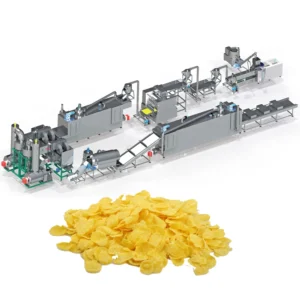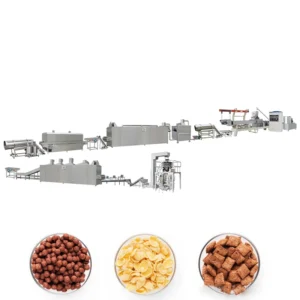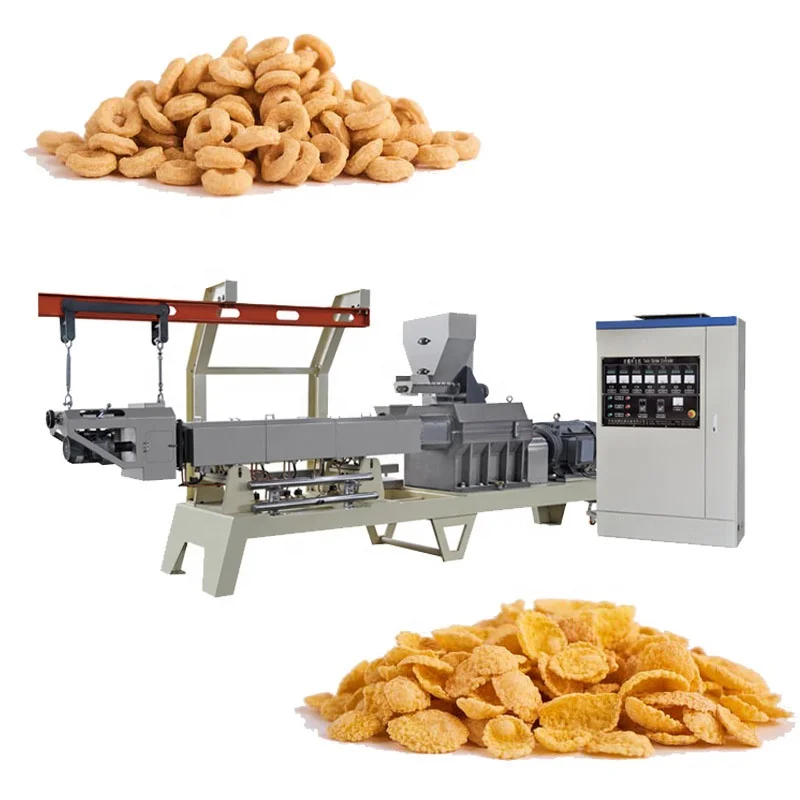
Throughput-Matched Stations — Every unit from the twin-screw extruder through the sugar coating roller is sized to the same capacity target, eliminating the bottlenecks that form when separate vendors supply isolated machines.
Technical Specifications
| Parameter | Value |
|---|---|
| Product Type | Corn Flakes Production Line |
| Model Options | MT-65 / MT-70 / MT-75 / MT-85 |
| Screw Type | Twin screw (co-rotating, sectional modules) |
| Installed Power | 84 kW (MT-65) / 132 kW (MT-70) / 186 kW (MT-75) / 239 kW (MT-85) |
| Real Power | 59 kW (MT-65) / 92 kW (MT-70) / 140 kW (MT-75) / 167 kW (MT-85) |
| Output Capacity | 120–150 kg/h (MT-65) / 200–250 kg/h (MT-70) / 300–400 kg/h (MT-75) / 400–500 kg/h (MT-85) (basis not stated in source) |
| Overall Dimensions | 12000×1200×2200 mm (MT-65) / 28000×1500×2800 mm (MT-85) |
| Mixer Tank Size | φ600×500 mm |
| Flakes Press Roller Size | 510×310×1050 mm |
| Oven Heating System | Gas-fired, both-side baking system |
| Control System | Separate controller box (flakes press); line-wide automation configurable |
| Key Features | Gear box forced automatic lubrication, extruder self-cleaning function, adjustable roller distance for flake thickness |
Application Suitability
| Application | Material or Output |
|---|---|
| Traditional Corn Flakes | Corn grits and corn flour processed through extrusion, flaking, and high-temperature baking |
| Multi-Grain Breakfast Cereals | Blends of wheat flour, rice flour, and corn meal for varied texture profiles |
| Fortified Cereal Bases | Grain mixtures with added vitamin and mineral premixes for nutritional programs |
| Puffed Snack Formats | Alternate die configurations to produce expanded snack pellets or core-filled shapes |
Why a "Complete Line" Quote Can Still Leave Gaps in Your Corn Flakes Machine Setup
A true breakfast cereal production line equipment package must account for the material transfer between stations, not just the nominal capacity of the extruder itself.
I once saw a facility where the extruder was sized perfectly, but the sugar coating drum was undersized, causing half the batch to sit and absorb moisture before it could be sealed. When you are evaluating a corn flakes machine full equipment range, you have to look at the drying and baking stages as the true pace-setters. A bottleneck at the oven means the extruder runs in start-stop cycles, which degrades the gelatinisation of the starch and leads to inconsistent flake density [NEED_CITE: thermal processing consistency in grain extrusion].
Balancing Extrusion Shear and Flaking Pressure
The coordination between the twin-screw extruder and the flakes press determines the structural integrity of the final product. Co-rotating sectional screw modules allow the breakfast cereal production line equipment to manage the intense shear required to fully cook the starch while maintaining the moisture levels needed for pressing. If the material exits the die too dry, the big roller on the press will shatter the pellet rather than flatten it into a cohesive flake.
Precision Control Across Thermal Stages
Temperature management defines the crispness of the final output. The gas-fired high-temperature oven utilizes a both-side baking system to ensure that the moisture gradient is reduced uniformly. In a complete corn flakes machine full equipment range, the cooling conveyors must be matched to the oven’s output speed to prevent the sugar coating from melting into a solid mass inside the spraying drum.
Decoding the Power and Dimensional Requirements
Understanding the real power versus installed power is vital for facility electrical planning. The MT-75, for instance, requires significant amperage during startup, and the 24000×1500×2800 mm footprint demands a linear workshop layout. The gear box oil forced automatic lubrication system ensures that the high-torque demands of processing high-fiber grain blends do not lead to premature wear during continuous shifts [NEED_CITE: industrial motor and gearbox load standards].
The Consequences of Misconfigured Station Ratios
When the sugar spraying system is not synchronized with the cooling phase, the flakes become clumped and unsellable. I have seen producers attempt to retrofit larger ovens onto existing lines, only to find that the ceiling height and utility connections were insufficient. These integration errors cause more downtime than the extruder ever would, turning what should be a high-volume run into a manual sorting exercise [NEED_CITE: production line synchronization challenges in food manufacturing].
Why This Manufacturer’s Equipment Range Stands Out
Every station from the φ600×500 mm mixer tank to the sugar spraying roller is sourced from a single technical workflow. The screw configuration and die design are specified based on your raw material’s behavior, ensuring the extruder does not just run, but produces the correct texture. Furthermore, the in-house testing workshop allows for trial runs on your specific high-fiber or fortified blends before the equipment ever leaves Jinan.
Documentation & Verification
- Line layout and capacity calculation showing matched throughput for mixer, extruder, and oven.
- Screw and die configuration record based on your specific corn grit or multi-grain blend.
- Electrical schematic confirming voltage, frequency, and gas requirements for the oven system.
- Factory test record using your raw material to verify flake density and thickness.
- CE declaration of conformity and ISO certificate for international safety and quality standards.
Installation, Commissioning & Support
- Foundation planning for the 28-meter line footprint, accounting for the heavy flakes press and oven.
- Electrical setup for the 186 kW (MT-75) installed power and separate controller boxes.
- Calibration of the adjustable roller distance on the flakes press to meet your thickness specs.
- Thermal profiling of the gas-fired oven to ensure both-side baking uniformity.
- Training on the self-cleaning function to minimize changeover time between different cereal recipes.
Preparing Your Technical Inquiry
To receive a configuration that matches your actual workshop conditions, please provide the specific type of grain (corn grits, flour, or blend) and your target moisture content at the extruder die. Include your available floor length and ceiling height, as the high-temperature oven and sugar spraying system require significant linear space. Finally, confirm your local voltage and frequency, as the motor and control systems are built to order.
Frequently Asked Questions
Q: How do you match the oven capacity to the extruder output?
A: We calculate the thermal load based on the moisture content of the pressed flakes and the target baking time. The oven length and burner configuration are then sized to ensure the flakes reach the required crispness without slowing down the flakes press or the extruder.
Q: Can the flakes press handle high-fiber or multi-grain formulas?
A: Yes, but the roller gap and pressure must be adjusted. High-fiber materials tend to be more elastic; we specify the roller surface and cooling system based on your recipe to prevent the flakes from shrinking or cracking after they leave the press.
Q: What raw material testing is done before the corn flakes machine ships?
A: We run your specific formula in our testing workshop to verify the screw configuration and die design. This ensures the gelatinisation is correct and that the material behaves as expected when it hits the flakes press, preventing startup delays at your facility.
Q: How is the sugar coating applied without causing clumping?
A: The sugar spraying system is synchronized with a cooling stage. The flakes must be at a specific temperature before entering the coating drum; otherwise, the sugar syrup will not crystallize properly, leading to a sticky product that cannot be packed.
Q: What spare parts are included with the full equipment range?
A: The initial shipment includes wear parts such as specific screw modules and die plates. We provide a comprehensive wear parts list and supply records so you can plan for replacements based on the abrasiveness of your grain formulation.