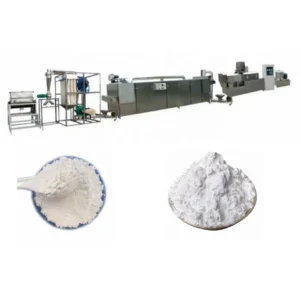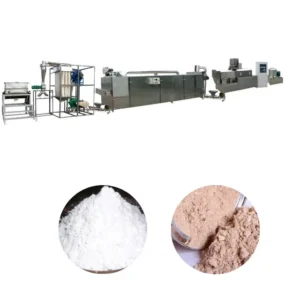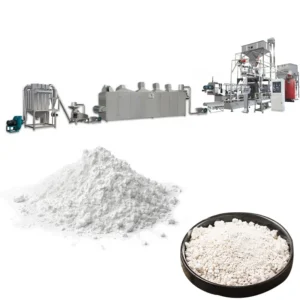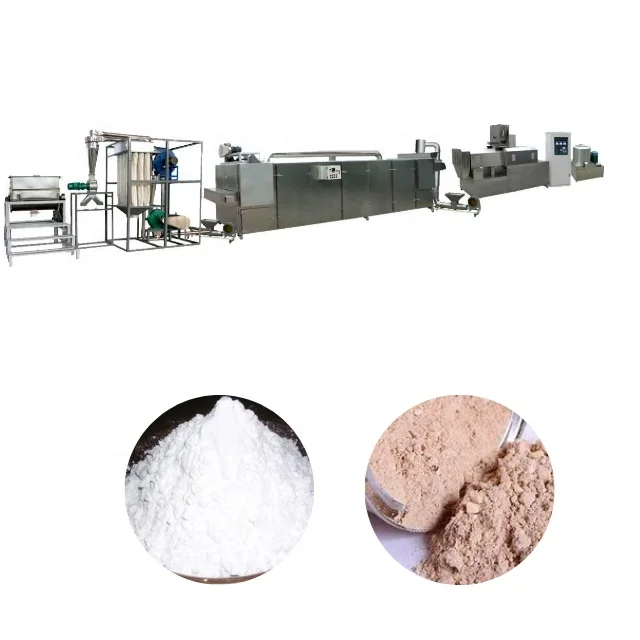
Integrated Station Throughput — every component from batching to grinding is sized against the extruder’s actual output on your starch formulation, eliminating mid-line bottlenecks that stall production.
Technical Specifications
| Parameter | Value |
|---|---|
| Product Type | Modified Starch Processing Production Line |
| Extruder Type | Twin screw |
| Capacity Range | 100–1500 kg/h (basis not stated in source — confirm raw material type, moisture content, and product specification) |
| Power | 45–200 kW |
| Voltage | 220–440V, tri-phase (frequency to be confirmed per market) |
| Control System | PLC controlled, temperature controlled |
| Line Configuration | Twin screw extruder, cooling conveyor, pulse grinder, mixing and batching systems |
| Contact Material | Food grade stainless steel (except PVC conveyors) |
| Fuel Options | Gas, diesel, electricity, steam |
| Weight | 1000–5000 kg |
| Assembly State | Complete production line from batching to packing |
| Standards | CE certified, ISO certified |
Application Suitability
| Application | Material or Output |
|---|---|
| Oil drilling fluid starch | Corn starch, potato starch modified for viscosity and thermal stability |
| Paper making industrial starch | Wheat flour, corn starch processed for binding and coating grades |
| Food grade modified starch | Rice flour, soybean flour, corn starch for thickening and stabilizing |
| Pregelatinised nutrition starch | Blended starch and additive formulations for infant and dietary food |
What "1500 kg/h" Means on Your Actual Starch
Rated capacity only holds when the screw profile, moisture input, and downstream cooling are matched to your specific raw material.
I once watched a processor in Southeast Asia lose an entire batch of pregelatinised corn starch because the extruder was set up for cassava. The gelatinisation window shifted, the material clumped inside the barrel, and the pulse grinder downstream choked on irregular output. That modified starch processing line equipment range had the right nameplate number, but the screw configuration was never adapted to corn. Buyers evaluating lines at this capacity level should always ask what raw material and moisture percentage the quoted throughput was measured on [NEED_CITE: starch gelatinisation temperature ranges across corn, cassava, and wheat].
How Screw Configuration Controls Starch Modification
The twin screw extruder sits at the centre of any modified starch processing line equipment range because it governs shear, residence time, and thermal history simultaneously. Different starch sources — corn, potato, wheat, rice — each demand a distinct screw element arrangement to reach full gelatinisation without degrading the polymer chains. Barrel temperature zones are independently controlled so the operator can build a gradient that matches the specific modification target, whether that is cold-water swelling for food applications or controlled viscosity for oil drilling mud.
Matching Cooling and Grinding to Extruder Output
The extruder discharges a continuous ribbon of gelatinised starch that must be cooled before grinding. The cooling conveyor uses a wind knife arrangement to strip surface moisture, and its belt speed must track the extruder’s discharge rate exactly. If the conveyor runs slow, material stacks up and re-absorbs moisture; if it runs fast, the ribbon thins and dries unevenly. Downstream, the pulse grinder with cyclone discharge and dust collector must handle the full cooled throughput without surging [NEED_CITE: particle size distribution requirements for industrial modified starch grades].
Reading the Specification Sheet Beyond Nameplate Numbers
Power range of 45–200 kW reflects the spread across smaller batch operations and continuous high-volume production. The actual motor load depends on screw fill factor, raw material bulk density, and the degree of modification required. Voltage at 220–440V tri-phase must be confirmed against local supply before the electrical cabinet is wired — a 50 Hz motor on a 60 Hz grid will overspeed and burn out within the first shift. PLC control with independent temperature zones lets operators store recipes for different starch formulations, reducing changeover time between product runs. Food grade stainless steel on all contact surfaces prevents iron contamination that would discolour white starch powders.
The Hidden Cost of Unmatched Line Components
When an extruder is sourced from one vendor and the dryer or grinder from another, nobody guarantees the interfaces. I have seen cooling conveyors that could not keep up with the extruder discharge, forcing operators to throttle output to half the rated capacity. The modified starch then sat in a holding bin absorbing ambient humidity, defeating the purpose of controlled drying. These mismatches do not show up on a quotation — they appear on the first production day [NEED_CITE: common causes of throughput loss in starch extrusion lines].
Why Source the Full Line from One Supplier
Every station in this modified starch processing line equipment range is throughput-matched before the layout is finalised, so the cooling conveyor belt speed and pulse grinder feed rate are calculated against the extruder’s actual discharge on your raw material. Screw configuration and die design are specified to your starch source and target modification, not copied from a generic template. The in-house testing workshop runs your material before shipment, producing a documented trial report rather than leaving process development to your first production week. Pre-sales engineering covers line layout, utility planning, and voltage confirmation so commissioning stays on schedule. Ongoing support includes operator training and a defined wear parts list for screws and dies.
Documentation & Verification
- Line layout with throughput calculations matched to your starch formulation and target output
- Screw and die configuration record specific to your raw material source
- Electrical schematic confirming voltage, frequency, and control language for your facility
- Factory trial run report on your starch material before dispatch
- CE declaration of conformity and ISO certificate for customs and regulatory entry
- Operation manual with recipe parameters for each starch grade produced
Installation, Commissioning & Support
- Foundation plan provided for extruder and grinder weight loads up to 5000 kg total line mass
- Dedicated electrical circuit sized to the confirmed 45–200 kW motor and heating load
- Modular station layout allows phased installation aligned with your facility readiness
- PLC parameter sets loaded during commissioning with operator training on recipe changeover
- Wear parts list covering screws, dies, and grinder screens with reorder lead times noted
- Scheduled maintenance intervals defined for bearing lubrication and conveyor belt inspection
Preparing Your Inquiry
Share the specific starch source you will process — corn, potato, wheat, cassava — and the modification target such as pregelatinisation for food use or viscosity control for drilling fluid. Include your facility voltage and frequency so the electrical cabinet is built correctly from the start. If you have an existing milling or packing operation upstream or downstream, describe the interface so the line layout accounts for material flow.
Frequently Asked Questions
Q: What raw materials can the twin screw extruder process for modified starch?
A: The extruder handles corn starch, wheat flour, rice flour, soybean flour, potato starch, and additive blends. Each material requires a specific screw element arrangement and barrel temperature profile to achieve the correct gelatinisation without degrading the starch polymer. We confirm the configuration during the trial run on your actual formulation before the line ships.
Q: How do you confirm voltage and frequency match my facility requirements?
A: The line supports 220–440V tri-phase supply, but frequency must be verified separately because motor speed and heating element behaviour change between 50 Hz and 60 Hz grids. We request your facility electrical specification during the quotation stage and build the control cabinet to match, documented in the electrical schematic before production begins.
Q: What supporting equipment is included to prevent production bottlenecks?
A: The modified starch processing line equipment range includes mixing and batching systems, the twin screw extruder, a cooling conveyor with wind knife moisture removal, and a pulse grinder with cyclone discharge and dust collector. Each station is throughput-matched to the extruder output so no single component limits your actual production rate.
Q: Can you provide trial runs on my specific starch formulation before delivery?
A: Yes. Our testing workshop runs your raw material on the configured extruder before shipment. The trial produces a documented report covering screw speed, barrel temperatures, moisture input, and output characteristics. This lets you validate the modification result and adjust parameters before the line arrives at your facility.
Q: What documentation verifies capacity claims on my actual raw material?
A: You receive a factory trial run report generated on your starch formulation, showing measured throughput, product quality parameters, and the specific screw and die configuration used. This report accompanies the machine specification sheet, line layout with capacity calculations, and CE declaration of conformity.