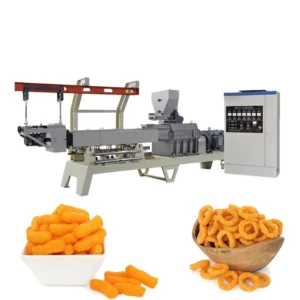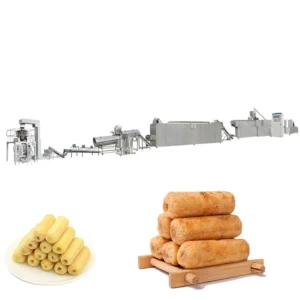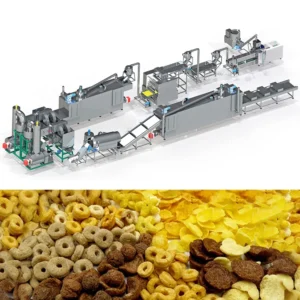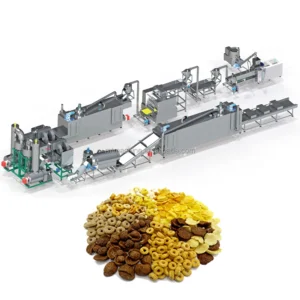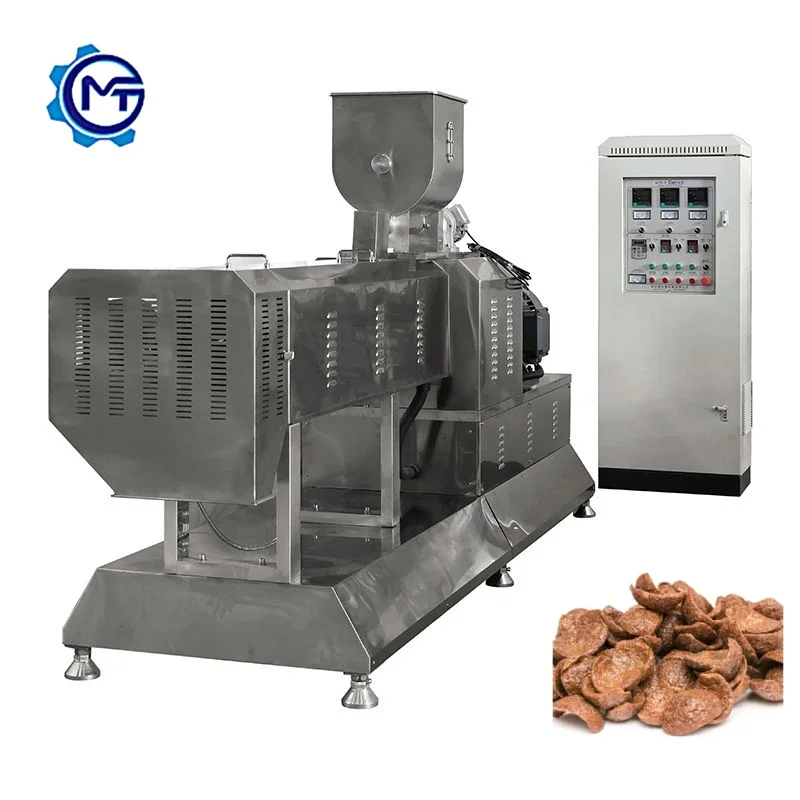
Integrated Line Matching — Every station from mixing through packing is throughput-balanced on a single layout, so the extruder never outpaces the flaker or dryer in a corn flakes operation.
Technical Specifications
| Parameter | Value |
|---|---|
| Product Type | Corn Flakes & Puffed Breakfast Cereal Production Line |
| Model Options | MT70 / MT85 / MT75 |
| Screw Type | Twin Screw |
| Installed Power (MT70) | 160 kW |
| Installed Power (MT85) | 190 kW |
| Installed Power (MT75) | 210 kW |
| Power Consumption (MT70) | 120 kW |
| Power Consumption (MT85) | 140 kW |
| Power Consumption (MT75) | 150 kW |
| Capacity (MT70) | 150–200 kg/hr (basis not stated in source — confirm raw material formulation and moisture content) |
| Capacity (MT85) | 300–400 kg/hr (basis not stated in source — confirm raw material formulation and moisture content) |
| Capacity (MT75) | 300–500 kg/hr (basis not stated in source — confirm raw material formulation and moisture content) |
| Overall Dimensions (MT70) | 41 × 1.5 × 2.2 m |
| Overall Dimensions (MT85) | 43 × 1.5 × 3.2 m |
| Overall Dimensions (MT75) | 45 × 1.5 × 3.5 m |
| Control System | PLC control for flaking machinery; MCC and PLC for full line |
| Heating Source Options | Gas, Electric, Steam |
| Flaking Machinery | Hydraulic double-roller system, dual independent motors, infrared sensor temperature control |
| Hot Air Roasting Oven | Vibrating pan, dual circulating fans, cyclone dust removal, conciliation burner |
| Coating System | Double tumble sugar melting, elevator, coating drum, spraying nozzle |
| Die Configuration | Interchangeable moulds — ball, tube, stick, ring, fruit loop, star, wheel, flower, heart |
| Raw Materials | Corn, rice, wheat, oat, barley powder |
| Standards | CE, ISO |
Application Suitability
| Application | Material or Output |
|---|---|
| Natural corn flakes production | Corn grits and corn flour |
| Sugar-coated breakfast cereals | Corn base with sugar syrup coating |
| Cocoa-flavored puffed cereals | Corn, rice, or wheat blend with cocoa coating |
| Shaped cereal snacks | Oat, barley, or mixed grain powder in ring, star, ball formats |
Why Nominal Capacity Figures Mislead Breakfast Cereal Buyers
A breakfast cereal production line full equipment catalog often lists a single throughput number, but that figure shifts once your actual grain formulation enters the barrel. The only capacity number that matters is the one measured on your specific raw material at your target moisture.
I have walked into facilities where the extruder was rated for a certain hourly output on standard corn grits, yet the buyer’s supplier provided a coarser grind. The result was under-gelatinized dough, poor flake integrity, and output that fell well short of expectations. The mismatch was not the machine’s fault — it was a specification gap. When sourcing a breakfast cereal production line full equipment set, the conversation must begin with your material certificate of analysis, not the brochure number [NEED_CITE: raw material particle size impact on extrusion throughput].
Station-by-Station Equipment Overview
The line begins with a batching and mixing station where grain powders are blended with water and minor ingredients to a target moisture before entering the twin-screw extruder. The extruder cooks and forms the dough under controlled barrel temperature zones and shear, then cuts it into pellets. From there, material moves through a flaking stage, a pre-dryer, a hot air roasting oven, an optional sugar or flavor coating drum, a final dryer, a cooler, and onward to packing. Each piece of breakfast cereal production line full equipment is listed here so buyers can see what fills every position between raw material infeed and sealed bag.
How the Flaking and Roasting Stations Shape the Final Product
The flaking machinery uses a hydraulic double-roller system with independent dual-motor drive, meaning each roller can be adjusted for pressure and gap without affecting the other. Infrared sensors monitor roller surface temperature in real time. This level of control matters because corn flakes that are too thick will not toast evenly in the roasting oven, while flakes that are too thin shatter during coating. The hot air roasting oven then takes over with a vibrating pan and high-temperature spraying tubes. Two circulating fans move air across the product bed, and a cyclone dust removal device pulls fines out of the air stream so they do not re-settle on the flakes [NEED_CITE: airflow uniformity requirements in cereal roasting ovens]. Getting both stations right is what separates a flake that stays crisp in milk from one that goes soggy within seconds.
Reading the Power and Dimension Data for Your Facility
The installed power figures — 160 kW for the MT70, 190 kW for the MT85, and 210 kW for the MT75 — represent peak draw across all motors and heaters in the breakfast cereal production line full equipment set. Actual consumption runs lower at 120 kW, 140 kW, and 150 kW respectively under normal operating load. These numbers dictate your transformer sizing and dedicated circuit planning. The overall lengths stretch from 41 meters to 45 meters depending on model, and the height reaches up to 3.5 meters on the MT75, which means your facility needs adequate ceiling clearance above the roasting oven and dryer exhaust ducting. Twin-screw extrusion introduces more shear and residence time flexibility than single-screw designs, allowing a wider range of grain formulations — from pure corn to oat-barley blends — but that flexibility only pays off when the screw configuration and die selection match your specific recipe. The interchangeable die moulds covering ball, tube, stick, ring, fruit loop, star, wheel, flower, and heart shapes give a single extruder the range to produce multiple SKUs without a hardware changeover beyond the die plate itself.
The Hidden Cost of Skipping Station Matching
When the extruder pushes material faster than the flaker can press it, a backlog of warm pellets sits waiting and begins to retrograde — the starch structure hardens unevenly and the resulting flakes crack during roasting. When the dryer is undersized relative to the coater output, sugar-coated flakes enter the packing stage still tacky, leading to clumping inside the bag. I have seen entire production days lost because one station was spec’d on a different capacity basis than the rest. These bottlenecks do not show up in a quotation spreadsheet [NEED_CITE: throughput balancing methodology in cereal processing lines]. The consequence is always discovered after installation, when the line is supposed to be earning revenue.
Why Source the Complete Range Here
Line layout drawings are prepared with throughput calculated across every station, not copied from a generic template. Screw configurations and die designs are specified against the buyer’s actual raw material formulation and target flake geometry. An in-house testing workshop runs trial production on customer-supplied grain blends before the line ships, so the screw profile and moisture settings are validated in advance. The twin-screw platform covers corn flakes alongside puffed cereal formats, allowing a single extruder investment to support multiple product launches. Pre-sales engineering continues through on-site installation, commissioning, operator training, and ongoing wear-part supply, meaning the same team that designed the layout is accountable when the line runs in your facility.
Documentation & Verification
- Line layout drawing with capacity calculation matched to your grain formulation
- Machine specification sheet listing screw and die configuration for your target flake shape
- Electrical schematic confirming voltage, frequency, and control language before production
- Factory test record and trial run report produced on your raw material sample
- CE declaration of conformity and ISO certificate for customs and compliance filing
- Wear parts list identifying screws, dies, and rollers for first-year inventory planning
Installation, Commissioning & Support
- Foundation must support line lengths up to 45 m with level tolerance for the hydraulic flaking rollers
- Dedicated power circuit sized for up to 210 kW installed load with MCC panel integration
- Equipment ships in modular sections requiring on-site assembly and alignment of conveyor links
- Commissioning includes screw configuration tuning and infrared sensor calibration on the flaker
- Operator training covers PLC interface navigation and die changeover for multiple cereal shapes
- First-year spare package includes replacement screws, die plates, and flaking roller segments
What to Prepare Before Requesting a Quotation
Send your raw material specification — grain type, particle size distribution, and typical moisture content — along with your target product format, whether that is a traditional corn flake, a sugar-coated variant, or a shaped puffed cereal. Confirm your facility’s available voltage and frequency, the ceiling height above the intended line footprint, and whether your utility supply favors gas, electric, or steam heating. If you have existing upstream mixers or downstream packing machines you plan to integrate, include their throughput and connection details so the breakfast cereal production line full equipment layout can be matched to them from the start.
Frequently Asked Questions
Q: How do I match each station’s capacity so no single machine bottlenecks the line?
A: Each station — extruder, flaker, dryer, roaster, coater — must be rated on the same raw material basis. We calculate throughput using your specific grain formulation and moisture content, then size every downstream unit to handle the extruder’s actual output, not a generic figure. The line layout drawing documents this matching so you can verify before production begins.
Q: What raw material formulations work with this twin-screw extruder, and how does die selection affect final shape?
A: The twin-screw design handles corn, rice, wheat, oat, and barley powders across a range of particle sizes. Die selection determines the cross-section — from rings to fruit loops to stars — while screw configuration and barrel temperature profile control expansion and density. We run trials on your material to lock in both parameters before the line ships.
Q: Can the dryer and roasting oven be configured for gas, electric, or steam depending on my utility supply?
A: Yes. The drying and roasting stations support gas, electric, or steam heating. Your utility infrastructure and local energy cost determine which source makes sense. We confirm the heating source during the specification stage so the burners, elements, or heat exchangers are installed correctly at the factory.
Q: What is the footprint of the complete line, and how should I plan utility connections?
A: Line length ranges from 41 to 45 meters depending on model, with widths around 1.5 meters and heights up to 3.5 meters. You need ceiling clearance above the roasting oven exhaust, a dedicated electrical circuit for the MCC panel, and utility drops for your chosen heating source. The layout drawing shows all connection points before installation begins.
Q: Which wear parts should I stock for the first year of operation?
A: The primary wear items are extruder screws, die plates, and flaking roller surfaces. We provide a wear parts list with part numbers and expected service intervals based on your production schedule and material abrasiveness. Stocking these before your first changeover avoids unplanned downtime waiting for replacements.