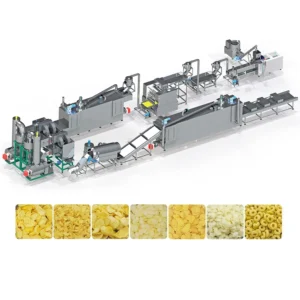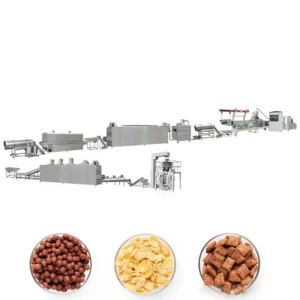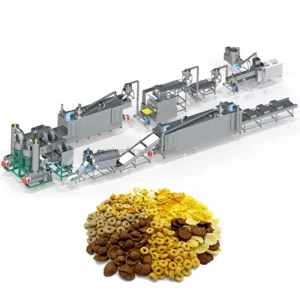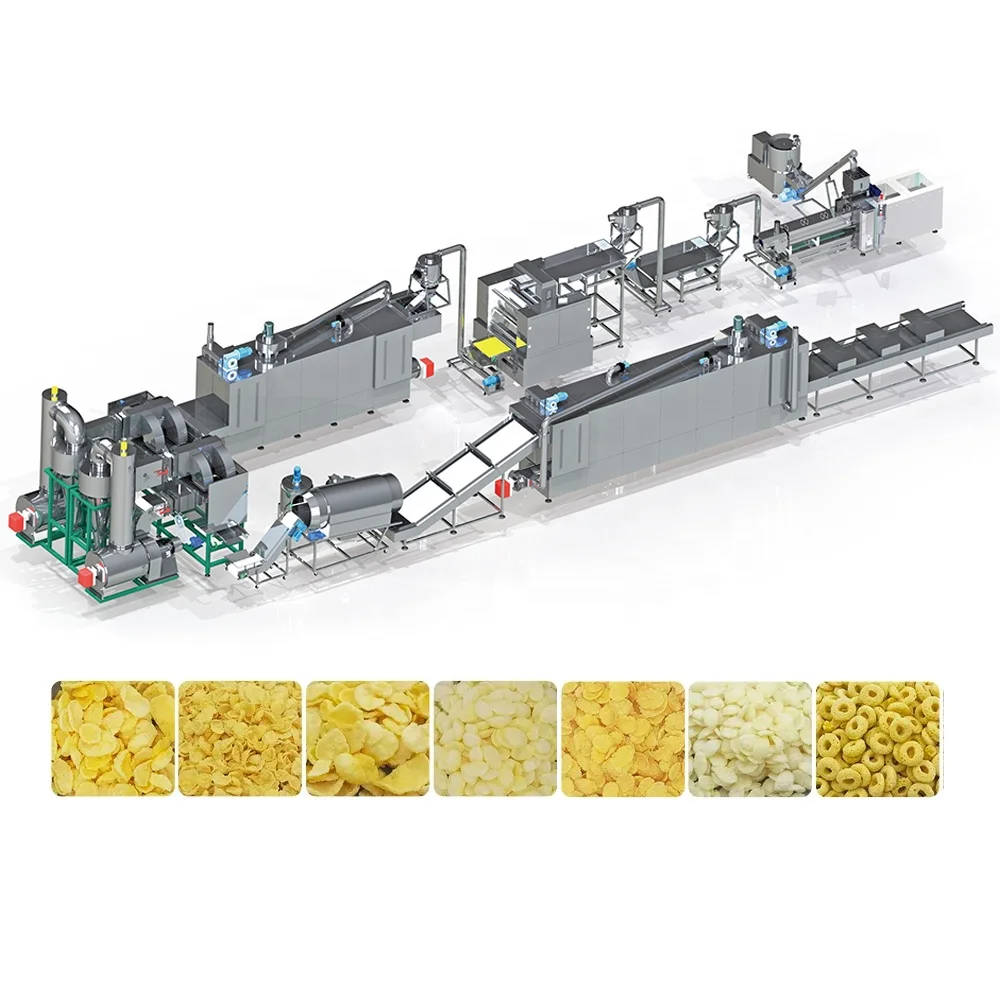
Complete Line Engineering — every station from flour mixer to cooling conveyor is capacity-matched in a single layout, so throughput is verified end-to-end before your breakfast cereals corn flakes machine full equipment range ships.
Technical Specifications
| Parameter | Value |
|---|---|
| Product Type | Breakfast Cereal and Corn Flakes Extrusion Production Line |
| Line Configuration | Flour Mixer → Screw Elevator → Double-screw Extruder → Elevator → Dryer → Elevator → Coating Line → Vibrating Spreader → Elevator → Dryer → Cooling Conveyor → Packing Machine |
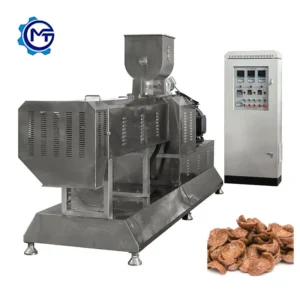
| Extruder | MT-75 Double Screw Extruder, co-rotating twin-screw, sectional modules |
| Extruder Functions | Forward and backward transport, mixing, de-gassing, cooking, forming |
| Mixer Tank Size | Ø600 × 500 mm |
| Mixer Power | 4 kW |
| Mixer Output | 10–30 kg per load (basis not stated in source — confirm batch time and raw material density) |
| Screw Conveyor Driving Power | 0.75 kW |
| Screw Conveyor Dimension | 2700 × 500 × 2400 mm |
| Corn Flakes Press Machine Power | 16.12 kW |
| Corn Flakes Press Roller Size | 510 × 310 × 1050 mm |
| Press Machine Features | Big roller, cooling system, adjustable roller distance for flake thickness control |
| High-temperature Oven Size | 4.5 × 1.4 × 1.8 m |
| Oven Power | 3.75 kW |
| Oven Heating Source | Gas |
| Sugar Spraying System Total Power | 28.75 kW |
| Sugar Spraying System Roller Size | Ø600 × 2700 mm |
| Contact Materials | Food-grade stainless steel throughout product contact zones |
| Voltage and Frequency | Customizable (e.g., 3ph 380V 50Hz, 3ph 415V 60Hz, 3ph 220V 60Hz — confirm target market requirement) |
| Control System | Available with PLC or MCC control (confirm configuration) |
| Standards | CE |
Application Suitability
| Application | Material or Output |
|---|---|
| Corn flakes production | Corn grits and corn flour, flaked and toasted |
| Choco hoops and cereal rings | Wheat flour, cocoa powder, oat flour blends |
| Fruit loops and puffed loops | Multi-grain flour blends with fruit flavour addition |
| Fortified breakfast cereals | Grain powders with added vitamins and minerals |
| Sugar-coated snack cereals | Extruded shapes coated with sugar syrup or honey |
| Whole grain wheat rings | Whole wheat and mixed grain flours |
Why a Mismatched Dryer Silently Caps Your Whole Line
An extruder that outpaces its dryer or coating drum does not produce more cereal — it produces a backlog that operators quietly throttle. Capacity must be verified station by station, not quoted as a single headline number.
I remember a Middle East buyer who received a breakfast cereal line where the extruder was sized for a higher throughput than the gas oven could handle. The flakes came out under-dried, stuck together in the coating drum, and the sugar layer turned clumpy. The buyer spent the first three weeks re-drying product in a borrowed oven just to fulfil orders. A breakfast cereals corn flakes machine full equipment range is only as fast as its slowest station. [NEED_CITE: thermal load matching in cereal drying operations]
Equipment Stations in Sequence
Each machine in this breakfast cereals corn flakes machine full equipment range sits in a fixed sequence. The flour mixer hydrates grain blends uniformly before the screw elevator meters material into the MT-75 double-screw extruder, where co-rotating sectional modules control shear and residence time for consistent gelatinisation.
Press Roller and Oven Thermal Profile
The corn flakes press uses an adjustable roller gap with an integrated cooling system, so flake thickness stays within tolerance even after long production runs. Downstream, the gas-fired oven at 4.5 metres long provides dual-side baking. If the oven temperature profile is not mapped to the flake moisture entering from the press, you get scorched edges or a soft centre — and neither passes quality inspection. [NEED_CITE: moisture gradient control in flaked cereal baking]
Sugar Coating and Final Drying
The sugar spraying system runs a Ø600 × 2700 mm temperature-keeping roller to maintain syrup viscosity across the drum. After coating, the second dryer and cooling conveyor bring the cereal to packing temperature. Skipping any station — or undersizing one — shifts the bottleneck rather than removing it.
Reading the Specs That Actually Matter
The MT-75 twin-screw extruder uses sectional screw modules rather than a single-piece screw. This matters because different grain blends — corn, rice, oat, whole wheat — require different compression ratios and kneading block arrangements to reach the right degree of starch gelatinisation. A fixed screw forces you to compromise on one blend to suit another.
The press roller at 510 × 310 mm with adjustable gap lets you set flake thickness from thin and crisp to thick and chewy. Roller size directly determines the contact arc length, which governs how evenly the pellet is flattened before entering the oven.
Gas heating in the high-temperature oven provides rapid temperature recovery when wet product loads enter. Electric ovens of this size often lag during load changes, causing uneven bake across the belt width.
Food-grade stainless steel contact surfaces prevent iron contamination that discolours light cereal products and shortens shelf life. [NEED_CITE: food contact material regulations for grain processing machinery]
The Cost of Overlooking Downstream Stations
Buyers often compare extruder motor power and screw diameter while leaving the dryer, coater, and cooling conveyor as afterthoughts. When the coating drum cannot keep up, sugar pooling on the cereal surface causes reject batches. When the cooling conveyor is too short, warm cereal enters the packing station and generates condensation inside the bag, leading to mould complaints within days. These failures appear weeks after commissioning and are traced back to a line that was never balanced as a system. [NEED_CITE: post-coating moisture migration in packaged cereal]
Why Source the Full Range Here
Every station is specified under one supplier, so the mixer batch size, extruder throughput, dryer belt area, and coating drum volume are calculated together rather than assembled from separate quotations.
The screw configuration and die design are matched to your specific grain blend and target shape — ring, hoop, flake, or ball — not copied from a generic build.
An in-house testing workshop runs your actual raw material before shipment, so gelatinisation behaviour, expansion ratio, and flake integrity are confirmed before the line leaves Jinan.
Pre-sales consultation includes line layout and capacity calculation, and post-delivery support covers on-site installation, commissioning, and operator training on your product format.
Voltage, frequency, and control language are confirmed before production begins, avoiding weeks of delays during commissioning at your facility.
Documentation & Verification
- Line layout drawing showing every station dimension and throughput match for your cereal format
- Screw and die configuration record specific to your grain blend and target shape
- Electrical schematic with voltage, frequency, and control language confirmed for your market
- Factory test record from trial run on your raw material before dispatch
- CE declaration of conformity covering the complete line assembly
- Operation and maintenance manual with wear parts list for extruder screws and press rollers
Installation, Commissioning & Support
- Foundation plan accounts for the 4.5-metre oven length and full conveyor run
- Dedicated electrical circuit sized for the 28.75 kW sugar spraying system and 16.12 kW press
- Extruder arrives with sectional screw modules pre-assembled; die plate fitted on site to match product
- Gas supply pressure and burner calibration verified during first oven firing
- Operator training covers screw module rearrangement for different cereal shapes
- Wear parts stock includes replacement screw elements and press roller bearings
What We Need From You
Send us your target cereal format — flake, ring, hoop, or ball — along with the grain blend you intend to run, including moisture content if known. Tell us your local voltage and frequency, the control language your operators need, and whether you require a trial run on your raw material in our workshop before the line ships.
Frequently Asked Questions
Q: How is each station’s capacity matched to prevent bottlenecks across the full cereal line?
A: Every station — mixer, extruder, dryer, press, coater, cooling conveyor — is calculated against the same target throughput before the layout is finalised. We provide a line capacity document showing the rated flow at each point, so no single machine constrains the sequence. This is confirmed during the trial run on your material.
Q: What extruder screw configuration is recommended for my specific grain blend and moisture level?
A: The MT-75 uses sectional co-rotating screw modules that can be rearranged to adjust compression ratio, kneading intensity, and residence time. We select the module arrangement based on your grain blend composition and incoming moisture, then validate it during the in-house trial run before shipment.
Q: Can the line accommodate non-standard voltage and frequency for my target market?
A: Yes. Voltage and frequency are confirmed during the specification stage before production begins. Options include 3-phase 380V 50Hz, 415V 60Hz, 220V 60Hz and other configurations. The electrical schematic and motor nameplates are prepared to match your site supply.
Q: Which packing machine options are compatible with the cooling conveyor output?
A: The cooling conveyor feeds directly into the packing station at the end of the line. Packing machine selection depends on your bag format, target weight per bag, and sealing method. We specify the packing unit to match the cooled cereal throughput so product does not queue on the belt.
Q: What is included in the factory test record before the line ships?
A: The factory test record documents the trial run performed on your actual raw material in our testing workshop. It covers extruder parameters, gelatinisation result, flake thickness from the press, oven drying curve, coating uniformity, and final product density. You receive this report before the line is crated for dispatch.