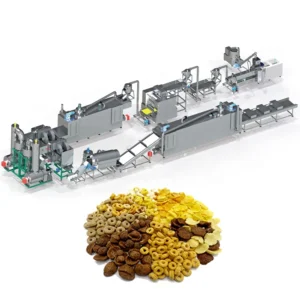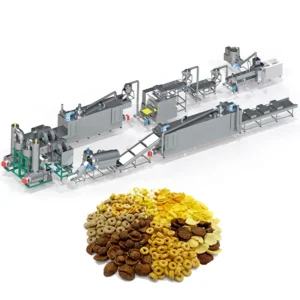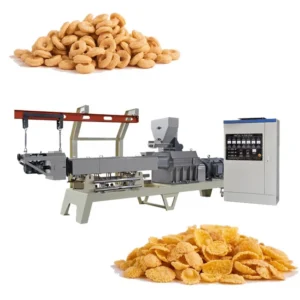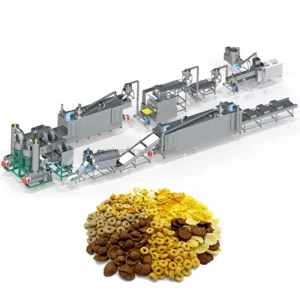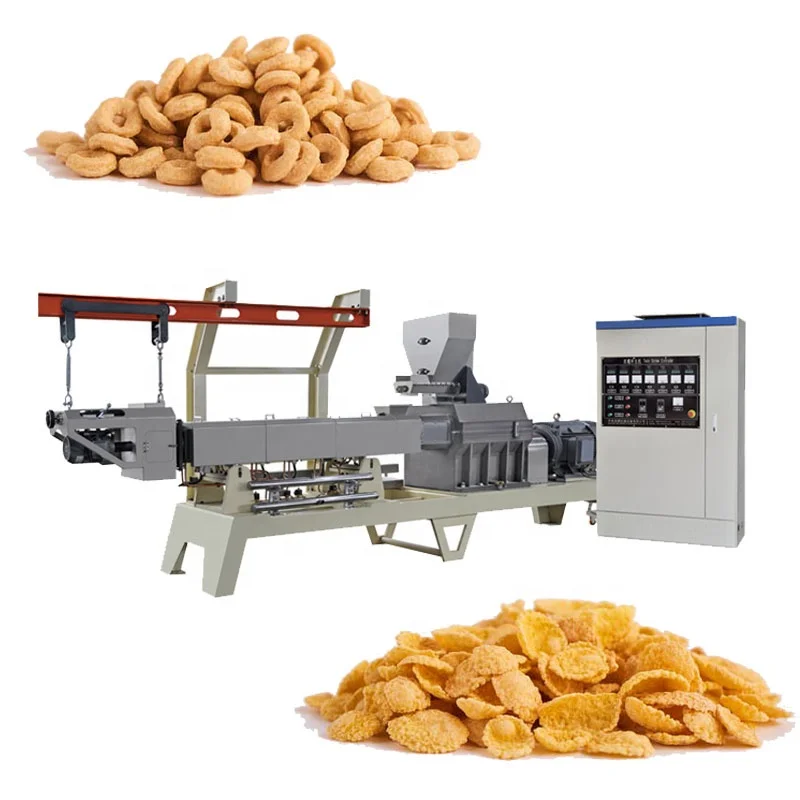
Integrated Station Throughput — Every segment of this breakfast cereal line is calculated against the same raw material and moisture baseline so no single station restricts your actual output.
Technical Specifications
| Parameter | Value |
|---|---|
| Model | MT70 / MT85 / MT75 |
| Product Type | Corn Flakes and Breakfast Cereal Production Line |
| Screw Type | Twin-screw |
| Installed Power | MT70 — 160 kW; MT85 — 190 kW; MT75 — 210 kW |
| Power Consumption | MT70 — 120 kW; MT85 — 140 kW; MT75 — 150 kW |
| Output Capacity | MT70 — 150–200 kg/hr; MT85 — 300–400 kg/hr; MT75 — 300–500 kg/hr (basis not stated in source — confirm raw material and moisture before selection) |
| Overall Dimensions (L×W×H) | MT70 — 41 × 1.5 × 2.2 m; MT85 — 43 × 1.5 × 3.2 m; MT75 — 45 × 1.5 × 3.5 m |
| Control System | PLC and MCC integrated across the full line |
| Line Stations | Mixing → Extruding → Flaking → Drying → Hot Air Roasting → Sugar Coating (optional) → Cooling → Packing |
| Flaking Machinery | Hydraulic double-roller system, independent dual-motor drive, infrared sensor temperature control |
| Dryer Heating Source | Gas or Electric (configurable) |
| Hot Air Roasting Oven | Vibrating pan, high-temperature spraying tubes, conciliation burner, dual circulating fans, cyclone dust removal |
| Coating System | Double tumble sugar melter, elevator, coating drum, spraying nozzle |
| Raw Materials | Corn, rice, wheat, oat, barley powder |
| Automatic Lubrication | Yes, with cooling function |
| Standards | CE, ISO |
Application Suitability
| Application | Material or Output |
|---|---|
| Natural corn flakes production | Corn grits, corn flour |
| Sugar-coated corn flakes | Corn base with sugar or honey coating |
| Oatmeal and multi-grain cereal | Oat, barley, wheat, rice blends |
| Shaped cereal snacks | Ball, tube, stick, ring, fruit loop, star, wheel, flower, heart via adjustable extruder die |
Why Rated Capacity Means Nothing Without the Raw Material Context
A line is only as fast as its slowest matched station running your actual grain blend.
I have watched a corn flakes line in Colombia stall at the dryer because the extruder was sized on pure corn grits while the buyer ran a 30% oat blend that holds more moisture. The throughput dropped and the roaster could not keep up. This is the kind of mismatch that surfaces only after commissioning, when change orders become expensive [NEED_CITE: importance of raw material basis in extrusion capacity rating]. Selecting the right corn flakes production line equipment manufacturer means verifying every station against your specific formulation before a single machine is built.
Matching Every Station to Your Grain Profile
A corn flakes production line equipment manufacturer must calculate throughput from the mixer forward. The twin-screw extruder processes your grain blend into a cooked dough, but moisture content and starch gelatinisation vary significantly between corn, oat, and wheat. The flaking station then compresses that dough between hydraulic double rollers — if the dough arrives too wet or too dry, flake thickness becomes inconsistent and downstream roasting cannot correct the texture.
How Flaking and Roasting Determine Final Product Quality
The flaking station on this line uses independent dual-motor drive for each roller and infrared sensor temperature control, which keeps flake thickness uniform across the belt width. After drying, the hot air roasting oven uses a vibrating pan with conciliation burner and dual circulating fans to achieve the surface bubbling and crispness the market expects [NEED_CITE: hot air roasting parameters for breakfast cereal crispness]. The cyclone dust removal device captures fines that would otherwise contaminate the coating stage or the packing area.
Reading the Spec Sheet Against Your Production Target
The MT70, MT85, and MT75 models share the same twin-screw architecture but diverge in installed power, physical footprint, and throughput range. Installed power spans from 160 kW on the MT70 to 210 kW on the MT75, which reflects the motor sizing needed for higher-volume extrusion of dense multi-grain blends. The overall line length stretches from 41 m to 45 m depending on model, which directly affects your factory layout planning. PLC and MCC control across the entire line means the extruder, flaking rollers, dryer, and roaster communicate on one platform — reducing the operator dependency that often causes batch-to-batch variation. Automatic lubrication with cooling function extends screw and barrel service intervals, which matters when you are running continuous shifts on abrasive corn grits.
The Cost of Underspecifying the Dryer and Coating Drum
Buyers often focus on extruder output and assume the dryer and roaster will follow. When the dryer cannot remove enough moisture before roasting, flakes emerge soft and shelf life shortens. If the coating drum is undersized relative to the roaster output, sugar-coated batches queue up and cool unevenly, creating clumps that the packing station cannot handle [NEED_CITE: downstream bottleneck effects in breakfast cereal processing]. These mismatches rarely appear in a quotation comparison — they appear on the factory floor during the first full-speed run.
What Separates a Matched Line from an Assembled One
Every station from mixing through packing comes from a single supplier, so throughput calculations are coordinated rather than guessed across separate vendors. Screw configuration and die design are specified to your raw material and target flake density, not copied from a generic build. The in-house testing workshop runs your actual grain blend before shipment, producing a trial run report that confirms texture and output. Twin-screw expertise spans corn flakes, oatmeal cereal, and multi-grain formats, meaning the same engineering team that configured your extruder understands the flaking and roasting parameters downstream. Pre-sales consultation covers line layout, utility planning, and phased installation so that commissioning starts from a known baseline.
Documentation & Verification
- Line layout and capacity calculation matched to your grain blend and target throughput
- Machine specification sheet with screw and die configuration record for your flake density
- Trial run report on your raw material from the in-house testing workshop before dispatch
- Electrical schematic with voltage and frequency confirmed against your facility supply
- CE declaration of conformity and ISO certificate for customs and regulatory clearance
- Operation and maintenance manual with wear parts list for screws, dies, and roller surfaces
Installation, Commissioning & Support
- Foundation and floor space planning based on the 41–45 m line length and station footprint
- Dedicated power circuit sized to the MT70 160 kW through MT75 210 kW installed load
- Full line arrives in segmented modules for staged assembly inside your production hall
- PLC and MCC system commissioned on-site with control language set to your operator preference
- Operator training covers extruder screw adjustment, flaking roller gap, and roaster temperature profiles
- Wear parts inventory including screws, dies, and roller surfaces stocked for first replacement cycle
What We Need to Build Your Line Correctly
To configure a line that matches your actual production environment, share your raw material specification including grain type, particle size, and moisture content. Confirm your target daily output and whether you plan to run natural flakes, sugar-coated variants, or both. Provide your factory floor dimensions, ceiling height, and local voltage and frequency so the electrical schematic and motor specifications are built right from the start.
Frequently Asked Questions
Q: How is output capacity verified for this corn flakes line?
A: Rated capacity figures are based on specific raw material and moisture conditions. We verify throughput by running your actual grain blend in the testing workshop before shipment, documenting real output at each station from extrusion through packing so the numbers reflect your production reality.
Q: How do you prevent dryer and roaster bottlenecks?
A: Every station is sized against the extruder output using your grain blend’s moisture profile. The dryer heating source, roaster fan capacity, and coating drum volume are all calculated together so no single machine restricts the line.
Q: Can the extruder screw configuration be customized to our grain blend?
A: Yes. Screw configuration and die design are specified to your raw material and target flake density. The in-house testing workshop validates the setup on your actual corn, oat, or multi-grain blend before the machine leaves the factory.
Q: What electrical details are confirmed before commissioning?
A: Voltage, frequency, and control language are confirmed during the specification stage. The electrical schematic is built to match your facility’s power supply, and the PLC interface is set to your operator’s preferred language before on-site commissioning begins.
Q: What spare wear parts should we plan for?
A: Screws, dies, and flaking roller surfaces are the primary wear items. A wear parts list with specifications and recommended replacement intervals is included in the documentation, and first-replacement stock is available with typical multi-week lead times.