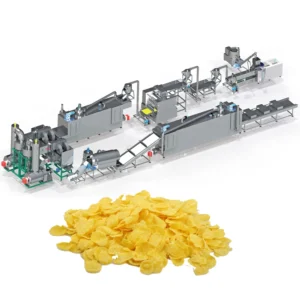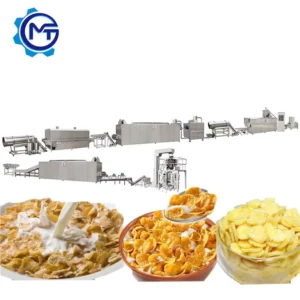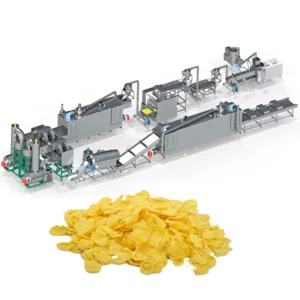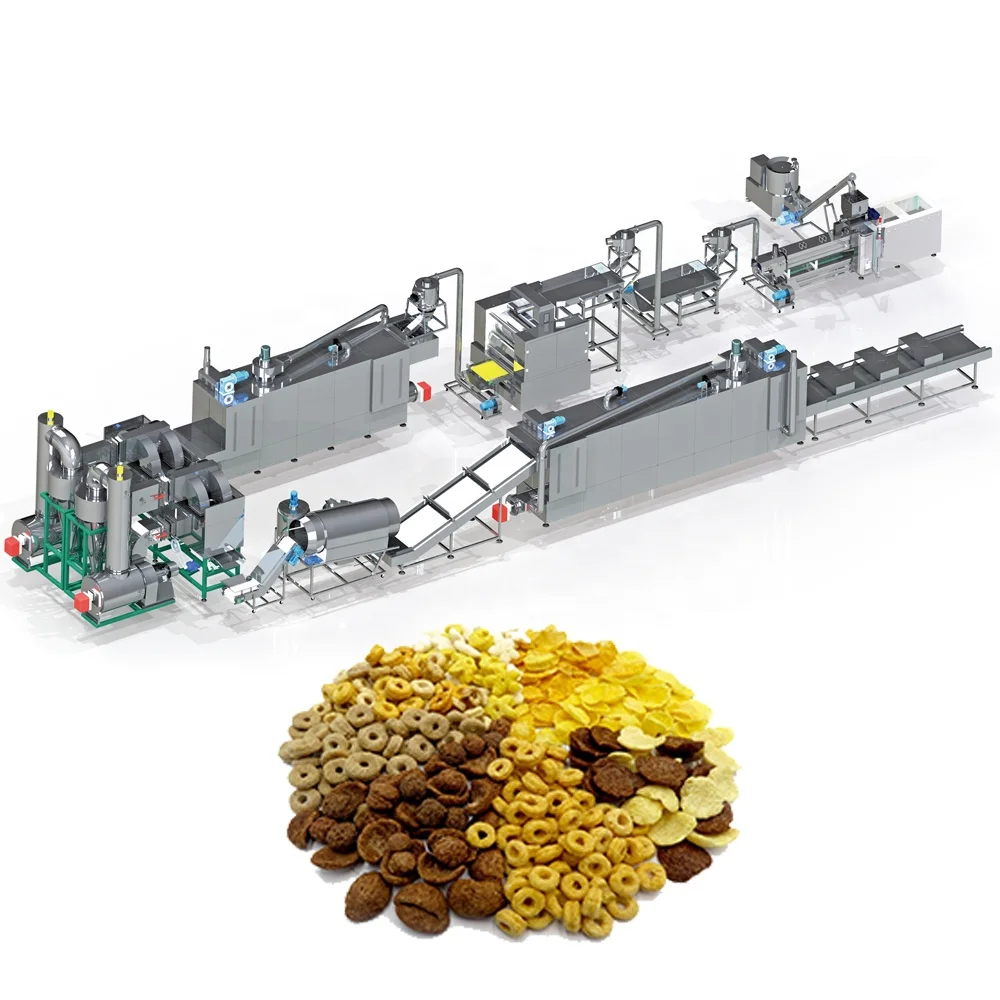
Integrated Line Matching — Every station from the flour mixer through the cooling conveyor is configured to the same target throughput, preventing the dryer or coating drum from becoming a bottleneck that caps your actual output well below the extruder’s nameplate rating.
Technical Specifications
| Parameter | Value |
|---|---|
| Product Type | Breakfast Cereal Corn Flakes Extrusion Production Line |
| Extruder Model | MT-65 |
| Extruder Type | Co-rotating twin-screw with sectional modules |
| Mixer Output | 10–30 kg per load |
| Mixer Power | 4 kW |
| Screw Conveyor Power | 0.75 kW |
| Flaking Press Power | 16.12 kW |
| Flaking Press Roller Size | 510 × 310 × 1050 mm |
| High-Temperature Oven Heating | Gas-fired, both-side baking system |
| Sugar Spraying System Total Power | 28.75 kW |
| Sugar Spraying System Roller Size | Ø600 × 2700 mm |
| Voltage & Frequency | 3ph 380V 50Hz (customizable) |
| Control System | Separate controller box (basis not stated in source) |
| Certification | CE |
Application Suitability
| Application | Material or Output |
|---|---|
| Traditional corn flakes | Corn flour, corn grits |
| Multi-grain breakfast cereals | Oat flour, rice flour, blended grain powders |
| Shaped cereal formats | Ring, ball, star, stick via interchangeable moulds |
| Fortified breakfast cereals | Grain powders blended with vitamins and nutritional ingredients |
| Sugar- or honey-coated cereal variants | Extruded flakes with syrup or honey glazing |
Why Matching Dryer Capacity to Extruder Output Matters More Than You Think
A breakfast cereal corn flakes equipment manufacturer that sizes the oven and coating drum to the extruder’s actual throughput — not its brochure figure — is the difference between a line that runs at rating and one that chronically underperforms.
I have watched lines get delivered where the twin-screw extruder could push product faster than the downstream dryer could handle moisture removal. The result is a backlog of wet flakes sitting on the conveyor, uneven toasting, and operators deliberately starving the extruder to keep up. The whole line then runs at a fraction of what was paid for. When you source a breakfast cereal corn flakes equipment manufacturer that treats every station as one system rather than a collection of individual machines, these mismatches get caught on paper before metal is cut [NEED_CITE: industrial line throughput balancing principles].
How Twin-Screw Extrusion Shapes Flake Quality from the Inside
The MT-65 co-rotating twin-screw extruder uses sectional screw modules that can be rearranged along the barrel to control residence time, shear intensity, and pressure profile. This matters because corn flour and oat flour gelatinise at different moisture and temperature thresholds, and a fixed screw build that works for one recipe may leave another under-cooked or over-sheared. Being able to reconfigure the screw elements means the same extruder can handle recipe changes without a hardware swap, which is exactly the flexibility a cereal producer needs when launching new formulations.
The Role of Flaking Press Geometry in Final Texture
Flake thickness is not just about appearance — it governs how the product toasts in the oven and how it holds up in milk. The flaking press on this line carries 510 × 310 mm rollers with an adjustable gap, allowing operators to dial in thickness based on the pellet density coming out of the extruder. The integrated cooling system on the press keeps the roller surface temperature stable during long runs, which prevents the starch from sticking and tearing as throughput demands change across a shift [NEED_CITE: starch behaviour during hot flaking operations].
Reading the Specs That Actually Matter for Flake Consistency
The gas-fired high-temperature oven uses a both-side baking arrangement, which addresses one of the most common complaints in corn flake production: flakes that are over-browned on one face and under-dried on the other. Even heat distribution across the belt width means moisture removal stays uniform, so you do not end up with a mix of burnt and soggy pieces in the same batch. The sugar spraying system runs a separate melting tank with a temperature-keeping roller at Ø600 × 2700 mm, maintaining syrup viscosity within a narrow band so that coating weight stays consistent whether you are running a light glaze or a heavy honey coat. On the power side, the sugar system alone draws 28.75 kW, which tells a facility planner exactly what dedicated circuit capacity is needed before the line arrives on site.
What Happens When Line Stations Are Not Sized Together
When a producer buys an extruder from one vendor and a dryer from another, nobody takes responsibility for the gap between them. The dryer may be rated for a different moisture load, the coating drum may not turn fast enough to keep up, and the cooling conveyor may be too short for the output volume. Each mismatch compounds, and the operator ends up running the entire line at the pace of its weakest link. These hidden bottlenecks rarely show up during a factory demonstration because demo runs are short and forgiving — the problem only surfaces during sustained production [NEED_CITE: consequences of unmatched processing line station capacities].
Why Procurement Decisions Land Here
Every station on this corn flakes line — from the 4 kW flour mixer through the twin-screw extruder, flaking press, gas oven, sugar coating system, and cooling conveyor — is specified as a single package, meaning throughput is calculated across the full chain before fabrication starts. Screw configuration and die design are matched to your actual raw material, not copied from a generic template, because the testing workshop runs your flour blend before the extruder ships. The control system and voltage are confirmed against your facility’s supply — 380V/50Hz, 415V/60Hz, or 220V/60Hz — so there are no commissioning delays caused by incompatible electrical infrastructure. CE certification is standard across the line, and the in-house testing workshop means your operators see real product coming off the equipment before it is crated.
Documentation & Verification
- Line layout drawing showing throughput matched across all stations for your target output
- Screw and die configuration record specific to your corn or multi-grain flour formulation
- Electrical schematic confirming voltage and frequency for your facility’s supply
- Trial run report generated on your raw material in the in-house testing workshop
- CE declaration of conformity covering the complete production line
Installation, Commissioning & Support
- Foundation plan accounts for the 4.5 m oven length and flaking press footprint of 1550 × 1300 mm
- Dedicated circuits specified for the 28.75 kW sugar system and 16.12 kW flaking press
- Gas supply connection sized for the both-side baking oven before equipment arrival
- Commissioning includes screw module adjustment and die alignment on your actual grain flour
- Spare screw elements, die plates, and flaking roller surfaces shipped with initial order
What We Need to Build Your Line Correctly
To configure a corn flakes line that actually delivers, send your primary grain flour type and any secondary ingredients you plan to blend, along with the flake dimensions and coating style your market expects. Confirm your workshop voltage and frequency, the available ceiling height for the elevator sections, and whether you need a packing station integrated at the end of the cooling conveyor. If you want a trial run on your own raw material before the line leaves the factory, include a sample shipment timeline so the testing workshop can be scheduled.
Frequently Asked Questions
Q: How is throughput matched across the mixer, extruder, dryer, and coating stations?
A: Each station is sized against the extruder’s actual output on your specific raw material, not a generic capacity figure. The mixer load cycle, screw conveyor feed rate, oven belt speed, and sugar drum rotation are all calculated together so no single station forces the rest of the line to slow down.
Q: What voltage and frequency configurations are available?
A: The standard build is 3-phase 380V at 50Hz. The line can be configured for 380V/60Hz, 415V/60Hz, or 220V/60Hz depending on your local grid standard. Confirming this early prevents rewiring or transformer costs during commissioning.
Q: Which screw configurations work for corn flour versus oat or multi-grain blends?
A: Corn flour typically needs higher shear and a longer cooking zone, while oat flour requires gentler handling to avoid over-gelatinisation. The sectional screw modules on the MT-65 are rearranged to suit each recipe, and the optimal build is validated during a trial run before shipment.
Q: Can a packing station be added to the end of the line?
A: Yes. The cooling conveyor discharge point is designed to feed into a downstream packing system. The layout drawing will show the integration point and belt height so your packing equipment aligns without product transfer gaps or spillage.