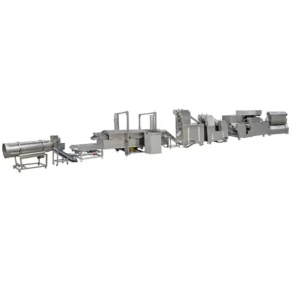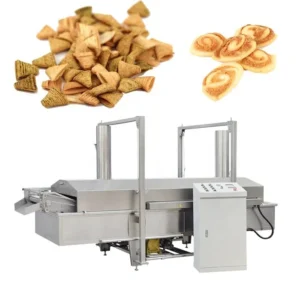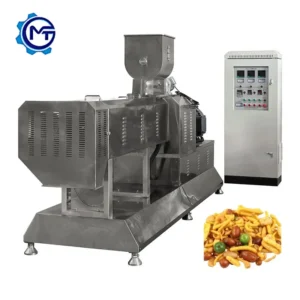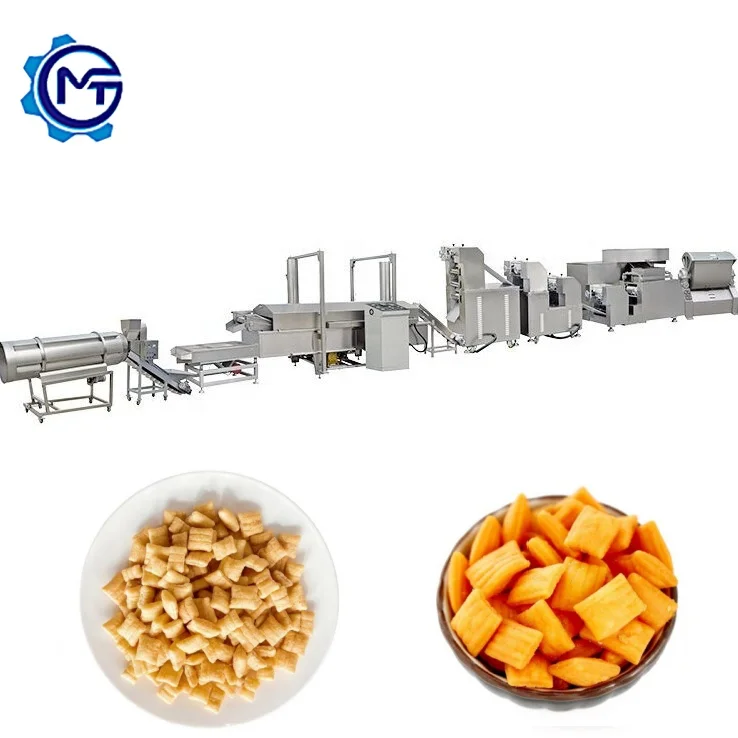
Matched Throughput Across Every Station — this continuous fryer is sized alongside upstream extruders and downstream coating units so no single station bottlenecks the snack line.
Technical Specifications
| Parameter | Value |
|---|---|
| Product Type | Continuous Deep Fryer for Puffed Snack Production Line |
| Rated Power (Drive/Control) | 2.6 kW |
| Heating Tube Power | 60 kW |
| Voltage & Frequency | 380V / 50Hz (configurable) |
| Power Source | Electric heating (gas heating available as option) |
| Control System | PLC |
| Oil Capacity | 320 L |
| Overall Dimensions (L×W×H) | 6700 × 2200 × 1200 mm |
| Net Weight | 2000 kg |
| Capacity Range | 100–1000 kg/h (basis not stated in source — confirm product type, moisture and oil temperature) |
| Heating Method | Electricity / Gas (selectable) |
| Belt Type | Upper and lower double-layer mesh belt |
| Speed Control | Frequency conversion stepless speed regulation |
| Oil Filtration | Continuous oil circulation filtration system |
| Lifting System | Automatic lifting for upper hood and mesh belt |
| Slag Discharge | Bottom slag discharge system |
| Material | Food-grade 304 stainless steel |
| Standards | CE, ISO |
Application Suitability
| Application | Material or Output |
|---|---|
| Fried dough bugles production | Wheat flour-based extruded pellets, fried to hollow cone shape |
| Corn chip frying | Corn masa or corn grits extrudates, flat or scooped formats |
| Puffed snack pellet frying | 2D/3D pellet snacks from potato starch, tapioca or composite flour |
| Extruded wheat flour crisps | Thin-sheet or rope-cut wheat snacks requiring uniform oil immersion |
| Snack line scale-up stations | Replacement or capacity expansion fryer in existing puffed food lines |
What Happens When Fryer Capacity Does Not Match the Extruder
A mismatched frying station turns the most expensive machine on the line into a bottleneck.
I worked with a South Asian producer who sourced a continuous frying machine for snack production line from a different vendor than their extruder. The extruder pushed out shaped dough pieces faster than the fryer could accept them, so product piled up on the transfer conveyor. Meanwhile, the oil temperature dropped every time a heavy batch entered, causing uneven colour and excess oil absorption. The line never reached its intended rhythm because nobody had calculated the transfer rate between the two stations [NEED_CITE: throughput matching between extrusion and frying stations]. When the fryer runs empty while waiting for upstream product, the oil degrades faster and energy is wasted on maintaining temperature without production.
How the Double-Layer Mesh Belt Controls Frying Uniformity
Puffed snack pieces are light and tend to float on the oil surface, exposing only their lower half to direct heat. The upper and lower mesh belt configuration on this continuous frying machine for snack production line clamps the product between two layers, holding each piece fully submerged. This approach produces consistent colour and texture across all surfaces, which matters when frying hollow shapes like bugles where uneven oil contact creates visible light patches. Belt speed is adjusted through frequency conversion, letting operators fine-tune residence time without stopping the line.
Oil Circulation Filtration and Its Effect on Product Quality
Frying starchy extrudates generates fine particulate that accumulates at the tank bottom and accelerates oil breakdown. The continuous oil circulation filtration system on this unit pulls oil through a filter loop during operation, removing carbonised crumbs before they raise the acid value. Cleaner oil maintains a lighter colour over longer runs and reduces the frequency of full oil changeovers. The bottom slag discharge system collects heavier debris separately, so maintenance staff can clear sediment without draining the entire 320-litre tank [NEED_CITE: oil degradation rates in continuous industrial frying operations].
Reading the Key Specifications for Your Line
The 60 kW heating tube power determines how quickly the oil recovers temperature after product enters the tank — a higher thermal load means the fryer can accept product at a steadier rate without temperature dips that cause pale, oily output. The 380V/50Hz electrical supply must match the destination factory’s utility grid; ordering a unit on a different voltage or frequency leads to motor and heater incompatibility that delays commissioning by weeks. Oil capacity of 320 litres sets the thermal mass available for temperature stability — a smaller tank would swing more on each product load. The 6700 mm overall length defines the conveyor run inside the oil bath, which directly governs maximum frying time at a given belt speed. Stepless speed regulation means operators dial in exact residence time rather than choosing between fixed gear settings.
The Cost of Specifying the Fryer in Isolation
When a frying station is purchased without confirming upstream forming speed and downstream de-oiling capacity, the typical result is a line that runs at the pace of its slowest station. Product accumulates before the fryer, cools on the conveyor, and enters the oil at inconsistent intervals. Downstream, if the de-oiling drum or flavouring station cannot keep up, fried product sits exposed and absorbs moisture from the air, losing crispness before it reaches the packing scale. These mismatches rarely show up in individual machine quotations [NEED_CITE: line balancing principles in snack food processing]. They only become visible during the first full-speed run, when rework and downtime have already started accumulating.
Why Buyers Source This Station Through the Full Equipment Catalogue
MT lists this continuous frying machine for snack production line alongside every upstream and downstream station — mixers, extruders, dryers, flavouring drums, coolers and packing units — so throughput is calculated across the entire sequence rather than each machine standing alone. Screw and die configuration on the extruder is matched to the same raw material that will later pass through this fryer, which affects moisture content entering the oil and therefore frying time. The PLC panel on the fryer communicates with the line MCC, giving operators a single interface for start-up and shutdown sequencing. Factory test records are generated with the buyer’s specific raw material before the equipment leaves the testing workshop. Electrical schematics and voltage confirmations are completed before production begins, preventing utility mismatches at the installation site.
Documentation & Verification
- Line layout drawing showing fryer position relative to extruder and de-oiling drum
- Machine specification sheet with confirmed heating method and oil capacity
- Electrical schematic matching destination voltage and frequency
- Factory test record on buyer’s raw material before dispatch
- Machinery test report and video outgoing inspection provided
- Wear parts list covering mesh belt sections and heating elements
Installation, Commissioning & Support
- Foundation must support 2000 kg static load across the 6700 mm frame length
- Dedicated 380V circuit sized for 60 kW heating load plus 2.6 kW drive
- Unit ships fully assembled; verify workshop door clearance for 2200 mm width
- First-run oil fill and temperature ramp supervised by commissioning engineer
- PLC parameter setting for belt speed and oil temperature logged during trial
- Spare mesh belt sections and heating tubes listed in wear parts schedule
- Daily cleaning cycle uses automatic hood lift for access to oil tank interior
What to Prepare Before Requesting a Quotation
Share the extruder output rate and the specific snack format you are producing — bugles, corn chips, or pellet-based crisps — so the fryer belt length and oil volume can be confirmed against your throughput target. Provide your factory voltage and frequency, along with the available floor space between the forming station and the downstream de-oiling drum. If you are replacing an existing fryer, note the current oil temperature range and any issues with product floatation or uneven colour.
Frequently Asked Questions
Q: How is fryer capacity matched to the upstream extruder output on a complete snack line?
A: We calculate the extruder’s actual output on your raw material and recipe, then confirm that the fryer belt speed and oil volume can accept that flow continuously. The transfer conveyor between stations is also sized so product does not accumulate or starve the fryer during normal operation.
Q: What heating options are available and how does each affect utility planning?
A: Electric heating uses the 60 kW tube bank on a 380V supply. Gas heating is available as an alternative for sites where electrical capacity is limited or gas cost is lower. Each option changes the utility connection requirements and must be confirmed before the machine enters production.
Q: How does the PLC control panel integrate with MCC for the full production line?
A: The fryer PLC connects to the central MCC so start-up, shutdown and emergency stop sequences run across every station together. Operators set frying temperature and belt speed from one interface, and alarms from the fryer appear on the main line screen.
Q: What voltage and frequency configurations are confirmed before shipment?
A: We verify your site voltage and frequency during the quotation stage and record it on the electrical schematic. The motor, heating elements and control transformer are all wound or selected for that specific supply before assembly begins.
Q: What supporting stations complete the line after frying?
A: After the fryer, product typically passes through a de-oiling drum or vibratory screen, then enters a flavouring station for seasoning application, followed by a cooling conveyor before packing. Each station is listed in the MT catalogue and sized to the same throughput target.