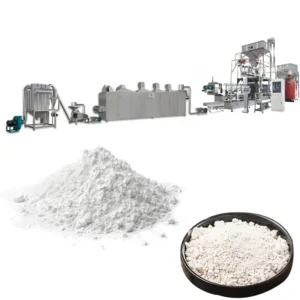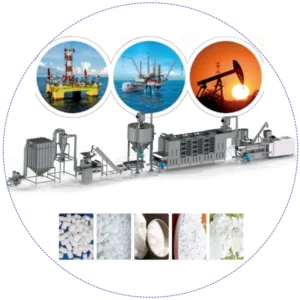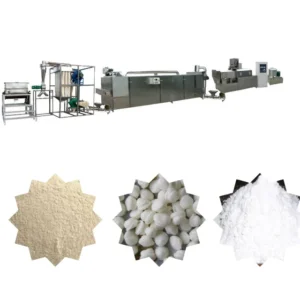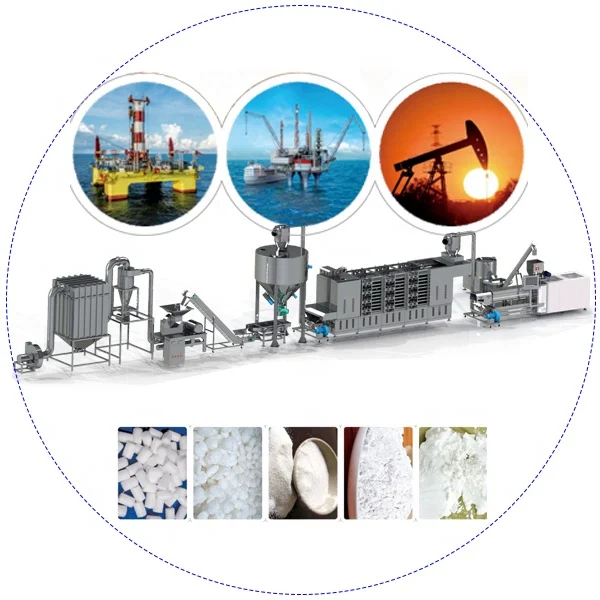
Complete Equipment Range — Every station from raw starch mixing through twin-screw extrusion to mesh-belt drying is sized as one system, preventing the bottleneck that forms when downstream equipment cannot match extruder discharge rates.
Technical Specifications
| Parameter | Value |
|---|---|
| Product Type | Modified Starch Twin-Screw Extrusion Line |
| Model Options | MT65 / MT70 / MT85 |
| Installed Power (MT65 / MT70 / MT85) | 72 kW / 92 kW / 108 kW |
| Power Consumption (MT65 / MT70 / MT85) | 50 kW / 65 kW / 75 kW |
| Output Capacity (MT65) | 140–160 kg/h (basis not stated in source — confirm raw material / moisture content) |
| Output Capacity (MT70) | 240–260 kg/h (basis not stated in source — confirm raw material / moisture content) |
| Output Capacity (MT85) | 500–600 kg/h (basis not stated in source — confirm raw material / moisture content) |
| Overall Dimensions (MT65 / MT70 / MT85) | 2200×1000×2300 mm / 2600×1000×2300 mm / 4500×1000×2600 mm |
| Screw Type | Co-rotating twin-screw with sectional modules |
| Line Stations | Feeding, extruding, cutting, heating, conveying, cooling |
| Mixer Contact Parts | Stainless steel, handle-opened discharge, safety interlock |
| Dryer Type | Mesh-belt with variable belt speed and temperature control |
| Certifications | CE, ISO |
Application Suitability
| Application | Material or Output |
|---|---|
| Textile sizing and warp preparation | Modified corn starch and cassava starch with controlled viscosity profiles |
| Paper coating and surface sizing | Pre-gelatinized starch from tapioca and corn sources |
| Building material additives | Modified starch for gypsum board adhesion and mortar rheology |
| Instant food and bakery ingredients | Pre-gelatinized starch requiring specific swelling and water-binding capacity |
| Oil drilling fluid additives | Modified starch engineered for fluid loss control |
| Foundry and casting binders | Denatured starch with tailored thermal breakdown characteristics |
What "500 kg/h on Modified Starch" Actually Requires From Your Line
A published extruder capacity figure is only meaningful when the mixer, dryer, and cooling conveyor are sized to handle the same mass flow without interruption.
Starch processing places unusual demands on downstream equipment. Pre-gelatinized starch exiting a twin-screw extruder carries significant residual moisture and thermal energy. If the mesh-belt dryer is shorter than the extrusion rate demands, partially dried material reaches the cooling conveyor still tacky, leading to clumping and line stoppages. I configured a line for a Southeast Asian client where the dryer was specified to match the extruder’s nominal capacity on paper, but the client’s cassava formulation held more moisture than assumed. The starch started caking on the transfer belts within hours of commissioning, and an entire production batch was scrapped before we adjusted the drying profile [NEED_CITE: moisture content variability in tropical starch feedstocks]. A modified starch processing line manufacturer must verify throughput matching at every station using the buyer’s actual raw material, not generic benchmarks.
How Sectional Screw Modules Shape Starch Modification
The co-rotating twin-screw design on the MT65, MT70, and MT85 uses sectional modules that can be rearranged along the barrel. Forward-transport elements move starch through the barrel, while reverse elements and kneading blocks create localized shear zones where gelatinisation and denaturation occur. This modular approach lets the process engineer adjust residence time distribution and shear intensity without replacing the entire screw assembly, which matters when switching between corn starch and cassava starch on the same modified starch processing line.
Barrel Zoning and the Gelatinisation Window
Each barrel section can be heated or cooled independently, giving operators control over the temperature profile from feed zone to die face. Starch gelatinisation occurs within a narrow temperature band that shifts depending on the botanical source and moisture level [NEED_CITE: gelatinisation temperature ranges for corn versus tapioca starch]. If the barrel profile is too aggressive, the starch degrades before reaching the die, producing a modified starch with lower-than-specified viscosity. Too mild, and incomplete gelatinisation leaves uncooked granules in the output, which downstream users discover as grit or inconsistent thickening behavior.
Interpreting the Power and Capacity Relationship
The MT65 draws 50 kW running power at a rated 140–160 kg/h capacity basis to be confirmed, while the MT85 draws 75 kW at 500–600 kg/h under the same unconfirmed basis. The non-linear relationship between power draw and output indicates that the larger model operates with different screw geometry and barrel volume rather than simply running a smaller unit harder. The stainless steel flour mixer with its safety-interlocked discharge gate feeds the extruder at a controlled rate, and the mesh-belt dryer’s variable speed allows belt residence time to be extended or shortened to match whatever throughput the extruder is set to deliver. Selecting the right model tier depends on whether the buyer’s target daily volume and shift pattern justify the installed power and floor space of the MT85 versus running an MT70 on extended shifts.
The Cost of Skipping Dryer-to-Extruder Matching
When the dryer capacity is undersized relative to the extruder output, the consequences extend beyond slower line speeds. Partially dried modified starch absorbs ambient moisture during cooling, particularly in humid production environments, causing the final product to fall outside the specified moisture content [NEED_CITE: hygroscopic behavior of pre-gelatinized starch in high-humidity conditions]. Buyers then face rejected shipments from end users who test incoming starch against agreed viscosity and moisture specifications. The problem often surfaces weeks after installation, once seasonal humidity shifts, making it difficult to trace back to the original line configuration decision.
Why Sourcing the Full Range From One Supplier Matters
Every station in the modified starch processing line — from the flour mixer through the twin-screw extruder, mesh-belt dryer, and cooling conveyor — is specified together rather than assembled from separate vendors. Screw configuration and die design are matched to the buyer’s specific starch source and target modification type before production begins. The in-house testing workshop runs trial batches on the buyer’s actual raw material, generating a test report before the equipment ships. Pre-sales engineering covers line layout and capacity calculation, and post-installation support extends through commissioning, operator training, and ongoing wear part supply. Voltage, frequency, and control system language are confirmed during the specification phase, preventing the delays that occur when electrical standards are assumed rather than verified [NEED_CITE: electrical voltage and frequency standards across export markets].
Documentation & Verification
- Line layout drawing showing throughput matching across mixer, extruder, dryer, and cooling stations
- Screw and die configuration record specific to your starch source and modification target
- Trial run report generated on your raw material in the testing workshop before shipment
- Electrical schematic with confirmed voltage, frequency, and control language for your facility
- CE declaration of conformity and ISO certificate for import and compliance requirements
- Wear parts list identifying screw segments, dies, and mixer seals with replacement intervals
Installation, Commissioning & Support
- Foundation and floor space planning based on MT65, MT70, or MT85 overall dimensions and utility routing
- Dedicated electrical circuit sized to the selected model’s installed power rating up to 108 kW
- Modular barrel and screw assembly allows on-site configuration adjustment during commissioning
- First-run parameter setting covering barrel temperature profile, screw speed, and dryer belt speed
- Operator training on screw module rearrangement for different starch sources and modification targets
- Scheduled wear part supply for screw segments and dies to maintain extrusion consistency over time
What to Include With Your Inquiry
To configure a modified starch processing line that matches your production requirements, provide the starch source you plan to process, the specific modification or pre-gelatinisation outcome your end users require, and your target hourly or daily output. Include your facility’s available voltage and frequency, the control system language your operators need, and the floor space and ceiling height in the area designated for the line. If you have existing upstream or downstream equipment that the new line must integrate with, specify the connection points and throughput rates.
Frequently Asked Questions
Q: How is output capacity verified, and what assumptions underlie the published kg/h figures?
A: Published capacity figures for each model are based on reference conditions that must be confirmed against your specific starch source, moisture content, and formulation. Before shipment, a trial run using your raw material is conducted in the testing workshop, producing a verified output report tied to your actual processing parameters.
Q: How is screw configuration matched to a specific starch source?
A: Sectional screw modules are arranged based on the gelatinisation temperature, shear sensitivity, and moisture behavior of your starch source. Corn starch, cassava starch, and tapioca starch each require different kneading block placement and barrel temperature profiles to achieve the target degree of modification.
Q: What downstream equipment is included to prevent bottlenecks at rated throughput?
A: The line includes a stainless steel flour mixer sized to feed the extruder continuously, a mesh-belt dryer with variable speed and temperature control matched to the extruder’s discharge rate, and a cooling conveyor designed for the moisture and thermal load of the specific starch being processed.
Q: Which electrical and control options are confirmed before production begins?
A: Voltage, frequency, and control system language are specified during the quotation phase and confirmed in the electrical schematic before manufacturing starts. This prevents commissioning delays that occur when a machine arrives configured for a different market’s electrical standard.
Q: What wear parts should be stocked from the first production run?
A: The wear parts list provided with documentation identifies screw segments, die plates, and mixer seals along with expected replacement intervals. Lead times for first replacement orders are confirmed at the time of line delivery so that production continuity is maintained.