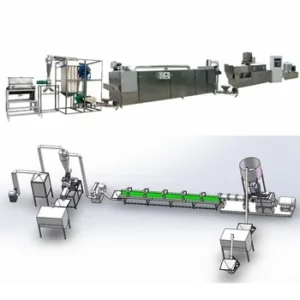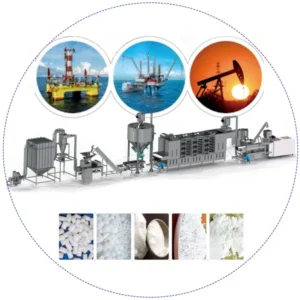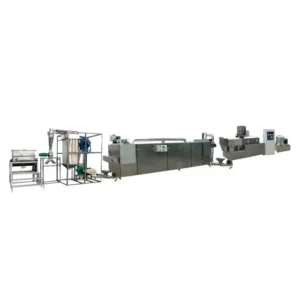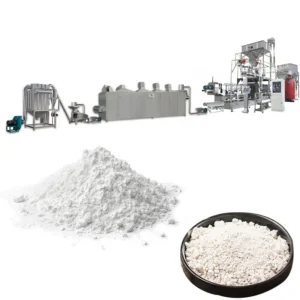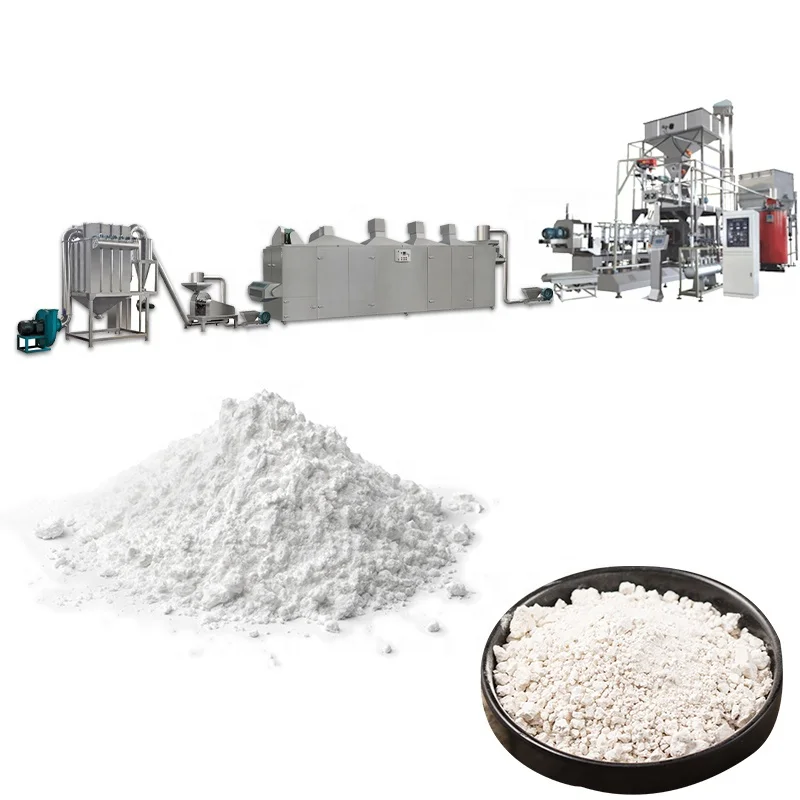
Throughput-Matched Line Design — every station from batching to grinding is specified to hold the same output on your actual starch raw material, preventing bottlenecks between extruder discharge and dryer intake.
Technical Specifications
| Parameter | Value |
|---|---|
| Product Type | Modified Starch Processing Line |
| Extruder Configuration | Twin screw |
| Raw Materials | Wheat flour, corn starch, potato starch |
| Output Capacity | 80–500 kg/h (basis not stated in source — confirm raw material type, moisture content, and target modification degree) |
| Voltage & Frequency | Three phase 380V/50Hz; single phase 220V/50Hz; customizable to local supply |
| Control System | PLC with inverter drive (Delta or Delixi — verify against current catalog) |
| Motor | Siemens (China) or equivalent China top brand (verify against current catalog) |
| Frame Material | Stainless steel 201 |
| Contact Parts Material | Food grade stainless steel 304 |
| Energy Source | Electricity, gas, diesel, or steam |
| Mixer Motor | 4.0 kW |
| Mixer Output | 3.0–4.0 kg per batch (verify against current catalog) |
| Screw Conveyor Motor | 1.1 kW |
| Screw Conveyor Output | Up to 150 kg/h (verify against current catalog) |
| Line Sequence | Mixer → Screw Conveyor → Twin Screw Extruder → Shifter → Air Conveyor → Dryer → Air Conveyor → Conditioning → Conveyor → Grinder |
| Certification | CE |
| Warranty | One year |
Application Suitability
| Application | Material or Output |
|---|---|
| Pregelatinized starch for oilfield drilling fluids | Corn starch or potato starch processed to API-standard viscosity and gel strength |
| Modified starch for bakery, sauce, and confectionery | Wheat flour or corn starch with controlled gelatinisation and functional modification |
| Industrial starch for paper coating and corrugating adhesives | Wheat flour or corn starch modified for adhesion and film-forming properties |
Why Nominal Capacity Rarely Matches Your Actual Output
The rated capacity of a modified starch processing line equipment manufacturer is only meaningful against a defined raw material, moisture level, and target modification.
I have watched lines arrive at overseas sites with output figures pulled from a generic corn starch trial, only for the buyer to load cassava or potato starch into the hopper and find the gelatinisation temperature window is entirely different. The extruder runs, but the product falls outside specification. The dryer cannot keep pace because the moisture profile has shifted, and the grinder chokes on material that was never tested at that degree of modification. Weeks of commissioning disappear into parameter adjustments that should have been resolved before the crate was sealed [NEED_CITE: starch gelatinisation temperature variance across corn, wheat, potato, and cassava sources].
Screw Geometry Dictates What Your Starch Becomes
The twin-screw extruder sits at the centre of this modified starch processing line. Barrel segment arrangement, screw element pitch, and die land length together determine shear intensity, residence time, and the degree of starch granule disruption. A configuration designed for wheat flour at moderate moisture will under-process potato starch, leaving ungelatinised cores that fail viscosity tests downstream. Each screw build is documented against your specific raw material and target modification type — pregelatinised, oxidised, or cross-linked — so the mechanical setup matches the chemistry you need.
Dryer and Grinder Capacity Must Track Extruder Output
A frequent failure point in starch lines is the mismatch between extruder discharge rate and the thermal capacity of the dryer. When the extruder pushes material faster than the dryer can reduce moisture to target levels, the downstream grinder receives product that is still too tacky, causing screen blinding and unplanned stops. Every station in this line is throughput-calculated as a single system. The air conveyor diameter, dryer belt length, and grinder screen area are all specified to handle the same mass flow the extruder delivers, so material moves continuously without queuing at any transfer point [NEED_CITE: thermal load calculation methods for continuous starch drying].
Reading the Specification Sheet for What It Actually Means
The 4.0 kW mixer motor and the 1.1 kW screw conveyor motor define how much material enters the extruder per hour and how consistently it arrives. If the mixer batch size and cycle time do not align with extruder feed rate, the screw will starve or surge, causing density variation in the final powder. Food-grade stainless steel 304 on all contact parts prevents iron contamination that would discolour light starches and catalyse oxidative degradation during storage. The PLC inverter control allows barrel zone temperatures to be set and held independently, which is critical because pregelatinised starch for drilling fluid requires a tighter temperature band than modified starch intended for paper adhesives. Selecting electricity, gas, diesel, or steam as the energy source changes both the heater specification and the utility infrastructure the buyer must prepare before the line arrives.
What Happens When Configuration Is Copied Instead of Specified
Lines built on generic screw and die settings produce starch that passes a quick visual check but fails functional testing. Pregelatinised starch for API drilling fluid must meet specific gel strength and fluid loss numbers; a screw configuration pulled from a snack food build will not generate the shear profile needed to reach those targets. The buyer discovers the gap only after installation, when laboratory results come back out of range and the supplier is no longer on-site to adjust the barrel profile [NEED_CITE: API specification requirements for pregelatinized starch in drilling fluids].
What This Supplier Does Differently
Screw configuration and die design are matched to the buyer’s raw material and target modification, not pulled from a standard catalogue build. The in-house testing workshop runs your actual starch — the same bags you will load on your factory floor — before the line ships, generating a trial report that documents temperatures, screw speed, moisture addition, and product test results. Every station from mixer to grinder is specified under one supplier, so throughput calculations are coherent across the entire sequence. Pre-sales engineering covers line layout, utility planning, and electrical schematic confirmation for the destination voltage and frequency. On-site installation, commissioning, and operator training are included, and wear parts such as screw elements and die plates are documented in the delivery package so replacements can be ordered before the first set reaches end of life.
Documentation & Verification
- Line layout and capacity calculation showing throughput matching between every station
- Screw and die configuration record matched to your starch type and target modification
- Trial run report on your actual raw material from the in-house testing workshop
- Electrical schematic with voltage, frequency, and control language confirmed for destination
- Factory test record documenting output and product parameters before crating
- Operation and maintenance manual with wear parts list and replacement intervals
Installation, Commissioning & Support
- Foundation must accommodate the full line sequence from mixer through grinder with level floor tolerance
- Three-phase 380V/50Hz supply with dedicated circuit rated for the combined extruder and dryer load
- Stations ship in modular assemblies requiring on-site alignment of conveyors between extruder discharge and dryer infeed
- First-run commissioning includes barrel temperature profiling and screw speed calibration on your raw material
- Operator training covers PLC interface navigation, die changeover, and emergency stop sequence
- Wear parts package includes spare screw elements, die plates, and barrel segments for the initial operating period
Request a Line Proposal
To receive a configuration that matches your production target, share your starch raw material type and source, the target modification or functional property you need, your daily output requirement, and the voltage and frequency at your facility. If you can send a sample of your raw material, a trial run in the testing workshop will confirm capacity and product parameters before the quotation is finalised.
Frequently Asked Questions
Q: How is output capacity verified on my specific starch raw material and moisture level?
A: A trial run is conducted in the testing workshop using your actual raw material at the moisture content you specify. Extruder screw speed, barrel temperatures, and feed rate are recorded, and the resulting product is tested for gelatinisation degree and functional properties. The trial report accompanies the shipment so commissioning starts from proven parameters.
Q: How is the screw configuration chosen for my target starch modification?
A: Screw element arrangement, pitch, and die land length are selected based on the shear and residence time your target modification requires. Pregelaminized starch for drilling fluid needs a different thermal and mechanical profile than modified starch for paper adhesives, and each configuration is documented in the build record.
Q: How is voltage, frequency, and control language confirmed before production?
A: The electrical schematic is prepared after the buyer confirms local supply specifications and preferred control language. The PLC program and inverter settings are loaded and tested at the factory so the control interface matches the operator’s language on arrival [NEED_CITE: voltage and frequency standards by export market].
Q: What spare wear parts are included and how are replacements sourced?
A: The initial package includes screw elements, die plates, and barrel segments sized to your configuration. A wear parts list with part numbers is provided so replacements can be ordered directly. The supplier maintains stock of standard elements and can machine application-specific dies within typical multi-week lead times.
Q: Can I run a trial on my own raw material before the line ships?
A: Yes. Send a representative sample of your starch to the testing workshop. The trial covers the full extrusion sequence from mixing through drying and grinding, and the resulting report documents every process parameter so your team can review product quality before authorising shipment.