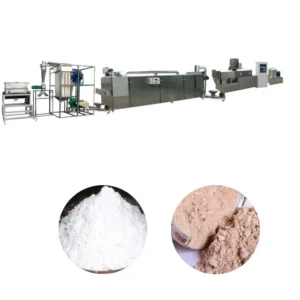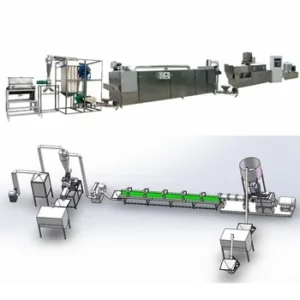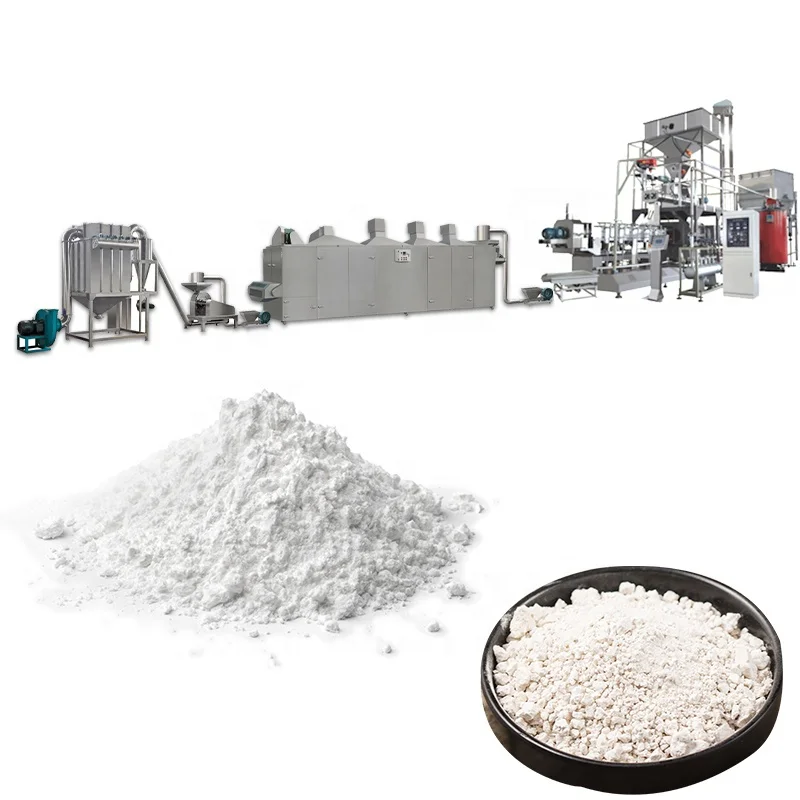
Turnkey Line Matched — Every station from batching to packing is configured as one integrated system, so throughput holds steady on your specific starch formulation rather than drifting between mismatched vendors.
Technical Specifications
| Parameter | Value |
|---|---|
| Product Type | Modified Starch Production Line |
| Model | MT65 / MT70 / MT85 |
| Screw Type | Co-rotating twin-screw with sectional modules |
| Output Capacity | MT65: 140–160 kg/h (basis not stated in source); MT70: 240–260 kg/h (basis not stated in source); MT85: 500–600 kg/h (basis not stated in source) |
| Installed Power | MT65: 72 kW; MT70: 92 kW; MT85: 108 kW |
| Power Consumption | MT65: 50 kW; MT70: 65 kW; MT85: 75 kW |
| Overall Dimensions | MT65: 2200×1000×2300 mm; MT70: 2600×1000×2300 mm; MT85: 4500×1000×2600 mm |
| Line Stations | Mixing → Extrusion → Drying → Grinding → Blending → Packing |
| Material Contact Parts | Stainless steel |
| Liquid Injection | Capable of steam or water injection |
| Assembly State | Complete production line, turnkey configuration available |
| Certification | CE |
| Warranty | 24 months, lifetime service |
Application Suitability
| Application | Material or Output |
|---|---|
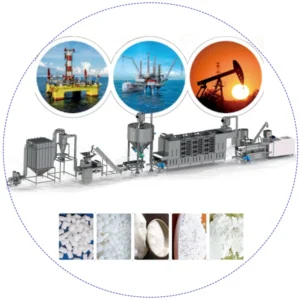
| Industrial drilling mud additive | Pregelatinized starch from corn flour, 60–80 mesh |
| Wallpaper adhesive production | Modified starch from rice flour and corn starch blends |
| Paper and textile sizing | Denatured starch for surface coating and warp sizing |
| Food-grade thickener and binder | Modified starch for bakery, dairy, and frozen food formulations |
| Construction material additive | Pregelatinized starch for dry-mix mortar and gypsum board |
| Pharmaceutical excipient | Pre-gelatinised starch as disintegrant or binder |
What "500 kg/h on Paper" Actually Means for Your Starch
Nominal capacity figures hide the variable that matters most: your raw material.
Over years of commissioning modified starch lines across different regions, I have watched extruders hit their rated throughput on standard cassava starch, then lose a third of their expansion rate the moment the customer switches to locally sourced high-amylose corn. Barrel temperature profiles, screw speed, and die geometry all need recalibration, and the commissioning window stretches by weeks instead of days. The modified starch production line equipment you evaluate on a brochure spec sheet will behave differently once it meets your actual flour mesh, moisture content, and amylose ratio. Selecting screw modules and die configurations around your specific feedstock — before the machine ships — is the difference between a line that runs on day one and one that demands a second round of engineering on the factory floor [NEED_CITE: raw material variability in starch extrusion processes].
How Co-Rotating Twin-Screw Modules Shape Starch Gelatinisation
The co-rotating twin-screw extruder at the heart of this modified starch production line equipment uses sectional screw modules that can be rearranged to control transport, mixing, liquid injection, cooking, and forming in a single continuous pass. Each module handles a distinct stage of starch modification: conveying elements move the flour forward, kneading blocks generate the shear needed for gelatinisation, and reverse-flight sections create the residence time required for thorough molecular restructuring. This modularity means the screw profile is not fixed at the factory — it is specified to the gelatinisation temperature and shear sensitivity of your particular starch source.
Matching Dryer and Grinder Capacity to Extruder Output
A frequent failure point in starch processing is an extruder that produces at full rate while the downstream dryer bottlenecks the entire line. The drying station on this modified starch production line equipment is sized to handle the moisture load exiting the extruder barrel, and the grinding station is rated to reduce the dried extrudate to the target mesh for final blending. When every station is sourced from one supplier with throughput calculations done across the full chain, the line maintains a steady material flow rather than accumulating work-in-progress between machines [NEED_CITE: throughput balancing in continuous food processing lines].
Reading the Specs That Actually Matter
Installed power ratings of 72 kW, 92 kW, and 108 kW across the three capacity tiers indicate the total motor and heating load available at the extruder, which directly determines how much mechanical and thermal energy can be delivered to the starch mass per unit of time. Power consumption figures — typically lower than installed power — reflect the draw under standard operating conditions and inform the transformer and cabling specification at your facility. The stainless steel contact surfaces across the mixer, extruder barrel, and dryer prevent iron contamination that would discolour light-coloured starch products and compromise food-grade or pharmaceutical-grade certifications. Liquid injection capability for steam or water allows in-barrel moisture adjustment, which is critical when your raw starch arrives at a moisture level different from the design basis.
The Cost of Skipping a Pre-Shipment Trial Run
Lines that arrive without a documented trial run on your actual raw material force all process development into the commissioning phase. Screw configurations copied from a generic build may produce pregelatinized starch with the wrong viscosity or cold-water solubility, requiring physical rework of the screw stack while the line sits idle. Die geometry that does not match your target expansion ratio can yield a dense extrudate that overloads the grinder and produces off-spec particle size distribution. These are not theoretical risks — they are the most common reasons starch extrusion projects overrun their startup schedules [NEED_CITE: commissioning delays in extrusion-based processing plants].
Why Source the Full Line From One Supplier
Throughput matching across mixing, extrusion, drying, grinding, blending, and packing is calculated as one system rather than assembled from independent quotes, which eliminates the capacity gaps that appear when stations are procured separately. Screw configuration and die design are specified to your raw material and target starch property, documented before production begins rather than guessed at during installation. An in-house testing workshop allows trial runs on your supplied flour or starch before the equipment ships, generating a report that confirms capacity and product properties on your actual feedstock. Electrical schematics include voltage and frequency confirmation for your destination country, preventing the wiring delays that stall commissioning. Wear parts lists with screw elements, dies, and seals are provided with the first shipment so that the initial replacement cycle does not become an unplanned downtime event.
Documentation & Verification
- Line layout and capacity calculation showing matched throughput across every station for your starch type
- Screw and die configuration record specified to your raw material mesh and target gelatinisation degree
- Electrical schematic with voltage and frequency confirmation matching your facility supply
- Trial run report on your supplied starch confirming output and viscosity before dispatch
- CE declaration of conformity covering the complete line assembly
- Operation and maintenance manual with wear parts replacement schedule
Installation, Commissioning & Support
- Foundation plan based on MT65, MT70, or MT85 footprint and dynamic load from the twin-screw extruder
- Dedicated circuit sizing per the installed power rating — 72 kW, 92 kW, or 108 kW depending on model
- Sectional screw modules shipped labelled and sequenced for correct barrel reassembly on site
- First-run parameter setting including barrel zone temperatures and screw speed for your starch formulation
- Operator training covering screw module swaps and die changes for product changeover
- Wear parts inventory of screws, dies, and seals covering the initial production cycle
Preparing Your Inquiry
To move from a general enquiry to a firm line configuration, share the starch source you intend to process — corn, rice, cassava, or a blend — along with the mesh size and typical moisture content at intake. Specify the target product property such as cold-water viscosity, degree of pregelatinisation, or particle size after grinding. Include your facility voltage and frequency, available floor space and ceiling height, and whether you can send a batch of raw material for a pre-shipment trial run.
Frequently Asked Questions
Q: How is the output capacity of the modified starch production line equipment verified before purchase?
A: Capacity figures are based on specific raw material and moisture conditions. Before production, a trial run is conducted using your supplied starch in the testing workshop, and a report documents the actual throughput, product viscosity, and gelatinisation degree achieved. This ensures the quoted output reflects your feedstock rather than a generic benchmark.
Q: What electrical and control details are confirmed before manufacturing begins?
A: Voltage, frequency, and control panel language are confirmed and recorded in the electrical schematic before the line enters production. This prevents mismatches between the machine wiring and your facility power supply, which is a common cause of delayed commissioning on international projects.
Q: How are screw modules and die geometry selected for a specific starch product?
A: The screw configuration is assembled from sectional modules — conveying, kneading, and reverse-flight elements — arranged to deliver the shear, residence time, and temperature profile your starch requires. Die geometry is matched to the target expansion ratio. Both are documented in a configuration record tied to your raw material specification.
Q: Can a trial run be performed on my raw material before the line ships?
A: Yes. Send a representative batch of your starch or flour to the testing workshop, and the line runs a full production cycle — extrusion, drying, and grinding — on your material. The trial report covers throughput, moisture loss, particle size, and viscosity so you can verify product properties before accepting delivery.
Q: What spare wear parts are included, and how is the first replacement planned?
A: Each shipment includes a wear parts list specifying screw elements, dies, and seals with recommended replacement intervals based on your production volume. The initial set covers the first replacement cycle so that maintenance can be scheduled proactively rather than reacting to unexpected wear failures.