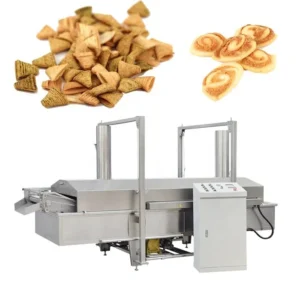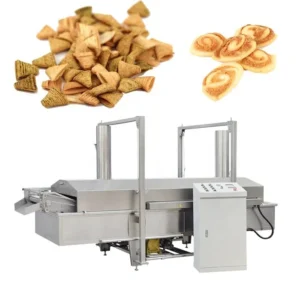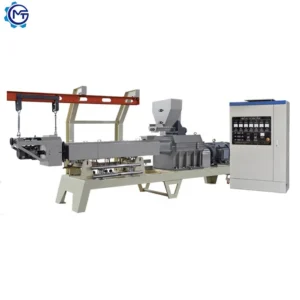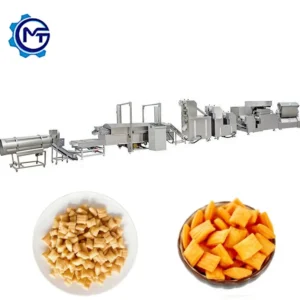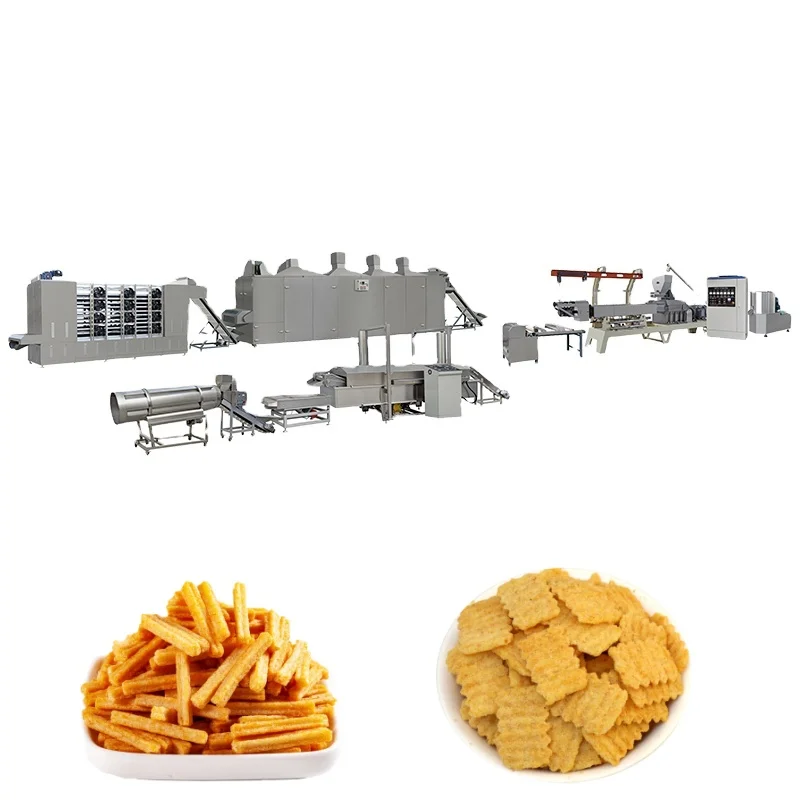
Matched Throughput Across Every Station — each unit from the mixer to the fryer is sized against your raw material and target chip density, so the extruder output never waits on the dryer or overloads the frying belt.
Technical Specifications
| Parameter | Value |
|---|---|
| Model | MT-65 / MT-70 / MT-85 / MT-75 / MT-95 |
| Product Type | Fried Pellet Chips Extrusion Production Line |
| Screw Type | Co-rotating twin screw with sectional modules |
| Main Motor Power | 100 kW (MT-65) / 130 kW (MT-70) / 180 kW (MT-85) / 185 kW (MT-75) / 280 kW (MT-95) |
| Output Capacity (MT-65) | 120–150 kg/h (basis not stated in source — confirm raw material, moisture, and product shape) |
| Output Capacity (MT-70) | 200–250 kg/h (basis not stated in source) |
| Output Capacity (MT-85) | 300–500 kg/h (basis not stated in source) |
| Output Capacity (MT-75) | 400–500 kg/h (basis not stated in source) |
| Output Capacity (MT-95) | 800–1000 kg/h (basis not stated in source) |
| Mixer Power Options | 4 kW / 7.5 kW / 15 kW |
| Cutting Machine Power | 1.47 kW |
| Cutting Machine Dimensions | 2500 × 600 × 1100 mm |
| Fryer Belt Width | 600 mm stainless steel mesh |
| Fryer Energy Options | Electricity / Fuel Gas |
| Dryer Heating Method | Gas / Electric / Diesel |
| Voltage & Frequency | Customizable (e.g., 3ph 380V 50Hz, 3ph 415V 60Hz, 3ph 220V 60Hz) |
| Overall Dimensions (MT-65) | 22000 × 1200 × 2200 mm |
| Overall Dimensions (MT-70) | 24000 × 1500 × 2200 mm |
| Die Configuration | Interchangeable dies/rollers for sticks, square, rib, diamond, wavy, pillow, bugles, shell, screw, round tube, wave |
| Certification | CE |
| Warranty | 1 year |
Application Suitability
| Application | Material or Output |
|---|---|
| Fried bugles and corn chip snacks | Corn flour, corn starch blends |
| Tortilla-style and wavy fried chips | Wheat flour, corn flour, potato starch |
| Pillow and shell-shaped pellet chips | Potato powder, rice flour, mixed starch bases |
| Diamond and rib-cut extruded crisps | Corn and wheat flour with modified starch additives |
| Contract production for private-label brands | Quick die changeover across multiple chip geometries on a single line |
What a Nameplate Capacity Rating Actually Means for Fried Pellet Chips
Capacity numbers on a spec sheet assume a specific raw material blend, moisture level, and chip geometry — none of which match your recipe by default.
I once watched a fried pellet chips line get signed off on a rated throughput figure, only for the buyer’s coarser corn flour to cause uneven feed into the extruder. The output surged and stalled in waves, and after frying the chip weight per bag drifted outside tolerance. The line was technically capable, but the screw configuration had never been matched to that particular grind size. When you evaluate a fried pellet chips production line equipment for sale, the capacity row in a table is a starting point for a conversation, not a guarantee. The real question is whether the supplier will run your exact flour blend through the extruder before the machine ships [NEED_CITE: twin-screw extrusion behavior on varying starch particle size distributions].
Every Station Sized to the Same Real-World Throughput
A fried pellet chips line is only as fast as its slowest station. The twin-screw extruder pushes gelatinised dough through the die, but if the downstream dryer cannot remove enough moisture before the fryer, the belt slows down and the extruder must idle. This lineup covers mixing, extrusion, cutting, drying, frying, and de-oiling as a matched set. Each model from the MT-65 through the MT-95 is configured so the dryer residence time and fryer belt speed align with the extruder’s actual output on your material.
Interchangeable Dies That Actually Change Over in a Shift
The cutting and shaping station uses interchangeable dies and rollers rather than a fixed geometry. You can run bugles on a morning shift, then swap to wavy or diamond chips after lunch without pulling the extruder barrel apart. The die and roller sets cover shapes from pillow and shell to screw and round tube, giving a single fried pellet chips production line equipment for sale the flexibility to serve multiple private-label contracts. The changeover involves releasing the die plate, sliding in the new roller or die insert, and re-aligning the cutter — a process measured in minutes rather than hours [NEED_CITE: die changeover procedures on twin-screw extruded snack lines].
Reading the Specs That Matter for Fried Chip Texture
The co-rotating twin-screw design with sectional modules lets you adjust the screw profile to control shear, residence time, and degree of starch gelatinisation. A higher-shear configuration works for dense corn-based pellet dough, while a gentler profile suits potato starch blends that scorch easily. Main motor power ranges from 100 kW on the MT-65 to 280 kW on the MT-95, which directly correlates to the torque available for pushing viscous dough through restrictive die geometries. The fryer’s 600 mm stainless steel belt and adjustable speed let you set oil contact time precisely — critical when switching between thin wavy chips that fry in seconds and thicker pillow shapes that need longer immersion. Dryer heating is available in gas, electric, or diesel, which affects both operating cost and the temperature ramp profile entering the fryer. Voltage and frequency are configurable before production starts, preventing the commissioning delays that happen when a 380V 50Hz machine arrives at a 415V 60Hz facility.
The Hidden Cost of Skipping the Material Trial
Buyers who skip a pre-shipment trial on their own raw material often spend weeks recalibrating after installation. The screw modules may need rearranging, the dryer temperature profile may need adjusting, or the fryer belt speed may need slowing down — all on the factory floor instead of in the supplier’s testing workshop. Commissioning delays, wasted raw material, and missed delivery windows compound quickly. Lines that run perfectly on the supplier’s test flour can behave differently on a buyer’s locally sourced corn or potato starch [NEED_CITE: raw material variability impact on extrusion line commissioning timelines].
Why This Lineup Stands Behind Its Own Ratings
The supplier assembles every station — mixer, extruder, dryer, fryer, seasoning — under one roof, which means throughput matching is done during engineering rather than left to the buyer to reconcile between separate vendors. Screw configuration and die selection are specified against the buyer’s raw material sample, not copied from a generic build. The in-house testing workshop runs your flour blend before shipment, producing a trial run report that documents actual throughput and chip quality. Documentation includes line layout drawings, capacity calculations, electrical schematics, and a wear parts list so you can plan replacements before the first set of screws wears down. The CE-certified build meets export machinery directive requirements.
Documentation & Verification
- Line layout and throughput calculation sheet matched to your raw material blend
- Screw configuration and die selection record specific to your chip geometry
- Trial run report on your flour sample documenting actual output and chip density
- Electrical schematic with voltage, frequency, and control language confirmed before build
- Wear parts list with recommended multi-year spare screw and die quantities
- CE declaration of conformity for export customs clearance
Installation, Commissioning & Support
- Overall line length up to 24 metres requires a clear floor span with levelled foundations
- Main motor up to 280 kW demands a dedicated circuit with correctly rated breakers
- Dryer and fryer stations ship separately and are joined to the extruder frame on site
- First-run parameter setting covers barrel zone temperatures, screw speed, and fryer belt timing
- Operator training includes die changeover, screw module swaps, and fryer oil management
- Free wearing parts ship with the line; additional two to three years of spares recommended
What We Need to Configure Your Line
To specify the right model and screw configuration, share your primary flour type and any starch additives, the target chip shapes you plan to run, and your desired hourly output on that specific recipe. Include your facility voltage and frequency, and whether you need gas, electric, or diesel heating on the dryer. If you have existing upstream mixers or downstream packing equipment, note the connection points so the line layout accounts for them.
Frequently Asked Questions
Q: How is the output capacity of each model verified before purchase?
A: Each model’s capacity rating is based on specific raw material and moisture conditions. We run your actual flour blend through the extruder in our testing workshop and provide a trial report showing real throughput, chip density, and texture. This report becomes the baseline for your line configuration and acceptance criteria.
Q: Can the voltage and control panel be set up for my local electrical grid?
A: Voltage and frequency are confirmed during the specification stage and built into the motor, heater elements, and control panel before production starts. Common configurations include 380V 50Hz, 415V 60Hz, and 220V 60Hz. Control panel labels and PLC interface language are also set to match your operator team.
Q: How many chip shapes can one line produce, and how fast is the changeover?
A: The interchangeable die and roller system supports shapes including bugles, wavy, diamond, pillow, shell, screw, and round tube. Changeover involves releasing the die plate and swapping the insert — typically completed within a single shift change, allowing multiple product formats on one line.
Q: What supporting stations are included, and is packing integrated?
A: The standard lineup covers mixer, twin-screw extruder, cutting station, dryer, fryer, and de-oiling or seasoning. Packing equipment can be added to the line layout upon request. Each station is throughput-matched to the extruder model you select so no single unit creates a bottleneck.
Q: What spare parts should I order along with the line?
A: The line ships with a set of free wearing parts. We recommend ordering two to three years of additional spare screws, dies, and fryer belt sections based on your planned operating hours. A detailed wear parts list is provided with your quotation so you can budget and plan accordingly.