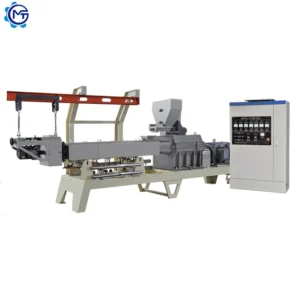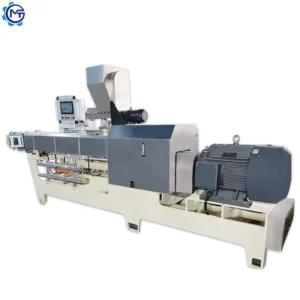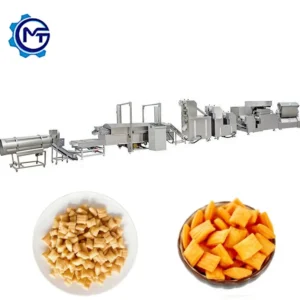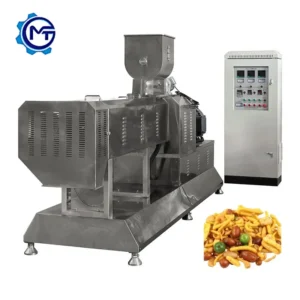
Capacity-Matched Integration — every station from extrusion to packing is configured as one system, so the fryer throughput aligns with upstream and downstream equipment rather than creating bottlenecks.
Technical Specifications
| Parameter | Value |
|---|---|
| Product Type | Automatic Continuous Deep Fryer for Snack Production Lines |
| Applicable Industries | Food & Beverage Factory, Food & Beverage Shops |
| Power Source Options | Electric / Gas / Coal |
| Voltage | 380V / 50Hz (basis to be confirmed per destination) |
| Heating Tube Power | 60 kW (basis not stated in source) |
| Control System | PLC |
| Oil Capacity | 320 L (basis not stated in source) |
| Output Capacity | 100–1000 kg/h (basis not stated in source — confirm product type, moisture, and fry time) |
| Overall Dimensions (L×W×H) | 6700 × 2200 × 1200 mm |
| Net Weight | 2000 kg (basis not stated in source) |
| Construction Material | Food-grade 304 Stainless Steel |
| Conveyor Type | Double-layer mesh belt with frequency conversion stepless speed regulation |
| Oil Filtration | Continuous circulation filtration system |
| Slag Discharge | Bottom-mounted automatic residue discharge |
| Lifting System | Automatic lifting of upper hood and mesh belt for cleaning |
| Drive Power | 2.6 kW (basis not stated in source) |
| Warranty | 1 Year (core components included) |
| Assembly State | Complete unit, shipped in strong plywood case |
Application Suitability
| Application | Material or Output |
|---|---|
| Fried pellet chip production | Extruded 3D or 2D pellets after drying, fried to golden colour and crisp texture |
| Puffed snack finishing | Twin-screw extruded corn, rice, or wheat-based shapes requiring oil frying for surface texture |
| Formed snack frying | Shaped dough or batter products passing through the continuous fryer after a forming station |
| Integrated snack line station | Downstream unit after extruder and dryer, feeding into flavouring drums and packing |
What Throughput Claims Leave Out When the continuous frying machine for snack production line Is Sized Wrong
A fryer rated at a nominal figure rarely delivers that number on the buyer’s actual snack formulation.
I once watched a fried snack line stall in a humid workshop because the fryer ran ahead of the dryer feeding it, and半成品 piled up along the aisle floor until the whole line stopped for rework. The problem was never the fryer itself — it was the mismatch between stations. When a continuous frying machine for snack production line is quoted on a generic capacity without specifying oil temperature, fry time, or moisture content of the incoming product, that number is essentially meaningless on the factory floor [NEED_CITE: factors affecting frying throughput in extruded snack lines]. Buyers need the capacity verified against their specific pellet density, moisture level, and target colour.
Matching Fryer Throughput to the Rest of the Line
The continuous frying machine for snack production line sits between the dryer and the flavouring drum in a typical extruded snack configuration. If the upstream dryer delivers 400 kg/h of semi-dried pellets, the fryer must handle that volume at the required residence time without overcrowding the mesh belt. Overloading causes uneven colour and oil absorption; underloading wastes energy and degrades oil quality faster.
Why Double-Layer Belt Design Matters for Floating Products
Light extruded snacks tend to float in hot oil, which causes uneven frying and inconsistent colour. The double-layer mesh belt holds the product submerged during the entire fry cycle. Frequency-controlled stepless speed regulation lets the operator adjust belt travel to match different snack densities — heavier pellet chips move slower through the oil, while lighter puffed shapes pass through more quickly. This flexibility is critical when a single line produces multiple SKUs [NEED_CITE: mesh belt design considerations for continuous deep frying of buoyant snack products].
Reading the Specifications That Actually Affect Output
The 60 kW heating tube power determines how quickly the oil recovers temperature after cold product enters the fryer. On high-throughput runs, insufficient heating capacity causes the oil temperature to drop, extending fry time and increasing oil absorption. The 320 L oil capacity and continuous circulation filtration system work together: filtered oil maintains a lower acid value, which extends the service life of the edible oil and reduces operating cost over long production shifts. The 2.6 kW drive motor powers the mesh belt and residue discharge mechanism. Food-grade 304 stainless steel construction throughout the contact zones meets food safety expectations in export markets and withstands the corrosive effects of hot oil and salt residues [NEED_CITE: food-grade stainless steel standards for frying equipment].
What Happens When the Fryer Is Undersized for the Line
An undersized fryer forces the operator to reduce the upstream extruder speed, which drops the entire line below its designed capacity. The dryer still runs at full output, and semi-fried product accumulates in the buffer zone. Oil temperature fluctuates as batches are overloaded, producing chips with uneven colour and excessive oil content. Buyers who selected the fryer based on a brochure number rather than a line-level capacity calculation often discover the bottleneck only after commissioning [NEED_CITE: production line bottleneck diagnosis in snack food manufacturing].
Why Sourcing the Full Line from One Supplier Matters
MT configures the continuous frying machine for snack production line alongside the extruder, dryer, flavouring drum, and packing station so throughput is matched at every point rather than assembled from separate vendors. Screw and die design on the upstream extruder is specified to the buyer’s raw material, which determines the moisture and density entering the fryer. The in-house testing workshop runs trial batches on the buyer’s actual formulation before shipment, catching throughput mismatches early. PLC control language and voltage are confirmed during the engineering phase, so the HMI speaks the operator’s language on day one. Wear parts such as mesh belt segments, heating elements, and filtration media are listed and stocked for the first replacement cycle.
Documentation & Verification
- Line layout showing fryer position relative to extruder, dryer, and flavouring stations
- Machinery test report recording oil temperature stability and belt speed during factory trial
- Video outgoing inspection capturing fryer operation under load before crating
- Electrical schematic with confirmed voltage, frequency, and heating method for destination grid
- Wear parts list covering mesh belt sections, heating tubes, and filtration consumables
Installation, Commissioning & Support
- Foundation must support the 2000 kg operating weight plus oil load across the 6700 mm frame length
- Dedicated 380V circuit sized for the 60 kW heating load plus 2.6 kW drive motor
- Unit ships as a complete assembly; upper hood lifts automatically for first-time belt inspection
- Commissioning includes oil temperature profiling and belt speed calibration against product residence time
- Operator training covers PLC interface navigation, filtration system maintenance, and emergency stop procedures
- Spare mesh belt segments and heating elements ship with the initial order to cover the first replacement interval
What to Include in Your Inquiry
Provide the specific snack product type, raw material formulation, and target output per hour so the frying station can be matched to upstream extrusion capacity. Specify your facility voltage, frequency, and preferred heating method — electric, gas, or coal — so the unit is configured correctly before production. Indicate whether the fryer replaces an existing batch unit or integrates into a new line, so the layout accounts for conveyor heights and buffer zones between stations.
Frequently Asked Questions
Q: How is the output capacity verified for a specific snack product?
A: Output depends on oil temperature, fry time, product moisture, and belt speed. The testing workshop runs trial batches on the buyer’s actual raw material to record real throughput, colour consistency, and oil absorption before the line ships.
Q: What voltage and frequency options are confirmed before shipment?
A: The standard configuration is 380V / 50Hz, but voltage and frequency are confirmed during engineering to match the destination grid. The heating elements, drive motor, and PLC power supply are all adjusted accordingly before production.
Q: How does the PLC interface language get specified?
A: The control language is confirmed during the specification phase. The HMI is programmed in the operator’s language so the team can navigate fryer parameters, alarms, and maintenance prompts without translation barriers on the first production day.
Q: How do I match the fryer to my existing extruder and flavouring drum?
A: Provide the extruder’s actual output on your raw material and the flavouring drum’s batch cycle time. The line layout is calculated so the continuous frying machine for snack production line bridges the two stations without creating a buffer overflow or starvation condition.
Q: What spare wear parts should be ordered initially?
A: Mesh belt segments, heating elements, and filtration media are the primary wear items. A recommended first-order spare list is provided with the quotation, sized to cover typical replacement intervals during the first production year.