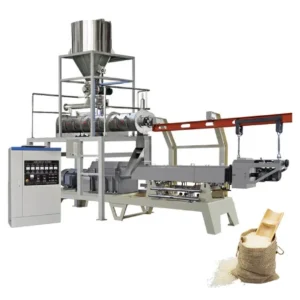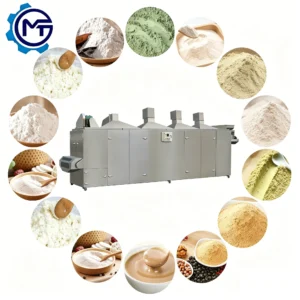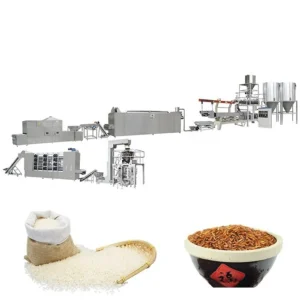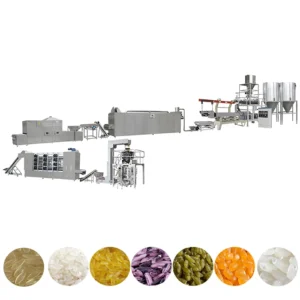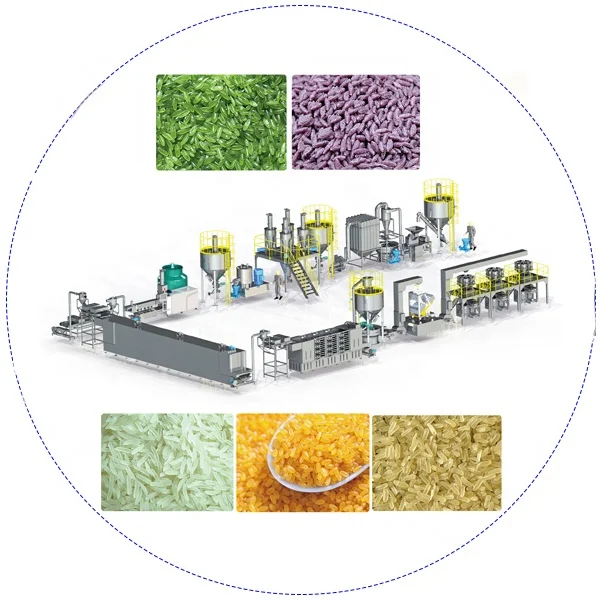
Throughput-matched station design — every mixer, extruder, dryer and roaster in this artificial rice line is sized to the same capacity baseline, preventing upstream starvation or downstream bottlenecking across the full production sequence.
Technical Specifications
| Parameter | Value |
|---|---|
| Model | MT65 |
| Product Type | Fortified Rice Kernel Extrusion Line |
| Installed Power | 85 kW |
| Power Consumption | 60 kW |
| Capacity | 80–100 kg/h (basis not stated in source — confirm raw material and moisture content) |
| Overall Dimensions | 28 × 1.2 × 2.2 m |
| Screw Type | Twin screw |
| Feeding System | Single or double screw feeding system selectable |
| Control System | Frequency speed controlling, high automation |
| Lubrication | Automatic lubricating and cooling |
| Drying Oven Heating Source | Electric or gas |
| Drying Oven Feature | Circulation drying process, frequency motor controls mesh belt speed |
| Basic Material Compatibility | Broken rice, corn, millet, wheat, oats, buckwheat, bean, starch, vitamin, mineral |
| Production Procedure | Mixing → Extruding → Vibrating → Low temperature drying → Cooling → High temperature roasting → Cooling → Packing |
| Final Products | Artificial rice, fortified rice kernels |
| Certification | CE, ISO |
Application Suitability
| Application | Material or Output |
|---|---|
| Fortified rice kernel production | Broken rice blended with vitamins and minerals |
| Artificial rice from coarse grains | Corn, millet, buckwheat, oats with starch binder |
| Nutritional rice for institutional feeding programs | Wheat and bean flour with micronutrient premix |
| Instant rice kernel manufacturing | Pre-gelatinised starch and broken rice blends |
| Multi-grain rice analogues | Mixed grain flours with controlled expansion density |
What "80–100 kg/h" Really Means for a complete equipment range artificial rice making machine
Capacity figures only hold when the raw material, moisture level and screw configuration match the test conditions.
Most buyers see a headline output number and assume it applies to whatever grain blend they plan to run. In practice, a line rated on standard milled rice flour may behave very differently when the feed stock includes buckwheat husk or high-fibre bean powder. I once watched a Southeast Asian customer run a local杂粮 blend through a standard setup — expansion collapsed, kernel density went out of spec, and the whole screw profile had to be reworked before the line could hold any meaningful throughput [NEED_CITE: raw material variability in twin-screw extrusion of composite flours].
Station-by-Station Equipment Breakdown
The complete equipment range artificial rice making machine catalogue covers every station from the batching hopper through to the packing conveyor. The twin-screw extruder sits at the centre, equipped with automatic lubricating and cooling to maintain barrel temperature stability during long production runs. Upstream, the mixing and feeding system is available in single or double screw configurations depending on how cohesive your raw blend is — powders with high vitamin or mineral loading tend to bridge in single-screw feeders.
Drying and Roasting Section Design
After extrusion, kernels pass through a vibrating screen to separate agglomerates before entering the low-temperature drying oven. The circulation drying process uses a frequency motor to control mesh belt speed, letting operators tune residence time to the moisture content of the specific batch. A second high-temperature roasting stage then develops the surface colour and texture that buyers in the retail rice market expect. Heating is configurable between electric and gas sources to match local utility costs [NEED_CITE: energy source selection for industrial drying ovens in food processing].
Reading the Specification Sheet Against Your Raw Material
The installed power of 85 kW and running consumption of 60 kW reflect a line balanced for continuous duty on grain-based formulations. The twin-screw configuration gives a longer residence time and higher shear than a single-screw unit, which matters when you need full gelatinisation of coarse millet or buckwheat starch. Frequency speed controlling across the extruder, dryer belt and cooling conveyor means the entire line can be ramped up or down from one panel — critical when you are dialling in a new formulation. The 28-metre overall footprint assumes a straight-line layout; U-shaped or L-shaped arrangements can reduce the length requirement but need utility drops repositioned accordingly. Automatic lubricating and cooling on the screw shaft reduces unplanned stops during extended shifts, particularly important when running high-mineral premixes that accelerate bearing wear.
The Hidden Cost of Mismatched Station Sizing
An extruder that outpaces its dryer will force operators to throttle screw speed, meaning you are paying for capacity you cannot use. Conversely, an oversized dryer running half-empty wastes thermal energy and can over-dry kernels, leading to cracking during the roasting stage. I have seen lines where the roaster was spec’d for a higher throughput than the extruder could deliver — the result was scorched kernels on the belt edges and inconsistent colour across the batch [NEED_CITE: thermal uniformity in continuous food drying and roasting equipment].
Why Source the Full Line From One Equipment Supplier
Every station is throughput-matched before the line ships, so the mixer output, extruder screw speed, dryer belt width and roaster bed depth are all calculated against the same capacity baseline. Screw configuration and die design are specified to the buyer’s actual grain blend, not copied from a generic build — this matters because artificial rice density and cooking behaviour are directly tied to die geometry. An in-house testing workshop allows trial runs on the customer’s own raw material before dispatch, catching formulation issues early. Frequency speed controlling is integrated across all stations under one control logic, simplifying operator training. Pre-sales engineering covers line layout, utility planning and voltage confirmation so that commissioning is not delayed by electrical mismatches [NEED_CITE: electrical standards and voltage requirements for food processing machinery exports].
Documentation & Verification
- Line layout drawing with capacity calculation for your specific grain blend
- Machine specification sheet for each individual station in the range
- Screw and die configuration record matched to your raw material sample
- Electrical schematic with voltage and frequency confirmed for your market
- Trial run report on customer-supplied raw material before shipment
- CE declaration of conformity and ISO certificate included in the delivery package
Installation, Commissioning & Support
- Foundation plan based on the 28 × 1.2 × 2.2 m overall line dimensions
- Dedicated power circuit sizing for the 85 kW installed load
- Modular station delivery allowing phased assembly in low-clearance workshops
- First-run parameter setting on the twin-screw extruder with your grain formulation
- Operator training covering frequency speed controlling and automatic lubrication checks
- Wear parts list including screws, dies and mesh belts with reorder intervals
What to Include in Your Inquiry
Send the specific grain or starch blend you intend to process, including particle size and moisture content. Confirm your local voltage and frequency so the control panel and heating elements can be matched before production. If you have an existing mixing or packing station you want to integrate, share the throughput and connection dimensions so the line layout can accommodate them.
Frequently Asked Questions
Q: How is throughput matched across the extruder, dryer and roaster stations?
A: Each station is sized against the same capacity baseline during the line configuration stage. The extruder screw speed, dryer mesh belt width and roaster bed area are all calculated so that material flows continuously without accumulation or starvation between stages.
Q: What utility connections are needed for each piece of equipment?
A: The full line draws up to 85 kW installed power, with individual stations on separate circuits. Gas-heated dryers require a confirmed supply pressure. Cooling water is needed for the automatic lubrication system on the twin-screw extruder barrel.
Q: How do I choose between single and double screw feeding?
A: Cohesive blends with high vitamin or mineral loading tend to bridge in single-screw feeders, making the double screw option more reliable. Free-flowing grain flours generally feed well with the single screw arrangement, which is simpler to maintain.
Q: Can individual machines be adapted to local voltage and factory layout?
A: Motors, heating elements and control panels are configured to the buyer’s confirmed voltage and frequency. The straight-line footprint of 28 metres can be rearranged into U or L shapes when workshop length is limited, subject to utility drop repositioning.
Q: What spare wear parts should I stock from the first order?
A: Screws and dies are the primary wear items on the extruder, and mesh belts on the drying oven experience gradual abrasion. A recommended spare parts list with expected replacement intervals is provided with every shipment.