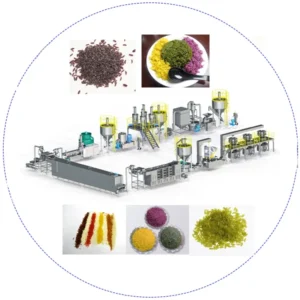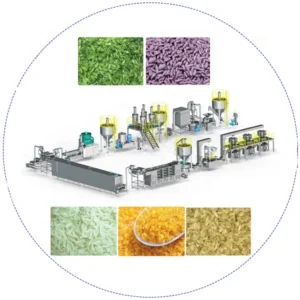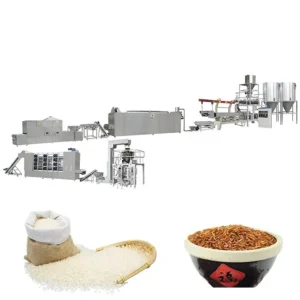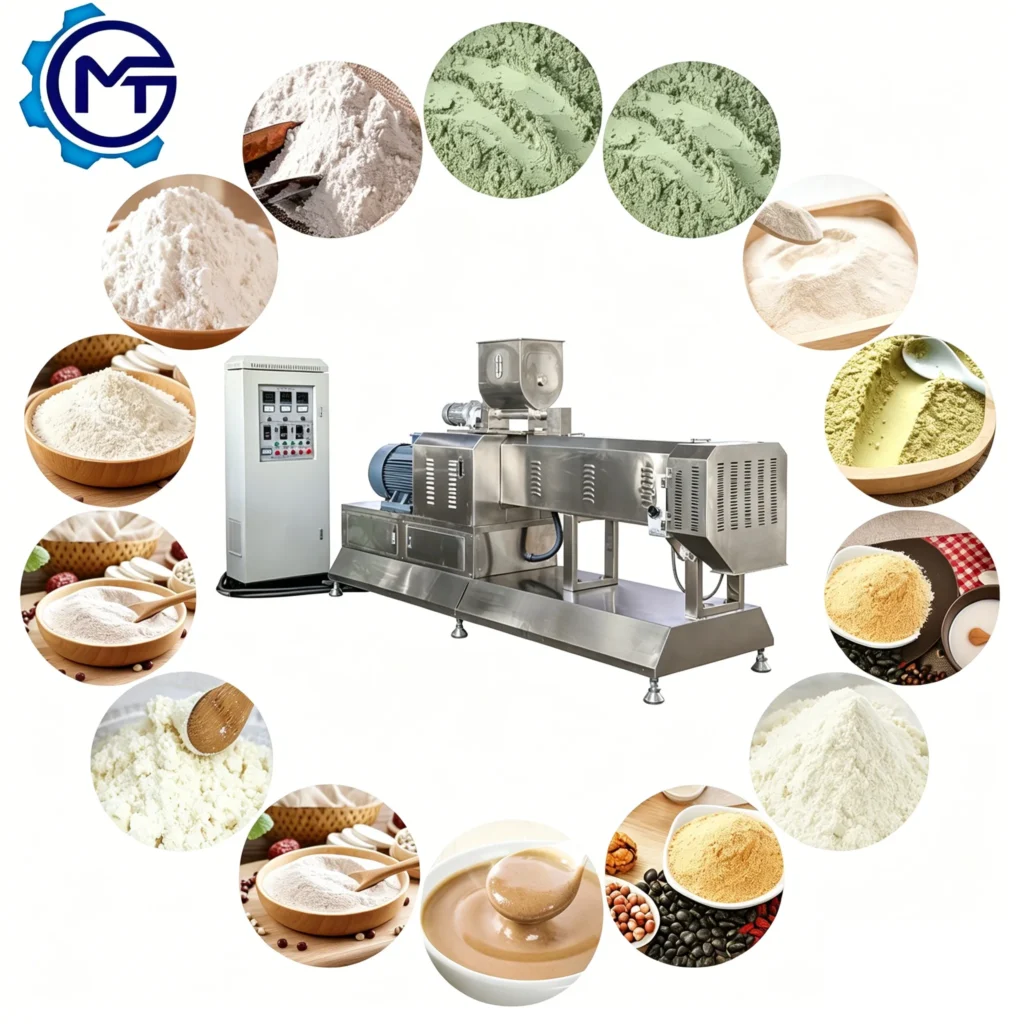
Single-Source Throughput Matching — Every station on this nutritional powder processing line, from the batching mixer through the twin-screw extruder to the pulse grinder, is built and balanced under one roof so that no single machine bottlenecks the next.
Technical Specifications
| Parameter | Value |
|---|---|
| Product Type | Nutritional Powder Processing Line |
| Line Variants | MT65 / MT70 / MT75 / MT85 |
| Installed Power | 84 kW (MT65) / 160 kW (MT70) / 190 kW (MT75) / 210 kW (MT85) |
| Power Consumption | 59 kW (MT65) / 120 kW (MT70) / 140 kW (MT75) / 150 kW (MT85) |
| Output Capacity | 120–150 kg/h (MT65) / 150–200 kg/h (MT70) / 200–250 kg/h (MT75) / 300–400 kg/h (MT85) (basis to be confirmed with raw material formulation, moisture content, and target particle size) |
| Overall Dimensions (L×W×H) | 20,000×1,500×2,200 mm (MT65) to 25,000×1,500×3,500 mm (MT85) |
| Voltage & Frequency | 380 V, 50 Hz, three-phase (full-line confirmation required per buyer market) |
| Extruder Screw Type | Twin-screw |
| Mixer Batch Capacity Options | 20–30 kg / 70–80 kg / 170–180 kg per batch |
| Mixer Power Options | 4 kW / 7.5 kW / 15 kW |
| Mixer Contact Material | 304 stainless steel |
| Pulse Grinder Power | 11 kW |
| Drying Oven Drive | Double-pitch roller chain, round-trip drying |
| Drying Oven Fuel Options | Fuel / gas / electricity (buyer-selectable) |
| Standards | CE, ISO |
| Warranty | One year |
Application Suitability
| Application | Material or Output |
|---|---|
| Infant formula and baby food powder | Rice, oat, corn, and soy base with added vitamins and minerals |
| Fortified nutrition programme supply | Grain blends enriched with iron, zinc, and vitamin A |
| Modified and pregelatinised starch powder | Corn, cassava, or potato starch for instant food ingredients |
| Artificial rice and instant porridge base | Broken rice and grain flour reformed into quick-cook granules |
| Functional and health-care food powder | High-protein or high-fibre grain and legume formulations |
Why "Nominal Capacity" Rarely Survives Contact With Your Raw Material
A capacity figure means nothing unless it is tied to a specific formulation, moisture level, and particle size target.
I have walked into workshops where a nutritional powder processing line full equipment range was quoted at a comfortable output number, only to watch the extruder choke on a high-fat infant formula blend that behaved completely differently from the corn starch used during the supplier’s factory test. The mixer fed material faster than the extruder could gelatinise it, and the pulse grinder downstream sat idle half the time because the dried extrudate arrived in irregular chunks. [NEED_CITE: raw material behaviour variation in twin-screw extrusion of nutritional powders]. These mismatches do not show up on a brochure. They show up on the first production day, when the buyer is already committed.
How the Full Equipment Range Eliminates Station-to-Station Mismatch
When every machine in a nutritional powder processing line full equipment range comes from one manufacturer, the throughput calculation is not a hopeful estimate stitched together from different catalogues. The mixer batch cycle is timed so that the extruder hopper never starves and never floods. The drying oven belt speed is set to remove moisture to the exact level the pulse grinder needs for a consistent particle size. This level of coordination is difficult to achieve when sourcing individual machines from separate vendors, each quoting their own standalone capacity.
Why the Twin-Screw Section Defines Everything Downstream
The twin-screw extruder is where the raw material is actually transformed — starch gelatinisation, protein texturisation, and moisture adjustment all happen inside the barrel. Screw configuration and die selection determine whether the extrudate exits as a dense pellet or a porous ribbon, and that physical form dictates how efficiently the drying oven can remove residual moisture and how uniformly the pulse grinder can reduce the product to the target mesh size. [NEED_CITE: twin-screw extrusion screw configuration impact on downstream grinding efficiency]. A generic screw build copied from a different product category will produce an extrudate that looks acceptable but grinds unevenly, leaving coarse particles that fail infant food specifications.
Reading the Specifications That Actually Matter
The four line variants — MT65, MT70, MT75, and MT85 — differ not only in motor power but in the physical relationship between barrel length, screw diameter, and residence time. A longer residence time allows more complete starch gelatinisation, which is critical for nutritional powders that must dissolve instantly in water. The mixer batch capacity options — from 20–30 kg up to 170–180 kg — must be matched to the extruder’s hourly consumption rate so that the material never sits in the mixer long enough to absorb ambient moisture and clump. The drying oven’s fuel option — electricity, gas, or liquid fuel — affects not only operating cost but temperature uniformity across the belt width, which in turn determines whether the pulse grinder receives a consistently dried feedstock. The 304 stainless steel contact surfaces on the mixer are specified for food-grade compliance, but buyers should verify that the same standard extends to every conveying and contact point through the rest of the line.
The Hidden Cost of Specifying Stations in Isolation
I once reviewed a line where the buyer had independently sourced a high-capacity pulse grinder to "future-proof" the operation. The grinder was rated well above the extruder’s output, which sounded sensible until the grinder’s feed hopper design required a minimum material level to operate without vibration damage. The extruder could never fill the hopper fast enough, so the grinder cycled on and off, wearing its bearings prematurely. [NEED_CITE: equipment oversizing consequences in food processing line integration]. Mismatched stations do not just waste energy — they create maintenance patterns that no manual predicts.
What Single-Source Supply Actually Delivers
The testing workshop allows a trial run on the buyer’s own raw material formulation before the line ships, meaning the screw configuration, die geometry, and dryer temperature profile are set to real data rather than generic assumptions. The MCC and PLC control architecture is designed across all stations simultaneously, so the electrical cabinet speaks one language — literally and figuratively. Capacity calculations are documented per station, not just for the extruder, so the buyer can verify that the mixer, dryer, and grinder are all rated for the same sustained throughput. Pre-sales engineering covers layout, utility planning, and phased installation rather than ending at the quotation. Ongoing maintenance support includes wear parts supply — screws, dies, and grinder screens — sized specifically to the line configuration that was actually delivered.
Documentation & Verification
- Line layout drawing showing throughput calculation at every station from mixer to packing
- Screw and die configuration record matched to your specific raw material formulation
- Electrical schematic with voltage and control language confirmed for your local market
- Trial run report produced on your raw material in the testing workshop before shipment
- CE declaration of conformity and ISO certificate for the complete line
- Wear parts list with part numbers for screws, dies, and grinder screens
Installation, Commissioning & Support
- Foundation plan accounts for the 20 to 25 metre line length and pulse grinder vibration isolation
- Dedicated three-phase circuit sized for up to 210 kW installed power on the MT85 variant
- Drying oven fuel connection configured to your selected option — gas, electric, or liquid fuel
- Commissioning includes screw speed, barrel temperature, and dryer belt speed calibration on your material
- Operator training covers PLC interface navigation, screw changeover, and grinder screen replacement
- First-year warranty covers all line stations with wear parts supply from the same factory
What We Need to Configure Your Line
To prepare a line layout and capacity calculation, share your raw material formulation including base grains, added nutrients, and target moisture content after drying. Specify the final powder particle size or mesh requirement, your daily production target, and the local voltage and frequency at your facility. If you have existing upstream batching or downstream packing equipment, provide the model and throughput rating so the new line can be matched to it.
Frequently Asked Questions
Q: How is the output capacity of the nutritional powder line verified before shipment?
A: Capacity is verified through a trial run in the testing workshop using your actual raw material formulation. The extruder screw speed, barrel temperature profile, and dryer settings are adjusted until the line produces powder meeting your particle size and moisture specification. A written trial run report documenting these parameters accompanies the shipment.
Q: Which voltage and frequency configurations are available for export markets?
A: The standard mixer supply is 380 V, 50 Hz, three-phase, but the full line voltage must be confirmed for your local grid before production begins. This includes the extruder main motor, drying oven heating elements, and pulse grinder motor. The electrical schematic and control panel labelling are then prepared to match your market’s requirements.
Q: How is the screw and die configuration chosen for different nutritional powder formulations?
A: Screw elements are selected based on the starch, protein, and fat content of your raw material, as well as the target gelatinisation degree and extrudate density. Die geometry controls the extrudate shape and expansion ratio, which directly affects drying efficiency and final grind uniformity. The configuration is recorded and can be replicated for future production runs.
Q: Can individual stations like the mixer or grinder be upgraded independently later?
A: Yes, individual stations can be specified or upgraded, but throughput matching must be recalculated for the entire line. A larger mixer batch capacity, for example, is only useful if the extruder can consume the additional material without changing residence time. The line layout document shows where each station fits and what capacity headroom exists.