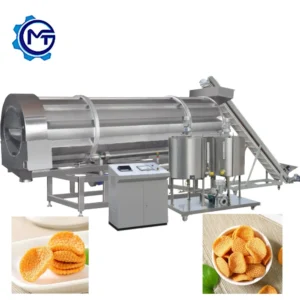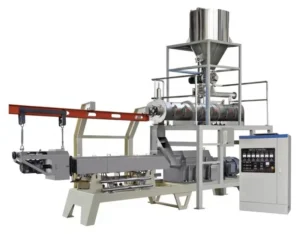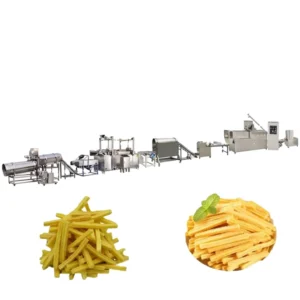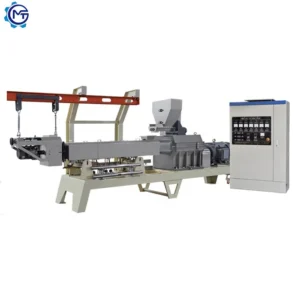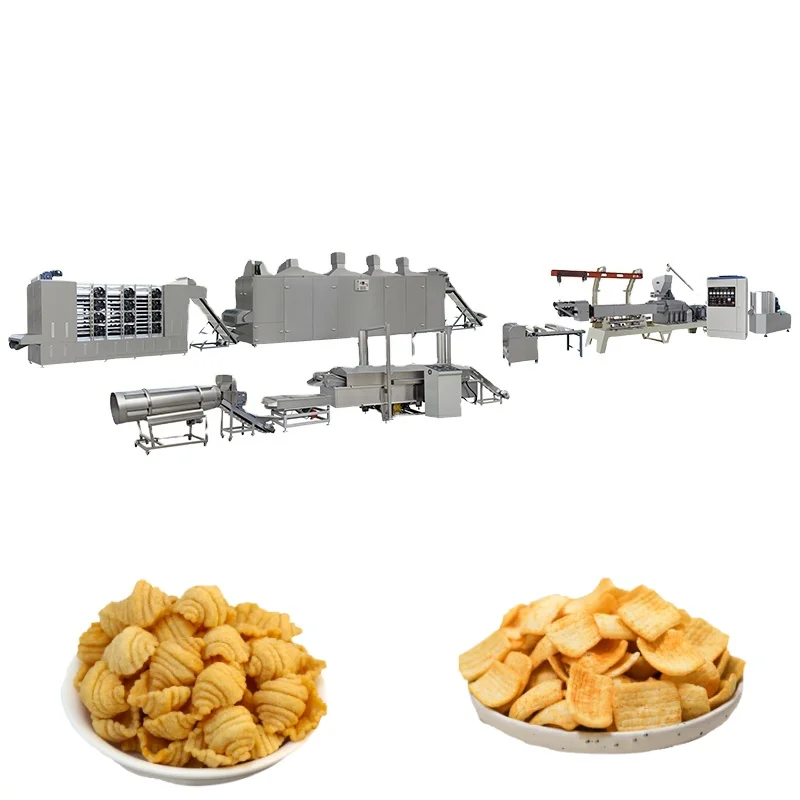
Matched Throughput Across Every Station — the extruder, fryer and cooling conveyor in this fried snack food processing line are sized together so one station never starves or floods the next.
Technical Specifications
| Parameter | Value |
|---|---|
| Product Type | Fried Snack Food Processing Line |
| Extruder Type | Twin-screw, co-rotating |
| Main Motor (MT-65 / MT-70 / MT-85) | 100 kW / 130 kW / 180 kW |
| Main Motor (MT-75 / MT-95) | 185 kW / 280 kW |
| Output Capacity | 120–150 kg/h to 800–1000 kg/h depending on model (basis not stated in source — confirm raw material formulation & moisture content) |
| Barrel Material | Food-grade stainless steel contact parts |
| Cutting Machine Power | 1.47 kW |
| Fryer Belt Width | 600 mm stainless steel |
| Mixer Power Options | 4 kW / 7.5 kW / 15 kW |
| Drying Method | Gas / Electric / Diesel heating options |
| Fryer Energy Options | Electricity / fuel gas / other options |
| Voltage & Frequency | Customizable (e.g., 3ph 380V 50Hz, 3ph 415V 60Hz, 3ph 220V 60Hz) |
| Assembly State | Complete line from mixing to frying |
| Standards | CE |
| Warranty | 1 year |
Application Suitability
| Application | Material or Output |
|---|---|
| Bugles and corn chips | Corn flour, corn starch |
| Rib chips and wavy chips | Wheat flour, potato starch |
| Pillow and tube shapes | Potato powder, blended grain formulations |
| Diamond and square tube snacks | Multi-grain starch blends |
Why Your Raw Material Moisture Content Decides the Real Output
A capacity number without a raw material basis is just a motor rating.
I once watched a fried snack line stall for three days because the local corn flour held a higher moisture content than the test sample used during quoting. The extruder pushed product, but the downstream fryer could not keep up with the wetter, denser output, and the whole line backed up. That is why the fried snack food processing line equipment manufacturer you choose must confirm capacity against your exact formulation before the order is signed [NEED_CITE: impact of feed moisture on extrusion throughput and downstream balance].
How the Extrusion Stage Shapes Fried Snack Texture
The twin-screw, co-rotating extruder handles the entire cooking cycle — mixing, de-gassing, gelatinisation and forming — in a single pass. Modular screw elements can be rearranged to adjust shear and residence time, which directly controls how much starch gelatinises before the product reaches the die. This is the station where the fried snack food processing line equipment manufacturer sets the foundation for the final crunch.
Matching the Fryer to the Extruder, Not the Other Way Around
A 600 mm stainless steel belt fryer with adjustable speed and temperature control must be matched to the extruder output rate. If the fryer runs too slow, product piles up and absorbs excess oil; too fast and the snack exits undercooked. Gas, electric and diesel heating options let the fried snack food processing line equipment manufacturer align the fryer with the utility costs in your market [NEED_CITE: industrial fryer energy source comparison for snack plants].
Reading the Spec Sheet Beyond the Headline Numbers
Motor power across the range spans from 100 kW on the MT-65 up to 280 kW on the MT-95, but the motor alone does not tell you what the line will produce. The screw configuration and die design determine how much mechanical energy actually transfers into the dough. Food-grade stainless steel contact parts keep the product stream compliant with hygiene standards, while the choice between gas, electric or diesel heating on both the dryer and fryer affects your per-shift utility bill far more than any nameplate figure.
The Hidden Cost of Skipping the Trial Run
When an extruder ships without a trial run on your actual raw material, you inherit the product development work. Screw elements, die geometry and moisture targets all need adjustment once the line is on your floor, and every day spent tuning is a day of lost production. Mismatched throughput between the extruder and the fryer compounds the problem, because you cannot isolate one variable at a time [NEED_CITE: common commissioning delays in extruded snack lines].
Why Source the Full Range Here
Every station — mixer, extruder, forming rollers, fryer — is specified under one supplier, so throughput is balanced before the line ships rather than patched together after installation. The in-house testing workshop runs your raw material on the actual extruder before dispatch, generating a trial run report that locks in screw and die settings. Voltage, frequency and control language are confirmed in the electrical schematic before production starts, and CE documentation is prepared for your export market.
Documentation & Verification
- Line layout showing throughput match between extruder and fryer stations
- Screw and die configuration record for your raw material formulation
- Electrical schematic confirming voltage, frequency and control language
- Trial run report on your specific corn or wheat flour blend
- CE declaration of conformity for export compliance
Installation, Commissioning & Support
- Foundation plan accounts for the full line length and fryer load
- Dedicated power circuit sized to the selected main motor rating up to 280 kW
- Mixer-to-fryer stations arrive as separate modules for staged assembly
- First-run parameter setting covers screw speed, barrel zones and fryer temperature
- Operator training includes die and roller changeover for shape switching
- Wear parts list covers screws, dies and fryer belt segments
Preparing Your Inquiry
Share your target snack shape, raw material formulation and moisture content so the line can be configured around your actual inputs. Include your plant voltage and frequency, available floor space and any existing upstream or downstream equipment that must integrate with the new line.
Frequently Asked Questions
Q: How is output capacity verified on my specific raw material formulation and moisture content?
A: Before shipment, your raw material is run through the extruder in the in-house testing workshop. The trial run report documents screw speed, barrel temperature profile, moisture addition and actual output rate, giving you a verified baseline rather than a generic capacity claim.
Q: Which fryer heating source fits my plant utility and operating cost?
A: The fryer is available with electricity, fuel gas or other options. The choice depends on your local energy tariff and available utility connections. Gas heating is common where pipeline supply is stable, while electric suits smaller lines or sites without gas infrastructure.
Q: How do I match mixer batch size to extruder feed rate across the line?
A: Mixer power options range from 4 kW to 15 kW, and the batch cycle time must align with the extruder’s continuous feed rate. The line layout document calculates this match so the mixer never starves the extruder or overfills the hopper.
Q: Can the line voltage and frequency be configured for my market?
A: Voltage and frequency are customizable, covering options such as 3-phase 380 V 50 Hz, 415 V 60 Hz or 220 V 60 Hz. The electrical schematic confirms your exact requirement before production begins, avoiding commissioning delays on site.