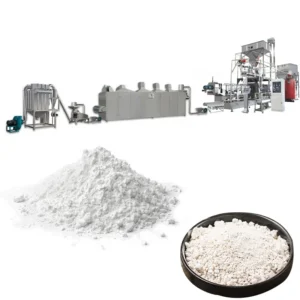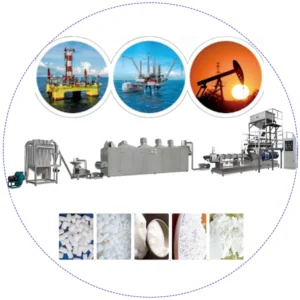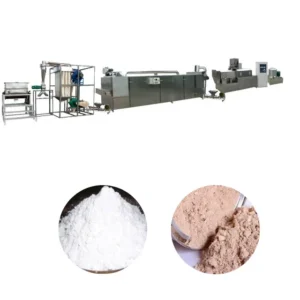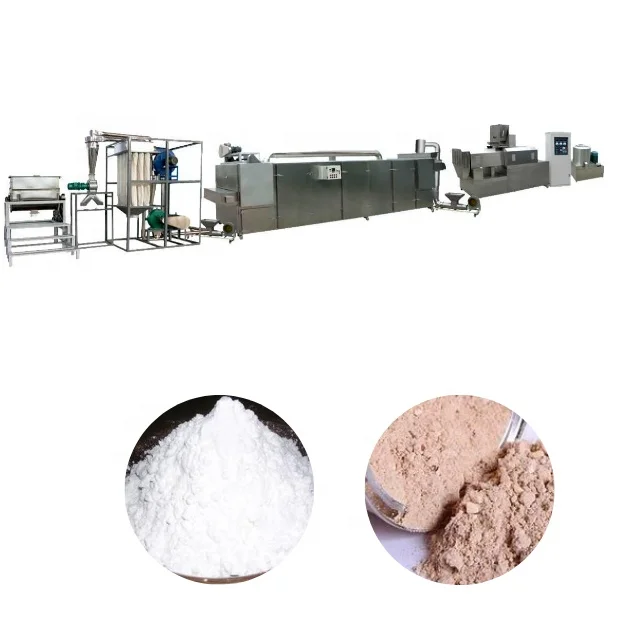
Throughput Matched Across Stations — every extruder, cooling conveyor, and pulse grinder in this modified starch processing line is sized together so the bottleneck never shifts downstream.
Technical Specifications
| Parameter | Value |
|---|---|
| Product Type | Modified Starch Processing Line |
| Line Stations | Twin-screw extruder, cooling conveyor, pulse grinder |
| Screw Type | Twin-screw |
| Raw Materials | Corn starch, wheat flour, rice flour, soybean flour, potato starch, additive materials |
| Power Range | 45–200 kW |
| Capacity Range | 100–1500 kg/h (basis not stated in source — confirm raw material type, moisture content, and modification degree) |
| Weight Range | 1000–5000 kg (source value — verify against manufacturer catalog) |
| Voltage Options | 220–440V, tri-phase |
| Frequency | 50/60 Hz |
| Control System | Available with PLC and MCC control |
| Fuel Options | Gas, diesel, electricity, steam |
| Contact Material | Food-grade stainless steel (food-contact zones); PVC on select conveyor sections |
| Standards | CE, ISO |
Application Suitability
| Application | Material or Output |
|---|---|
| Nutritional food additives | Modified corn or potato starch for infant formula and dietary supplements |
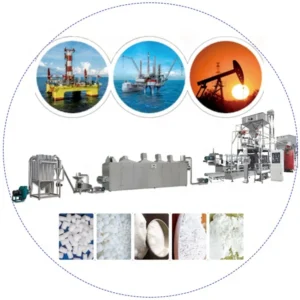
| Oil drilling fluid production | Starch modified for high-temperature viscosity stability in drilling mud |
| Paper making additives | Cationic or oxidized starch for surface sizing and coating |
| Industrial binding agents | Pregelatinized starch from wheat or rice flour for adhesives |
| Textile warp sizing | Modified starch for yarn strengthening before weaving |
Why "Rated Capacity" Misses the Real Picture
A modified starch processing line manufacturer should always pair the capacity number with the raw material and modification target.
When buyers compare quotes, the headline throughput figure often hides the fact that it was measured on a completely different starch type or moisture level. A line that runs smoothly on native corn starch at a low modification degree may struggle when the same buyer switches to potato starch with a higher cross-linking requirement. The extruder screw speed, barrel temperature profile, and die resistance all shift when the raw material changes, and the downstream cooling and grinding stations must follow suit. [NEED_CITE: starch modification degree impact on extrusion parameters]
Matching Extruder Output to Downstream Cooling and Grinding
Every station in this modified starch processing line is specified so that throughput remains consistent from the extruder die face all the way through the pulse grinder discharge. The twin-screw extruder handles gelatinization and modification in a single continuous pass, discharging hot, expanded starch directly onto the cooling conveyor. If the conveyor travel speed and wind knife air volume are not calculated against the extruder output rate, surface moisture remains trapped and the pulse grinder receives material that is still tacky inside.
How Screw Configuration Affects Starch Modification Results
The twin-screw arrangement allows operators to adjust shear intensity and residence time by rearranging screw elements along the barrel. Forward-conveying elements move material quickly with lower shear, while kneading blocks increase mechanical energy input for deeper molecular modification. Die design then controls expansion ratio and pellet density. A screw configuration that works well for pregelatinized corn starch will not produce the same viscosity profile when the target is cationic starch for paper sizing, which is why the configuration must be locked to the buyer’s actual recipe before production begins. [NEED_CITE: twin-screw element arrangement and starch gelatinization]
Reading the Specs That Actually Matter
The power range spanning 45 to 200 kW reflects the difference between small-batch specialty starch runs and continuous industrial production, where higher motor output is needed to maintain screw speed under the viscous load of modified starch paste. Voltage configurability from 220V to 440V at either 50 or 60 Hz means the electrical cabinet can be built for the destination market’s grid standard before the line ships. Food-grade stainless steel in all product-contact zones meets hygiene expectations for nutritional and food additive applications, while PVC conveyor sections keep costs controlled where direct food contact is not a factor. The choice of fuel source — gas, diesel, electricity, or steam — for the drying and cooling stages lets buyers align utility consumption with what is available and economical at their facility.
The Hidden Cost of Mismatched Station Speeds
When the cooling conveyor moves slower than the extruder discharges, hot starch accumulates at the transfer point and begins to re-agglomerate before it reaches the grinder. The pulse grinder then processes unevenly cooled chunks instead of uniform pellets, producing a wide particle size distribution that fails the buyer’s specification. Cyclone discharge and dust collection on the grinder cannot compensate for inconsistent feed material. This mismatch is rarely visible during a short factory test with a generic recipe, which is why trial runs using the buyer’s actual raw material are essential before the line leaves the workshop. [NEED_CITE: material transfer bottlenecks in continuous starch processing]
Why Buyers Source This Line Here
Every station from the batching system through the pulse grinder comes from a single supplier, eliminating the finger-pointing that happens when separate vendors blame each other for throughput gaps. Screw configuration and die design are documented against the buyer’s specific raw material and target modification degree rather than copied from a generic build. An in-house testing workshop allows trial runs on the customer’s actual starch before the line is packed for shipment, catching recipe and hardware issues early. PLC and MCC control systems are configured with the correct voltage, frequency, and operator language for the destination market before commissioning begins. Wear parts including replacement screw elements and dies are listed and available when the first changeover is due.
Documentation & Verification
- Line layout and capacity calculation matched to your workshop dimensions and target output
- Screw and die configuration record specific to your raw material and modification degree
- Electrical schematic confirming voltage, frequency, and control language before build
- Trial run report using your supplied starch in the testing workshop
- Factory test record with photos and parameter logs before dispatch
- CE declaration of conformity and ISO certificate for customs clearance
Installation, Commissioning & Support
- Foundation and floor space planning based on the full line footprint from extruder to grinder
- Dedicated power circuit sizing for the 45–200 kW extruder motor and auxiliary stations
- Equipment shipped in modular sections for practical on-site assembly and alignment
- First-run parameter tuning covering barrel temperatures, screw speed, and wind knife pressure
- Operator training on PLC interface, recipe storage, and screw element changeover
- Wear parts list with reorder codes for screw elements, dies, and grinder screens
What We Need to Build Your Line
To configure a modified starch processing line that holds its rated throughput on your actual material, we need your starch type and any additive ratios, the target modification degree or viscosity specification, and your daily output requirement. Please share your workshop floor area and ceiling height so the layout can be drawn to fit, along with your local voltage and frequency standard. If you already have upstream batching or downstream packing equipment, let us know the interface points so the new line integrates cleanly.
Frequently Asked Questions
Q: What raw material information do you need before proposing a line?
A: We need the starch source such as corn, wheat, potato, or rice, along with moisture content and any additives you plan to introduce. The target modification type — pregelatinization, oxidation, cross-linking, or cationic treatment — determines screw configuration and barrel heating profile. With these details, we calculate extruder size and downstream station capacity.
Q: How do you match extruder capacity to my real production needs?
A: We base the calculation on your specific raw material and target output rather than a generic benchmark. The cooling conveyor length and wind knife capacity are then sized to handle that exact discharge rate. The pulse grinder throughput is verified against the cooled pellet flow so no station becomes a bottleneck.
Q: Can the screw configuration be adjusted for different modification degrees?
A: Yes, the twin-screw barrel accepts interchangeable conveying and kneading elements. We design the initial arrangement around your primary recipe and document the layout. If you later add a second product with a different modification target, we provide an alternative screw element sequence and die specification for that run.
Q: What voltage and control options are available?
A: The electrical system is configurable for 220V to 440V tri-phase at either 50 or 60 Hz. PLC and MCC panels are built with operator interface language matching your workshop. We confirm the exact specification before the cabinet is wired so no rewiring is needed on arrival.