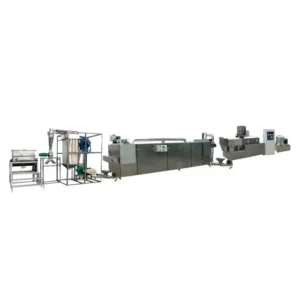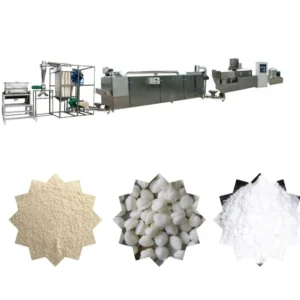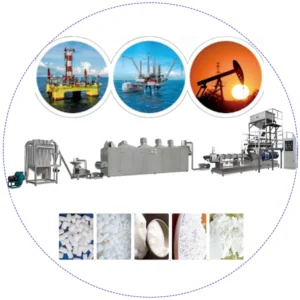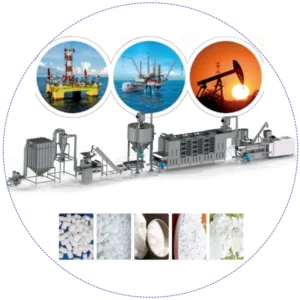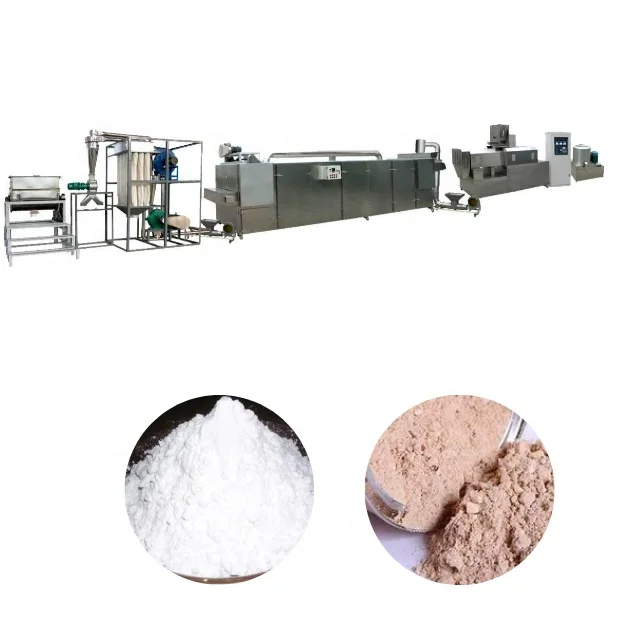
Complete Line Integration — every station from batching to packing is supplied under one manufacturer, eliminating throughput mismatches that occur when a modified starch processing line equipment manufacturer only provides the extruder.
Technical Specifications
| Parameter | Value |
|---|---|
| Product Type | Modified Starch Twin Screw Extrusion Production Line |
| Screw Type | Twin screw |
| Power Range | 45–200 kW |
| Output Capacity | 100–1500 kg/h (basis to be confirmed — depends on raw material type, moisture content, and specific starch formulation) |
| Machine Weight | 1000–5000 kg (source value — verify against final line configuration) |
| Voltage | 220–440V, tri-phase (configurable to 3ph 380V 60Hz, 3ph 415V 60Hz, 3ph 220V 60Hz) |
| Line Stations | Twin screw extruder, cooling conveyor, pulse grinder |
| Contact Material | Food-grade stainless steel (304); PVC on select conveyor sections |
| Control System | Available with PLC or MCC control |
| Fuel Options | Gas, diesel, electricity, or steam |
| Assembly State | Complete line with supporting equipment |
| Certification | CE |
Application Suitability
| Application | Material or Output |
|---|---|
| Pre-gelatinised starch for food thickeners and stabilisers | Corn flour, potato starch, rice flour |
| Modified starch for oil drilling fluid additives | Corn flour, soybean flour blends |
| Paper-making additive starch | Potato starch, corn flour, grain flour blends |
| Instantised starch powders for infant formula and nutrition programmes | Rice flour, corn flour, fortified blends |
| Industrial binder and adhesive starch | Cassava starch, corn starch blends |
Why "Rated Capacity" Rarely Survives Contact with Your Raw Material
Output is meaningless without naming the exact starch formulation and moisture level it was measured on.
A modified starch processing line equipment manufacturer will quote a line at a nominal throughput. The problem begins when that number was established on pure corn starch at controlled moisture, and your actual formulation is a cassava-corn blend with different gelatinisation behaviour. I watched a customer who ordered based on a nameplate figure arrive on-site and find his expansion rate dropping and viscosity readings well below target. His actual output settled at roughly half the quoted rate. That gap was not a machine defect — it was a specification mismatch. [NEED_CITE: starch gelatinisation temperature differences between cassava and corn]
How Screw Configuration Determines Modification Degree
The twin screw extruder at the core of this line handles the shear, heat, and residence time required to alter starch molecular structure. The screw element arrangement — conveying sections, kneading blocks, and reverse elements — directly controls how much mechanical energy transfers into the starch matrix. A screw profile designed for high-shear pregelatinisation will not produce the same modification degree as one configured for mild cross-linking. Each modified starch processing line equipment manufacturer that ships a generic screw setup forces the buyer to develop the process from scratch after installation.
Barrel Temperature Profile and Gelatinisation Control
Starch modification happens within a narrow thermal window. Corn starch gelatinises around a different temperature range than potato starch, and cassava-based blends shift that window further. The barrel zones on this twin screw extruder allow independent temperature profiling so the operator can establish a gradient that matches the raw material. When I worked with a processor running a corn-potato blend, the barrel zones needed a stepped profile rather than a flat setting to avoid premature gelatinisation in early zones and incomplete modification in later sections. Getting that curve right required several days of adjustment with the actual raw material on hand. [NEED_CITE: gelatinisation temperature ranges for common industrial starches]
Reading the Specs That Actually Matter on a Modified Starch Line
Power rating and screw diameter define the mechanical energy available for starch modification. A 45 kW extruder is suited to lighter formulations and lower modification degrees, while a 200 kW unit provides the torque needed for dense blends and high-shear pregelatinisation. Voltage configuration must match the buyer’s facility before production starts — arriving with a 380V 50Hz motor in a 415V 60Hz country delays commissioning by weeks. Food-grade 304 stainless steel on product contact surfaces is non-negotiable for starch destined for food, infant formula, or pharmaceutical applications. The pulse grinder at the downstream end controls final particle size through cyclone discharge with integrated dust collection, which matters when the end customer specifies mesh size for drilling fluid or paper coating additives.
The Hidden Cost of Mismatched Downstream Stations
When the extruder is specified without matching the cooling conveyor and pulse grinder capacity, the line develops a bottleneck. Starch that exits the extruder must cool quickly to preserve colour and functional properties — a conveyor that is too short or lacks adequate air-drying capacity leaves material too warm for the grinder, producing inconsistent particle size and potential clumping. I have seen operators forced to slow the extruder feed rate to let the cooler catch up, which means the line never reaches the throughput the buyer paid for. [NEED_CITE: impact of post-extrusion cooling rate on starch functional properties]
Why Buyers Choose This Equipment Source
The line is supplied as a matched system rather than assembled from separate vendors, so throughput at the extruder, cooler, and grinder is balanced before shipment. Screw configuration and die design are specified against the buyer’s actual starch formulation and target modification degree rather than copied from a generic build. An in-house testing workshop runs the buyer’s raw material before the line leaves the factory, producing a trial run report that confirms achievable throughput and product specification. CE certification covers the complete line for markets that require conformity documentation. Pre-sales consultation covers line layout and utility planning through to on-site installation and operator training.
Documentation & Verification
- Line layout and capacity calculation matched to your specific starch formulation and target output
- Screw and die configuration record documenting element arrangement for your modification degree
- Trial run report on your raw material conducted in the testing workshop before shipment
- Electrical schematic with voltage and frequency confirmation matched to your facility supply
- CE declaration of conformity covering the complete extrusion and downstream line
- Operation and maintenance manual with wear parts list specific to your line configuration
Installation, Commissioning & Support
- Floor plan showing footprint for extruder, cooling conveyor, and pulse grinder with utility connection points
- Dedicated power circuit sizing based on the 45–200 kW range and your confirmed voltage and frequency
- Assembled line arrives in modular sections for positioning within standard industrial ceiling heights
- First startup includes screw speed, barrel temperature profiling, and grinder mesh calibration on your starch
- Operator training covers screw element inspection intervals and barrel liner replacement procedures
- Wear parts list with lead times for screws, dies, and grinder screen replacements
What to Include with Your Inquiry
Share your starch formulation — the base grain type, any blends, and the moisture content you receive from your supplier. Specify your target modification degree or the functional property your end customer requires, such as viscosity range or gelatinisation percentage. Confirm your facility voltage, frequency, and preferred control language so the electrical package is built correctly before production starts.
Frequently Asked Questions
Q: How is output capacity verified on my specific starch raw material and moisture level?
A: Before shipment, your raw material runs through the extruder in our testing workshop. We document throughput, expansion ratio, and modification degree in a trial run report. Capacity figures quoted in the proposal are adjusted to reflect what the line actually produces on your formulation, not a generic benchmark starch.
Q: What screw configuration and barrel temperature profile is specified for my target starch modification?
A: Screw element arrangement and barrel zone temperatures are designed around your raw material type and target modification degree. Cassava, corn, and potato starches each require different shear and thermal profiles. You receive a configuration record documenting the exact element layout and temperature curve selected for your formulation.
Q: Can the line voltage and control language be confirmed to match my country’s electrical standard before production?
A: Voltage and frequency are confirmed during the specification phase before manufacturing begins. The line is configurable across 380V, 415V, and 220V tri-phase at 50 or 60 Hz. Control panel language and electrical schematics are matched to your facility requirements so commissioning proceeds without electrical rework on arrival.
Q: Is a trial run performed on my raw material before shipment, and what documentation do I receive?
A: Yes. Your raw material is processed in the testing workshop, and you receive a trial run report covering achievable output, product specification, and recommended operating parameters. This report accompanies the shipment along with the screw configuration record, electrical schematic, and CE declaration of conformity.
Q: How are wear parts such as screws and dies supplied, and what is the lead time for first replacement?
A: A wear parts list specific to your line configuration ships with the documentation package. Initial spare sets can be included in the first order. Replacement screws, dies, and grinder screens are manufactured to the same configuration record, with typical multi-week lead times depending on the complexity of the element profile.