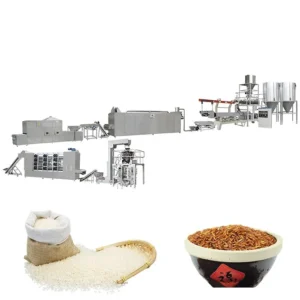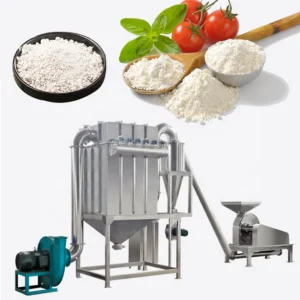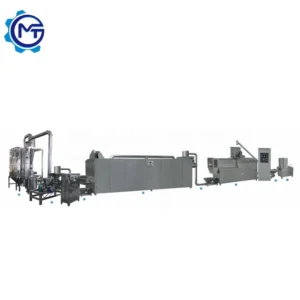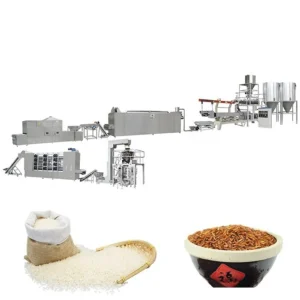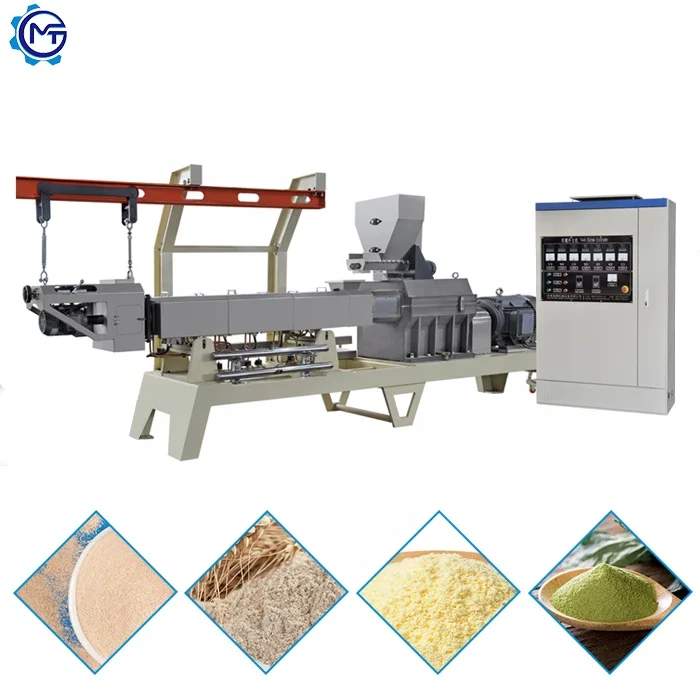
Throughput-matched stations — every mixing, extrusion, drying, and milling unit sized to your raw material so the line runs continuously instead of waiting on a bottleneck.
Technical Specifications
| Parameter | Value |
|---|---|
| Product Type | Nutritional Powder Processing Line |
| Assembly State | Complete production line (batching through packing) |
| Control System | Available with PLC or MCC control |
| Line Stations | Mixing and batching, extrusion, drying, milling/pulverizing, packing |
| Machine Customization | Accepted according to customer requirements |
| Factory Layout | Supplied according to customer factory size and local voltage |
| Voltage & Frequency | Customized to local supply (basis to be confirmed) |
| Recipe Support | Basic recipe and machine setting parameters supplied |
| Installation Service | One or two engineers dispatched for installation, testing, and training |
| Packaging | Plastic bubble film on machine surface; wooden case for spare parts; fumigation package and certificate available |
| Standards | CE certified; ISO certified |
Application Suitability
| Application | Material or Output |
|---|---|
| Infant formula and baby food powder production | Grain base, milk powder, vitamins, and mineral premix |
| Meal replacement powder processing | Soy protein, pea protein, oat flour, and dietary fiber |
| Nutritional supplement powder manufacturing | Isolate proteins, carbohydrate blends, and micronutrient carriers |
| Fortified food powder for nutrition programmes | Cereal grits, legume flours, and fortified vitamin-mineral blends |
When the Extruder Outruns the Rest of the Line
A nutritional powder processing line full equipment range only delivers its nameplate output when every downstream station can keep up.
I once mapped a baby formula line where the extruder was sized correctly, but the dryer could not handle the moisture load at that feed rate. The operator had to throttle the extruder back, and the line never reached the throughput the buyer had planned around. The mixing batch cycle was also twenty minutes longer than the extruder consumption rate, so the entire line sat idle between batches. Three days of commissioning were spent rebalancing cycle times that should have been matched on paper before the machines left the factory. When sourcing a nutritional powder processing line full equipment range, the question is never just what the extruder can do — it is whether the dryer, mill, and packing station are rated to hold the same output on your specific formulation. [NEED_CITE: typical moisture removal rates in food powder drying]
Matching Every Station to Your Formulation
A nutritional powder processing line full equipment range starts with the batching and mixing station, where cycle time must align with the extruder feed rate. If your formulation includes high-fat ingredients or viscous slurries, the mixer needs sufficient discharge speed to prevent the extruder hopper from running dry between batches. The screw configuration in the extrusion stage is then selected to handle the specific starch and protein content of your raw material, which directly determines the expansion and moisture profile entering the dryer.
Why Dryer and Mill Capacity Cannot Be an Afterthought
The drying stage must remove the exact moisture differential that the extruder introduces, at the same mass flow rate. Undersized drying capacity forces the extruder to slow down, while oversized drying wastes energy and can over-dry the product, affecting the subsequent milling stage. The pulverizing station must then reduce the dried extrudate to the target particle size distribution required for infant formula or meal replacement powder, and its throughput must match the upstream flow. [NEED_CITE: particle size distribution standards for infant formula powders] Any mismatch across these stations turns a continuous line into a series of start-stop operations.
Reading the Specs That Actually Matter
The control system choice — PLC or MCC — determines how tightly process parameters such as barrel temperature zones, screw speed, and dryer air temperature are held across production runs. PLC control allows recipe storage and automated setpoint changes, which matters when you switch between different powder formulations on the same line. The line stations list confirms whether milling is included as an integrated step or left as a separate procurement, which affects both footprint planning and throughput synchronization. Voltage and frequency customization to local supply is essential because running a 50 Hz motor on a 60 Hz supply — or vice versa — changes every rotational speed in the line, altering residence time in the extruder barrel and airflow in the dryer. Food-grade contact materials throughout every station ensure compliance with food safety standards in the target market.
The Hidden Cost of Undersized Supporting Equipment
When the dryer or mill cannot keep pace with the extruder, the result is not just lower output — it is inconsistent product quality. Extrudate that sits too long before drying develops surface moisture gradients, leading to uneven particle size after milling. Operators who constantly adjust feed rates to compensate for downstream bottlenecks introduce variability that no control system can fully correct. I have seen lines where the packing station was the constraint, forcing finished powder to accumulate in intermediate bins, exposing it to humidity and contamination risk. These problems do not appear in a single-machine quotation; they only surface when the full line runs together under load. [NEED_CITE: moisture sensitivity of nutritional powders during intermediate storage]
Why Procurement Through This Range Works
Every station in this nutritional powder processing line full equipment range is specified under one supplier, so throughput calculations are cross-checked across mixing, extrusion, drying, milling, and packing before the layout is finalized. Screw configuration and die design are matched to your raw material and target powder specification rather than copied from a generic build. The in-house testing workshop runs trial production on your actual raw material before shipment, so cycle times and moisture profiles are verified — not assumed. Food-grade contact materials are applied throughout every station, and the electrical schematic confirms voltage, frequency, and control language before the line enters production. Documentation includes a line layout and capacity calculation showing throughput matching across all stations.
Documentation & Verification
- Line layout and capacity calculation showing throughput matching across mixing, extrusion, drying, and milling
- Screw and die configuration record matched to your raw material and target powder mesh size
- Trial run report on customer raw material conducted in the testing workshop before shipment
- Electrical schematic with voltage, frequency, and control language confirmed for your market
- Factory test record documenting each station running at line speed before packing
Installation, Commissioning & Support
- Factory layout supplied based on your floor dimensions, ceiling height, and the PLC or MCC cabinet footprint
- Power supply verified against local voltage and frequency before motor and heater element specification
- Line arrives in modular station groups for staged assembly and utility connection
- Commissioning includes running your raw material through every station to confirm matched throughput
- Operator training covers recipe changeover on the control system and daily wear part inspection
- Wear parts list with lead times for screws, dies, and dryer screen replacements
What We Need to Configure Your Line
To size every station correctly, share your raw material composition and moisture content, target powder particle size, and daily production volume. We also need your factory floor dimensions, local voltage and frequency, and preferred control language. If you have existing upstream or downstream equipment that must integrate with this line, include those specifications so the throughput match accounts for the full process flow.
Frequently Asked Questions
Q: Which stations are included in the full nutritional powder line and where each fits?
A: The line covers mixing and batching, twin-screw extrusion, drying, milling or pulverizing, and packing. Each station is positioned in sequence so that material flows continuously from raw ingredient blending through to finished powder packaging, with intermediate conveying sized to match the throughput of adjacent machines.
Q: How are extruder, dryer, and milling capacities matched to avoid bottlenecking?
A: During line configuration, each station’s cycle time and mass flow rate are calculated against your raw material and target output. The dryer is sized to handle the exact moisture load the extruder produces, and the mill is rated for the resulting dried mass, so no single station forces the others to slow down.
Q: What raw material trial runs are performed before shipment?
A: Your raw material is processed through the extruder and supporting stations in the testing workshop. The trial run verifies screw configuration, moisture profile after drying, and particle size after milling. A full report documenting these results is provided before the line ships.
Q: What voltage, frequency, and control language options are available?
A: Voltage and frequency are customized to your local power supply. The control system is available with PLC or MCC configuration, and the operator interface language is set to match your production team before dispatch.