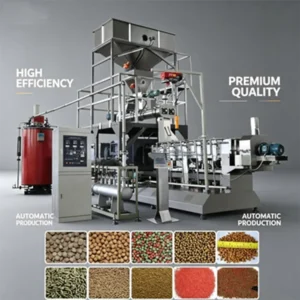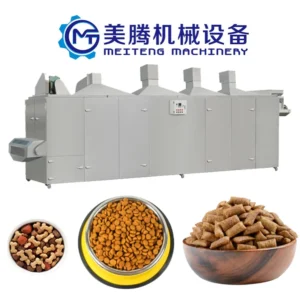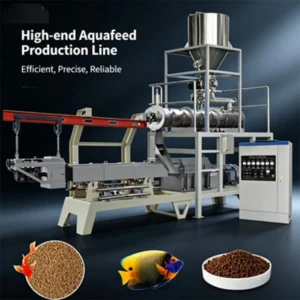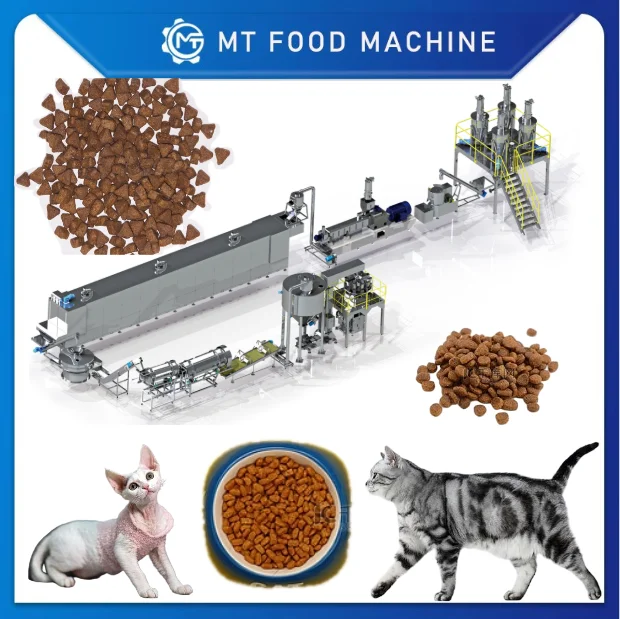
Throughput-Matched Engineering — every station from the batching system to the packer is specified as a single coordinated unit, eliminating the bottleneck risk that arises when extruders, dryers, and coating drums are sourced from separate vendors.
Technical Specifications
| Parameter | Value |
|---|---|
| Model | MT100 |
| Product Type | Pet Food Processing Line |
| Output Capacity | 1.5–2.0 t/h (basis not stated in source — confirm raw material formulation, moisture content, and pellet size) |
| Extruder Type | Twin-screw |
| Control System | PLC Controlled |
| Line Stations | Batching, extrusion, drying, coating, cooling, packing |
| Application Scope | Cat, dog, fish, bird, and cattle feed |
| Assembly State | Complete production line |
| Standards | CE, ISO |
Application Suitability
| Application | Material or Output |
|---|---|
| Dry kibble for dogs and cats | Corn, meat meal, poultry by-product, rice flour blends |
| Floating and sinking aquatic pellets | Fish meal, soy protein, wheat gluten, starch binders |
| Bird seed and supplement pellets | Millet, sorghum, vitamin-mineral premix carriers |
| Cattle feed pellets | Grain concentrates, protein meals, molasses-based formulations |
| High-fresh-meat premium recipes | Fresh meat slurry, animal fat, functional additives at elevated moisture |
What "Nominal Capacity" Leaves Out on a Pet Food Processing Line
A rated output means nothing until it is verified against your exact formulation, moisture level, and target pellet geometry.
I remember a pet food manufacturer who signed off on a line based on trial data run with standard corn flour. When their actual high-fresh-meat recipe hit the extruder, the viscosity was far higher, screw shear could not keep up, and expansion dropped well below spec. Three days of on-site parameter adjustment followed before the line stabilized. That gap between brochure capacity and real-world throughput is where most pet food processing line full equipment range projects stall. Buyers deserve to see their own raw material running through the machines before a purchase order is finalized [NEED_CITE: importance of raw material trial runs in extrusion equipment procurement].
Station-by-Station Throughput Alignment
A pet food processing line full equipment range only performs when every station handles the same mass flow. If the extruder pushes 2.0 t/h but the dryer is sized for 1.2 t/h, moisture removal becomes the constraint and product quality degrades. The MT100 is configured so that the batching system, twin-screw extruder, multi-pass dryer, flavouring drum, cooler, and packing station are each calculated against the same throughput target, preventing mid-line accumulation or starvation.
Screw and Die Configuration for Recipe-Specific Density
Different species and market segments demand different kibble densities — floating aquatic pellets require high expansion, while premium dog kibble often targets a denser, slower-sinking profile. The twin-screw assembly on the MT100 allows the screw element sequence and die geometry to be matched to the buyer’s raw material behaviour and target product specification. This level of configuration is what separates a generic extruder from one that consistently holds the texture and density a brand promises to its customers [NEED_CITE: twin-screw extrusion screw configuration principles for varying feed formulations].
Interpreting the Core Parameters
The twin-screw design provides positive conveyance, which is critical when processing high-fat or high-moisture recipes that would slip in a single-screw barrel. The PLC control system maintains barrel temperature profiles and screw speed within tight bands across long production runs, reducing batch-to-batch variation in pellet size and expansion ratio. Output capacity is listed at 1.5–2.0 t/h, but that figure shifts depending on raw material moisture, fat inclusion level, and die aperture — buyers should request a capacity calculation sheet based on their own formulation rather than treating the headline number as a guarantee. The complete line station list — batching through packing — means utility planning for steam, compressed air, and electrical load can be coordinated in a single layout document instead of reconciled across multiple vendor drawings.
The Hidden Cost of Mismatched Line Components
When an extruder is purchased separately from the dryer and coating drum, the integration risk falls entirely on the buyer. Undersized drying capacity leaves pellets above safe moisture thresholds, shortening shelf life and inviting mould complaints. An undersized flavouring drum cannot apply coating evenly at full line speed, leading to palatability inconsistencies that surface only after the product reaches the retail shelf. These downstream failures are expensive to diagnose because the root cause sits in the original equipment specification, not in operator error [NEED_CITE: common causes of post-installation throughput bottlenecks in feed extrusion lines].
Why Source the Full Equipment Range Here
The MT100 is built as a coordinated line under one supplier, so throughput matching between the extruder, dryer, and packer is engineered before fabrication rather than negotiated after installation. An in-house testing workshop allows trial runs on the buyer’s actual raw material, generating a documented report that confirms expansion, density, and output before the machines ship. Screw configuration and die design are specified to the target product rather than copied from a generic template, which matters when a brand differentiates on kibble shape or aquatic feed buoyancy. Electrical schematics, voltage confirmation, and PLC language options are finalized during the specification stage, reducing commissioning delays caused by incompatible control panels or untranslated HMI menus.
Documentation & Verification
- Line layout and capacity calculation showing station-by-station throughput matching
- Screw and die configuration record tied to your raw material and target kibble density
- Trial run report from the in-house testing workshop on your formulation before dispatch
- Electrical schematic with voltage and frequency confirmation for your facility
- Operation and maintenance manual covering PLC parameters and wear part replacement intervals
- CE declaration of conformity and ISO certificate for import clearance
Installation, Commissioning & Support
- Foundation and utility plan aligned to the MT100 line footprint and PLC cabinet load
- Dedicated electrical circuit sizing based on confirmed voltage and total connected power
- Sequential assembly from batching system through extruder, dryer, and packing station
- First-run parameter tuning on your raw material with screw speed and barrel temperature logging
- Operator training on PLC interface navigation, alarm response, and die changeover procedures
- Wear parts list covering screws, dies, and barrel segments with recommended reorder intervals
Preparing Your Inquiry
To move from a general inquiry to a firm line configuration, share your target species and recipe formulation including fat and moisture levels, the pellet shape and size range you need, and your local voltage and frequency standard. If your workshop has space or ceiling-height constraints, include a rough floor plan so the layout can account for dryer length and cooler conveyor runs. Specify whether your team requires the PLC interface in a language other than English, and indicate if you want a trial run on your raw material before shipment.
Frequently Asked Questions
Q: How is the output capacity of the MT100 verified against my raw material?
A: The listed 1.5–2.0 t/h figure is a starting point. Capacity shifts with formulation moisture, fat content, and pellet diameter. A trial run using your raw material is conducted in the testing workshop, and the results — including measured throughput, expansion ratio, and pellet density — are documented in a report you review before confirming the order.
Q: How are the extruder, dryer, and coating drum sized to avoid bottlenecks?
A: Each station is calculated against the same target mass flow derived from your recipe and pellet specification. The dryer pass length and airflow, the coating drum volume and spray rate, and the cooler conveyor speed are all matched to the extruder output so that no single station restricts the others during continuous production.
Q: What PLC language and voltage options are available for my market?
A: The PLC control system can be configured with HMI text in multiple languages based on your operator team’s needs. Voltage and frequency are confirmed during the specification stage — whether your facility runs on 380 V/50 Hz, 440 V/60 Hz, or another standard — so that the electrical cabinet arrives ready for connection without on-site transformer retrofitting.
Q: How is screw and die configuration selected for my recipe?
A: The screw element sequence — conveying, kneading, and reverse-flight sections — is arranged based on your raw material’s viscosity and gelatinisation behaviour. Die aperture and land length are chosen to produce the target pellet shape and density, whether that is a high-expansion floating aquatic pellet or a dense kibble for premium dog food.
Q: What spare wear parts are included, and how are replacements sourced?
A: The initial shipment includes a documented wear parts list identifying screws, dies, and barrel segments most subject to abrasion. Replacement components are manufactured to the same configuration record as the originals, ensuring that throughput and product quality remain consistent after the first changeover cycle.