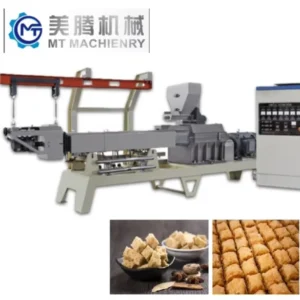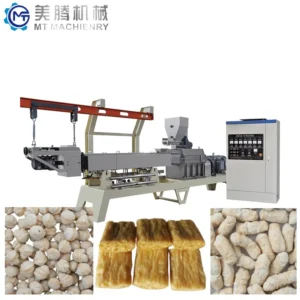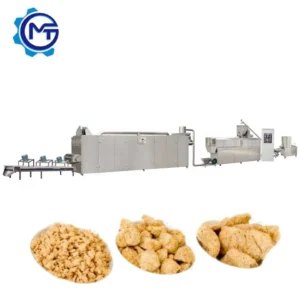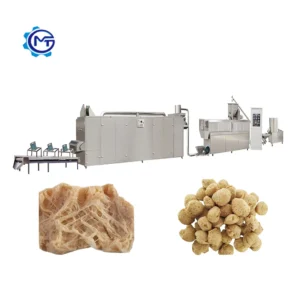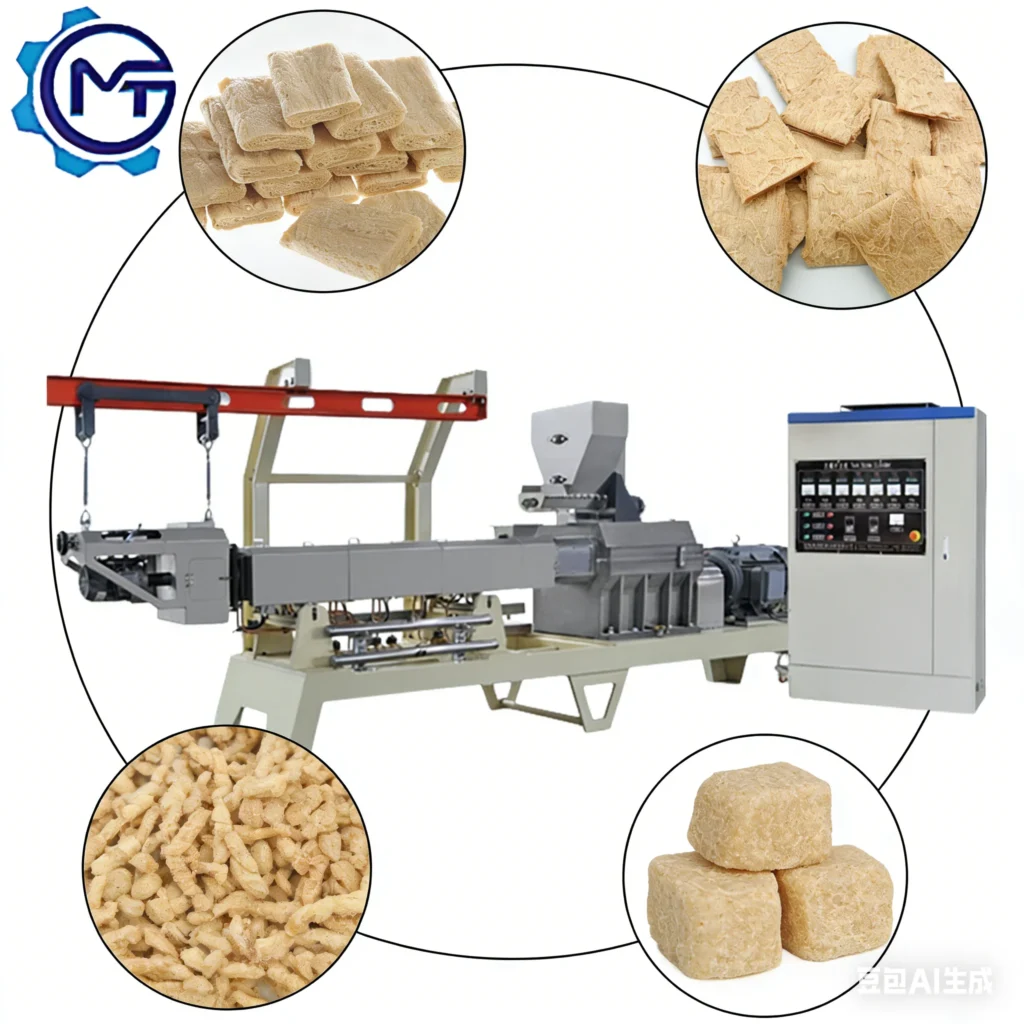
Matched Throughput Across Every Station — from the vertical mixer to the multi-layer dryer, each component in this TVP extrusion line is selected and balanced under a single supplier to prevent bottlenecks at any stage of textured vegetable protein production.
Technical Specifications
| Parameter | Value |
|---|---|
| Product Type | Twin Screw Extruder for Textured Vegetable Protein (TVP) |
| Model | MT65 / MT70 / MT75 / MT85 |
| Screw Type | Twin Screw |
| Screw Length Options | 1050 mm / 1520 mm |
| Installed Power | MT65 84kW | MT70 160kW | MT75 190kW | MT85 210kW |
| Power Consumption | MT65 59kW | MT70 120kW | MT75 140kW | MT85 140kW |
| Main Motor Power | 22 kW / 30 kW / 45 kW |
| Output Capacity | MT65 100-150 kg/h (basis not stated in source) | MT70 150-200 kg/h (basis not stated in source) | MT75 150-200 kg/h (basis not stated in source) | MT85 250-300 kg/h (basis not stated in source) |
| Overall Dimensions (L×W×H) | MT65 40000×1200×2200 mm | MT70 41000×1500×2200 mm | MT75 43000×1500×3200 mm | MT85 45000×1500×3500 mm (full line footprint) |
| Control System | PLC and MCC control |
| Die Configuration | Interchangeable moulds for soya nuggets, TVP/TSP, soya chunks |
| Mixer Type | Vertical mixing machine with stainless steel 304 mixing ruler |
| Mixer Capacity | 20-30 kg / 70-80 kg / 170-180 kg |
| Mixer Power | 4 kW / 7.5 kW / 15 kW |
| Dryer Heating Source | Fuel / Gas / Electricity (selectable) |
| Dryer Drive | Double pitch roller chain drive, round-trip drying |
| Rotary Cutting Motor | 0.75 kW |
| Feeding Motor | 0.75 kW |
| Heating Power | 10 kW / 14 kW |
| Assembly State | Complete production line (Mixer → Screw Conveyor → Extruder → Air Conveyor → Dryer → Cooling Machine) |
| Certification | CE |
Application Suitability
| Application | Material or Output |
|---|---|
| Textured vegetable protein production | Defatted soya flour, low temperature soya flakes |
| Soya nugget and chunk manufacturing | Soy protein concentrate, soybean dregs |
| Plant-based meat analogue base material | Peanut dregs, blended plant protein formulations |
| Diversified extruded product runs | Cereal and snack formulations via screw reconfiguration |
What "150 kg/h Output" Leaves Out About Your Raw Material
A capacity figure means nothing unless it is tied to the exact protein source and moisture level you will actually run.
Buyers often receive a line quoted on a nominal throughput, only to discover during commissioning that their specific defatted soya flour or pea protein blend cannot sustain that rate without compromising the fibrous texture the market demands. I recently worked with a plant-based meat producer in the Pearl River Delta who ordered a twin screw extruder rated for soy protein but intended to run pea protein instead. The screw configuration was not matched to the new material, the extrudate had no拉丝 structure, and several thousand yuan of raw material was scrapped before the parameters were stabilized over two weeks of re-tuning. [NEED_CITE: protein source variation and extrusion screw configuration requirements]
Matching the Screw Profile to Your Protein Matrix
Every protein source behaves differently under heat and shear inside the barrel. Defatted soya flour requires a specific screw element arrangement to achieve proper starch gelatinisation and protein alignment, while soybean dregs demand different moisture conditioning and residence time. The twin screw extruder platform offered here supports screw lengths of 1050 mm or 1520 mm, allowing the configuration to be adjusted for the raw material you actually source rather than a generic build. This is the core of what a Twin Screw Extruder for Textured Vegetable Protein manufacturer must address before the machine leaves the factory.
Die Geometry and the Texture Buyers Expect
The final product shape and internal fibre structure are determined at the die plate. Interchangeable moulds on this line allow production of soya nuggets, TVP granules, or larger soya chunks from the same extruder platform. Switching between formats means changing the die insert and adjusting the rotary cutting speed, not replacing entire assemblies. [NEED_CITE: die design influence on textured protein density and rehydration behaviour] For a contract manufacturer serving multiple food-service clients, this flexibility reduces changeover downtime and keeps the line productive across different order specifications.
Reading the Power and Capacity Table Correctly
The installed power across the MT65 through MT85 range spans from 84 kW to 210 kW, but actual power consumption during steady-state running sits considerably lower — between 59 kW and 140 kW. The gap between installed and consumed power reflects the start-up torque requirement and the safety margin for harder formulations. When planning your electrical infrastructure, the consumption figure is the one to use for calculating transformer load and cable sizing, while the installed power determines the circuit breaker rating. Mixer capacity options from 20-30 kg up to 170-180 kg are tiered to match the extruder feed rate so that batch mixing does not fall behind continuous extrusion output.
The Cost of a Mismatched Dryer Downstream
An extruder running at full output means little if the dryer cannot remove moisture fast enough to meet packaging specifications. Multi-layer dryers on this line use a double pitch roller chain drive for round-trip drying, and the heating source is selectable among fuel, gas, or electricity depending on local utility costs. A dryer that is undersized relative to extruder throughput forces the operator to slow the entire line, turning a nominal capacity advantage into an actual bottleneck. [NEED_CITE: moisture content targets for shelf-stable textured vegetable protein storage]
Why Procurement Through a Single Equipment Range Matters
Each station in this line is specified against the others rather than sourced independently. The vertical mixer batch size is calculated to keep the extruder fed continuously without surge or starvation. The screw conveyor transfer rate matches the extruder intake. The air conveyor and cooling machine capacities are set so that dried product does not accumulate or degrade before packing. This throughput matching is documented in the line layout proposal, so you can verify station-by-station balance before committing to production. The in-house testing workshop runs your actual raw material formulation before shipment, generating a trial run report that confirms both output rate and product texture on your specific flour or flake source. Electrical schematics and voltage specifications are confirmed against your facility supply standard before the control panels are wired, avoiding commissioning delays on site.
Documentation & Verification
- Line layout drawing showing throughput balance from mixer through cooling station
- Screw and die configuration record matched to your protein formulation
- Trial run report on your raw material from the in-house testing workshop
- Electrical schematic with confirmed voltage and frequency for your facility
- Wear parts list covering screws, dies, and cutting blades for first replacement cycle
- Operation and maintenance manual with PLC interface language confirmation
Installation, Commissioning & Support
- Full line footprint up to 45000 mm length requires level concrete flooring with anchor points for extruder and dryer stations
- Power supply must accommodate MT85 installed load of 210 kW with dedicated circuit breaker and surge protection
- PLC and MCC control cabinets arrive pre-wired; on-site connection limited to main power feed and sensor cabling
- First production run supervised by commissioning engineer with parameter logging for your specific raw material
- Operator training covers screw configuration changes, die swap procedure, and dryer temperature adjustment
- Spare screw elements, die inserts, and cutting blades identified in wear parts list for stocking at your facility
What to Include in Your Inquiry
To configure the right extrusion line for your operation, share the protein source you intend to run — whether defatted soya flour, soy flakes, or an alternative plant protein — along with your target daily output and the final product format such as nuggets, chunks, or granules. Specify your facility voltage and frequency, the control language your operators need, and whether you want a trial run on your raw material conducted before shipment.
Frequently Asked Questions
Q: How is the output capacity verified before the line ships?
A: The in-house testing workshop runs your specific raw material formulation through the extruder and records actual throughput, product texture, and moisture content. This trial run report is provided before shipment so you can confirm the line meets your production targets on your own flour or flake source, not on a generic test material.
Q: What screw configuration is used for TVP versus soya chunks?
A: TVP granules typically require a shorter residence time and a die with smaller openings, while soya chunks need longer screw length and larger die apertures to build the dense fibrous structure. Both configurations use the same twin screw platform with interchangeable screw elements and die inserts.
Q: How are the mixer and dryer sized relative to the extruder?
A: The vertical mixer batch capacity is matched so that mixing cycles keep pace with continuous extruder feed rate without interruption. The multi-layer dryer length and heating capacity are calculated to reduce product moisture to packaging specification at the extruder’s actual running output.
Q: What electrical details are confirmed before manufacturing begins?
A: Voltage, frequency, phase, and control panel language are confirmed against your facility standard. The electrical schematic is reviewed with your engineering team so that circuit breaker sizing, cable routing, and MCC placement align with your existing power infrastructure before the panels are built.
Q: What does on-site commissioning include for this line?
A: An engineer supervises mechanical assembly, connects power and control cabling, runs the first production batches on your raw material, and trains your operators on screw configuration changes, die swaps, dryer adjustment, and daily maintenance routines including wear part inspection schedules.