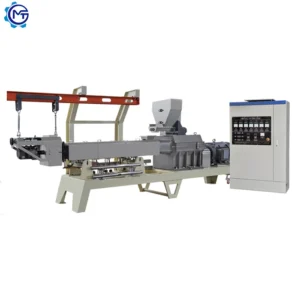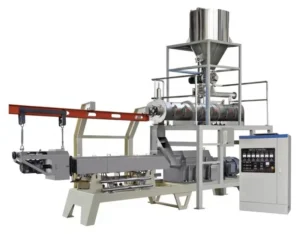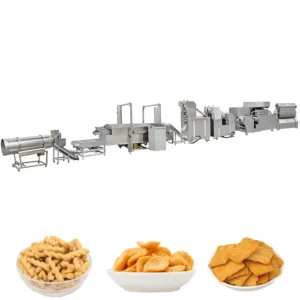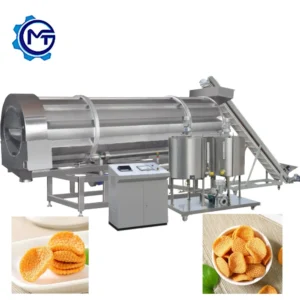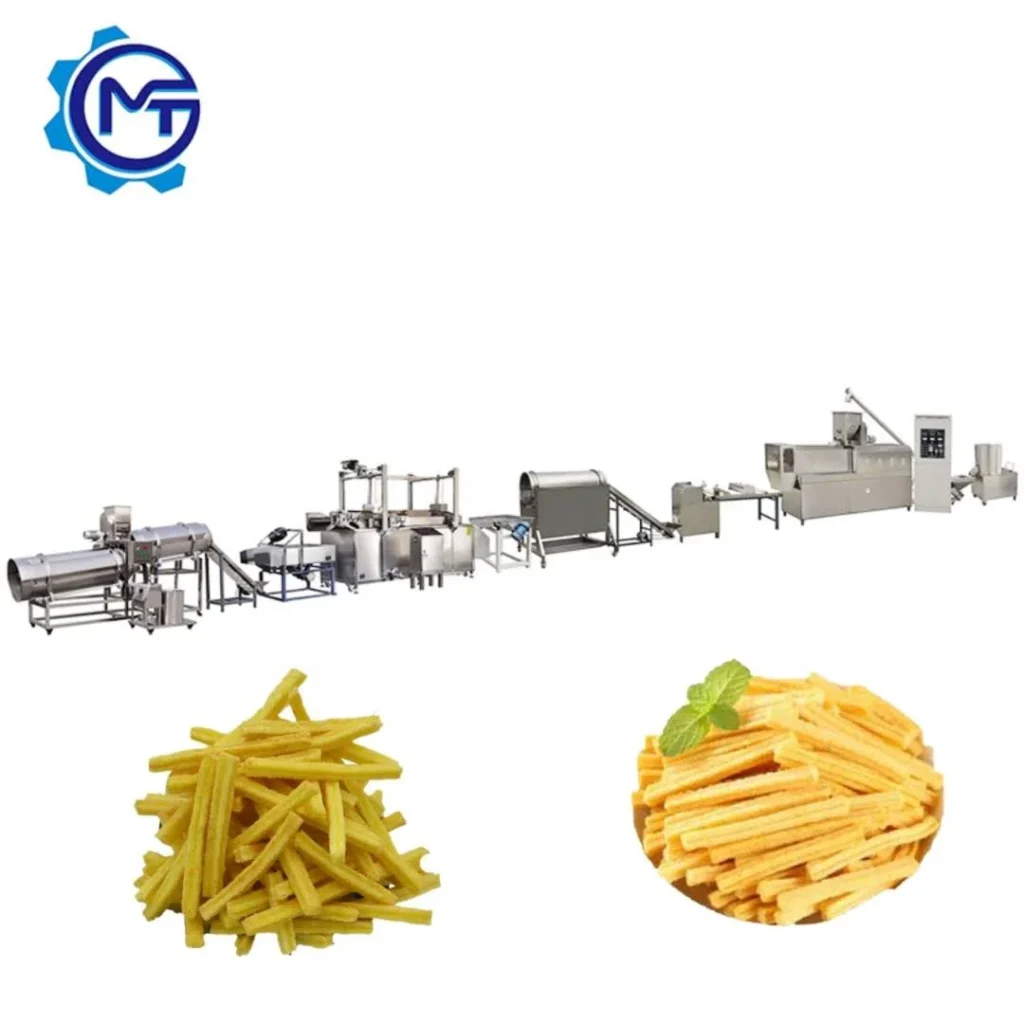
Coordinated Throughput Design — every station from mixer to flavoring drum is sized to the same target output, eliminating the bottleneck that occurs when a fryer or cutter is undersized relative to the press upstream.
Technical Specifications
| Parameter | Value |
|---|---|
| Product Type | Fried Snack Food Processing Line |
| Production Process Flow | Mixer — press machine — cutting machine — fryer — flavoring drum |
| Fryer Power | 60 kW |
| Flavoring Drum Power | 0.37 kW |
| Voltage & Frequency | Three-phase 380 V / 50 Hz; single-phase 220 V / 50 Hz (customizable to local standard) |
| Control System | PLC / MCC / manual — confirm before production (basis not stated in source) |
| Output Capacity | Confirm with raw material, product format and shift hours (basis not stated in source) |
| Fryer Brand | MT |
| Assembly State | Complete integrated line with mixing, pressing, cutting, frying and flavoring stations |
| Certification | CE |
Application Suitability
| Application | Material or Output |
|---|---|
| Rice crust chips (锅巴) | Wheat flour or rice flour blends with controlled gluten content |
| Bugles and horn-shaped fried snacks | Corn-based or wheat-based dough sheets |
| Corn chips and taco shells | Corn masa or corn grits with moisture conditioning |
| Fried puffed snack pellets | Starch-rich formulations requiring expansion control before frying |
| Flatbread-style crispy snacks | Wheat flour with oil and seasoning integration post-fry |
Why a Fryer That Doesn’t Match the Press Will Wreck Your Line
A fried snack food processing line manufacturer must size every station to the same throughput target — not quote each machine independently.
When the press extrudes more dough per hour than the fryer can handle, product queues up on the belt, cools below frying temperature, and enters the oil with inconsistent moisture. The result is uneven color, oil absorption spikes, and a shelf life that varies bag to bag. I have seen lines where the cutter ran fine on paper but the fryer could only handle two-thirds of the output, forcing the operator to idle the press every twenty minutes. [NEED_CITE: throughput mismatch between extrusion and frying stages in snack production]
Full-Line Integration from One Source
When a fried snack food processing line is assembled from separate vendors, each supplier guarantees only their own station. The mixer vendor does not know the fryer belt speed; the fryer vendor has no data on cutter throughput. Sourcing the complete system — mixer, press, cutter, fryer and flavoring drum — from a single supplier means every motor, belt and drum is matched to the same hourly target before the line ships.
Voltage and Frequency Locked Before Production Arrives
Electrical mismatches delay commissioning more than almost any other issue on food processing lines shipped internationally. A fryer rated for 380 V / 50 Hz will underperform on a 440 V / 60 Hz supply, pulling higher current and tripping breakers. This line supports three-phase 380 V / 50 Hz and single-phase 220 V / 50 Hz as standard, and voltage is confirmed against the buyer’s local grid before the electrical schematic is finalized. [NEED_CITE: international voltage and frequency standards for industrial food equipment]
Fryer Configuration for Different Snack Geometries
The fryer in this line is configurable in length and layer count. A single-layer belt suits flat rice crust chips that need full oil submersion for even browning, while a multi-layer design allows bugles and three-dimensional shapes to tumble through the oil with more residence time at lower belt speed. Choosing the wrong layer configuration leads to under-fried centers or over-browned edges depending on the product shape.
How Power Ratings Translate to Real Production Behavior
The 60 kW fryer rating indicates heating capacity — the ability to bring oil back to setpoint after cold product enters. A higher kW value means faster temperature recovery when product load fluctuates, which is critical when switching between thin chips and thicker puffed pieces. The 0.37 kW flavoring drum motor provides gentle tumbling that coats fried surfaces without crushing delicate textures like rice crust chips. Understanding these power values helps buyers predict how the line handles product changeovers rather than treating wattage as a standalone number.
The Hidden Cost of Skipping Trial Runs
Lines shipped without a trial run on the buyer’s actual raw material often reveal problems only after installation. Wheat flour gluten content varies by region — a formulation that produces intact rice crust chips in one country may shatter in the fryer when the flour source changes. Adjusting screw configuration, oil temperature curves and cutter speed after installation means weeks of downtime and scrapped product. [NEED_CITE: raw material variability impact on extruded and fried snack quality]
Why Buyers Choose This Line
Every station is engineered under one roof, so throughput calculations are verified against the complete process rather than individual machine brochures. The in-house testing workshop allows trial runs on the buyer’s actual flour or corn blend before shipment, catching formulation issues early. Voltage, frequency and control language are confirmed in the specification stage, not discovered during commissioning. The fryer and flavoring drum are matched to the cutter output, preventing the bottleneck that plagues multi-vendor lines.
Documentation & Verification
- Line layout drawing showing throughput match across mixer, press, cutter, fryer and flavoring drum
- Trial run report on buyer’s raw material conducted in the testing workshop before dispatch
- Electrical schematic with voltage and frequency locked to destination market standard
- Wear parts list covering press screws, cutter blades and fryer belt components for the first replacement cycle
- CE declaration of conformity for the complete integrated line
Installation, Commissioning & Support
- Floor plan and utility connection points for the 60 kW fryer circuit and flavoring drum power feed
- Assembly and leveling of press, cutter and fryer sections upon arrival at site
- First-run oil temperature profiling and cutter speed calibration on buyer’s product format
- Operator training covering dough moisture adjustment, fryer setpoint tuning and drum seasoning rate
- Scheduled replacement guidance for press screws, cutter blades and fryer belt links
What to Share When Requesting a Quotation
To configure this fried snack food processing line accurately, provide your target product format (rice crust chip, bugle, corn chip or other shape), the flour or corn blend you plan to use, and your intended daily output across available shift hours. Confirm your workshop’s voltage and frequency standard so the electrical design matches from day one. If you have existing upstream or downstream equipment, share the interface dimensions so the new line integrates without modification.
Frequently Asked Questions
Q: How is line capacity verified on my specific raw material and product format?
A: Capacity depends on the flour type, moisture content and target chip geometry. We run your actual raw material through the testing workshop, recording throughput at the press, cutter and fryer to confirm every station holds the same output rate before the line is finalized for production.
Q: What voltage, frequency and control language options are confirmed before production?
A: The standard configuration supports three-phase 380 V / 50 Hz and single-phase 220 V / 50 Hz. Before production begins, we confirm your local grid specification and the preferred language for the control interface so the electrical cabinet and HMI are built to match.
Q: How are fryer dimensions and layer count matched to the target snack shape and throughput?
A: Flat products like rice crust chips typically use a single-layer belt for uniform submersion. Three-dimensional shapes such as bugles may require a multi-layer configuration for longer oil residence at slower belt speed. The selection is based on your product geometry and confirmed throughput target.
Q: Can I run a trial on my raw material before shipment?
A: Yes. Send a sample of your flour or corn blend to the testing workshop. We run the complete process — mixing, pressing, cutting, frying and flavoring — and provide a trial report documenting texture, color and oil absorption results before the line ships.
Q: What spare wear parts are included and how are replacements supplied?
A: The initial shipment includes a wear parts list covering press screws, cutter blades and fryer belt components sized for the first replacement cycle. Replacement parts are manufactured in-house and shipped directly, so compatibility is guaranteed without sourcing from third parties.