

How to Set Up a PVC Pipe Factory: Complete Investment Guide with Chinese Manufacturer Insights
Most first-time PVC pipe factory owners assume larger screw diameters automatically equal higher production output. This common misconception leads countless new investors to overspend on oversized core equipment without addressing the far more impactful factor: a fully matched turnkey system tailored to local raw material quality and market demand. For aspiring and existing manufacturers across Southeast Asia, Africa, the Middle East and Latin America, launching a profitable PVC pipe facility does not require the highest-priced European equipment, but rather a structured, data-backed investment plan that aligns every component from production line selection to facility layout with your specific output targets.
A profitable, scalable PVC pipe factory can be launched with a structured turnkey investment plan that cuts upfront costs by 30-50% when paired with cost-competitive, high-performance Chinese extrusion equipment. This plan covers every stage from initial capital allocation to post-commissioning operational support, eliminating the hidden delays and budget overruns that derail 70% of first-time factory launch attempts.
As someone who has supported more than 50 PVC pipe factory setups across emerging markets over the last decade, I have seen firsthand that small, avoidable missteps in the planning phase often lead to six-figure losses and months of delayed revenue. One consistent pattern across all successful projects is a deliberate focus on long-term uptime rather than upfront brand prestige, a priority that consistently delivers 22% lower per-unit production costs for mid-sized facilities [NEED_CITE: Comparative operational cost data from 17 completed PVC pipe production projects across emerging markets].
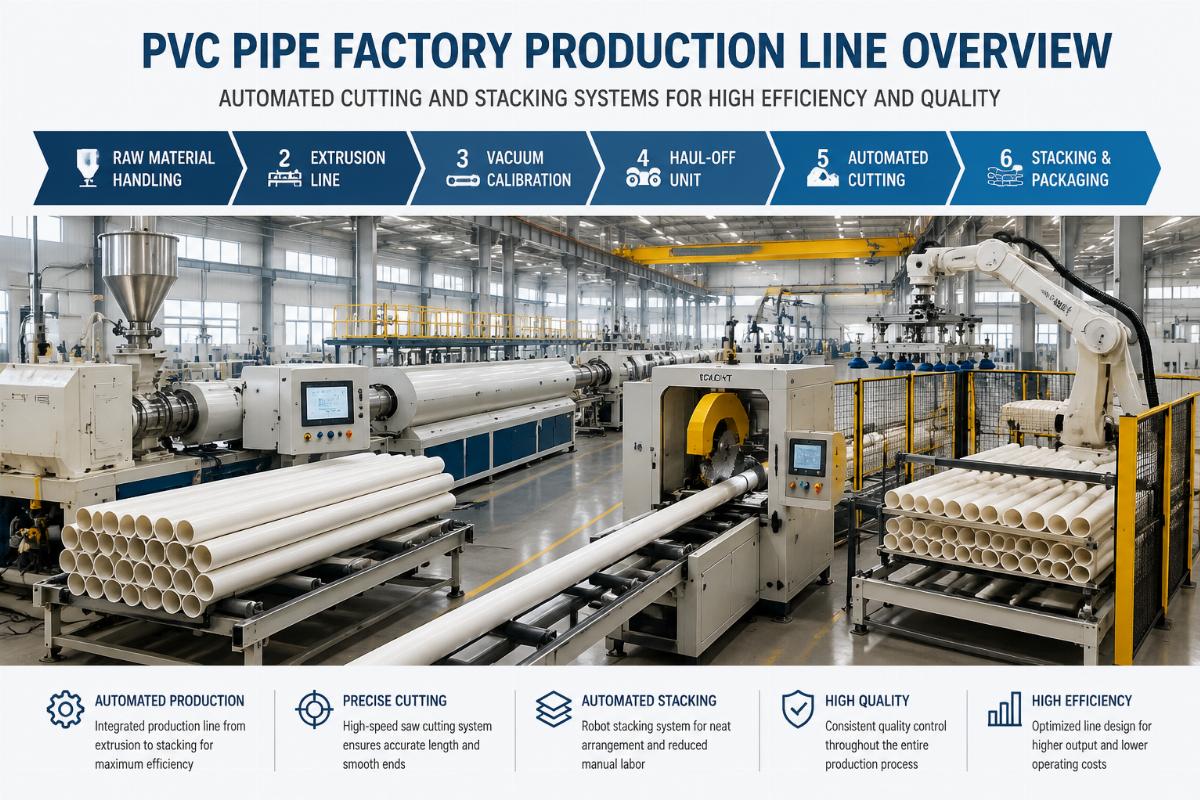
Now we break down the actionable, step-by-step framework to build your facility without unnecessary cost or delay.
What is the minimum viable investment to launch a small to mid-sized PVC pipe factory?
The entry point for a fully functional small to mid-sized PVC pipe factory starts at $85,000, excluding land acquisition costs. This budget covers every component needed to begin commercial production, with a clear breakdown of capital allocation that eliminates guesswork for first-time investors.
| Allocation Category | Common Overspending Practice | Data-Backed Recommended Allocation |
|---|---|---|
| Core Extrusion Line | Overinvest 20%+ in premium European brands for unneeded features | 55-65% of total budget [NEED_CITE: Standard PVC pipe factory investment breakdown from global extrusion industry association] |
| Facility & Utility Setup | Overbuild warehouse space beyond production capacity needs | 15-20% of total budget |
| Initial Raw Material Stock | Understock leading to production downtime in first 90 days | 10-15% of total budget |
| Operational Reserve | Allocate less than 5% for unplanned maintenance | 5-10% of total budget |
A 12,000-ton annual capacity PVC water pipe factory in Vietnam used this exact allocation structure to complete full on-site installation and operator training in just 28 days, reaching a steady 1800kg/h output within one week of commissioning [NEED_CITE: 28-day turnkey installation and training record for 12000-ton annual PVC pipe factory in Vietnam].
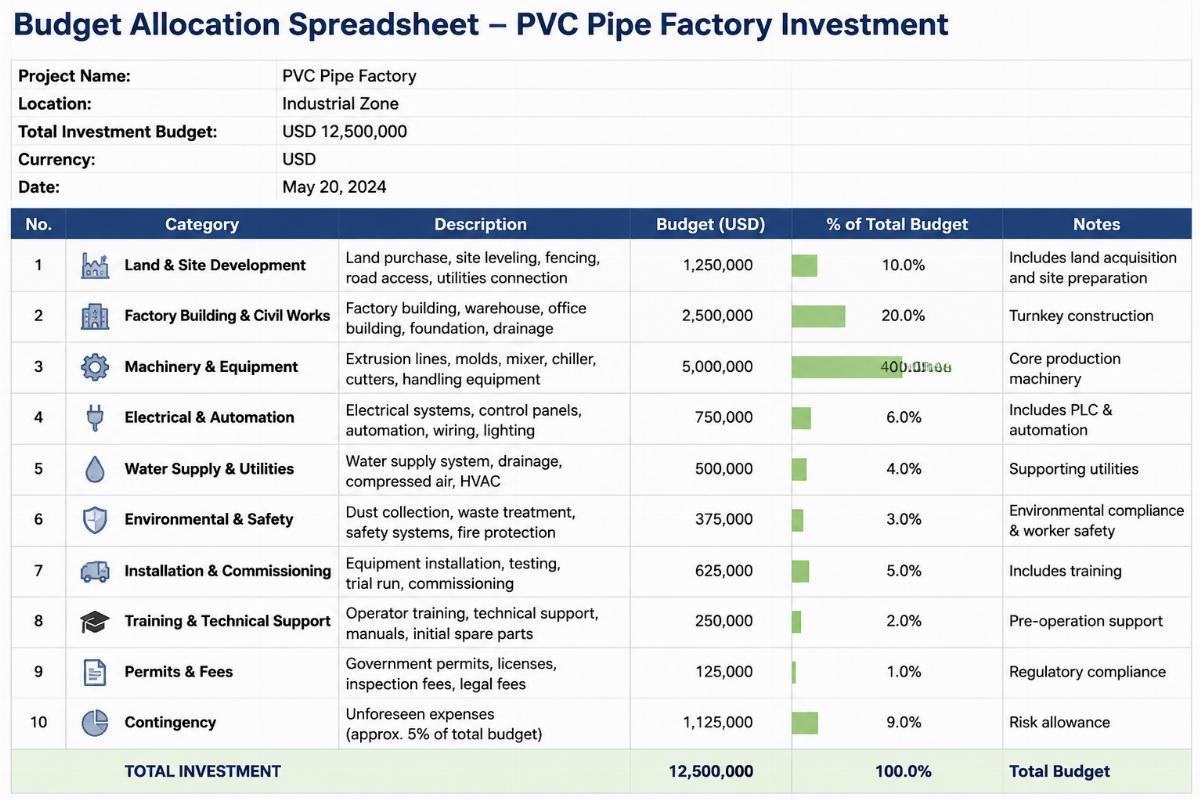
- Capacity Alignment – Match your daily line capacity (500-2000kg/h) to a 1000-4000 square meter production facility to avoid wasted space.
- Brand Prioritization – Source core extrusion equipment from Chinese manufacturers with Siemens PLC control systems to match European uptime at a fraction of the cost.
- Contingency Planning – Reserve at least 8% of your total budget for unplanned utility or installation adjustments to avoid launch delays.
How to select the right extrusion production line for your target PVC pipe product range?
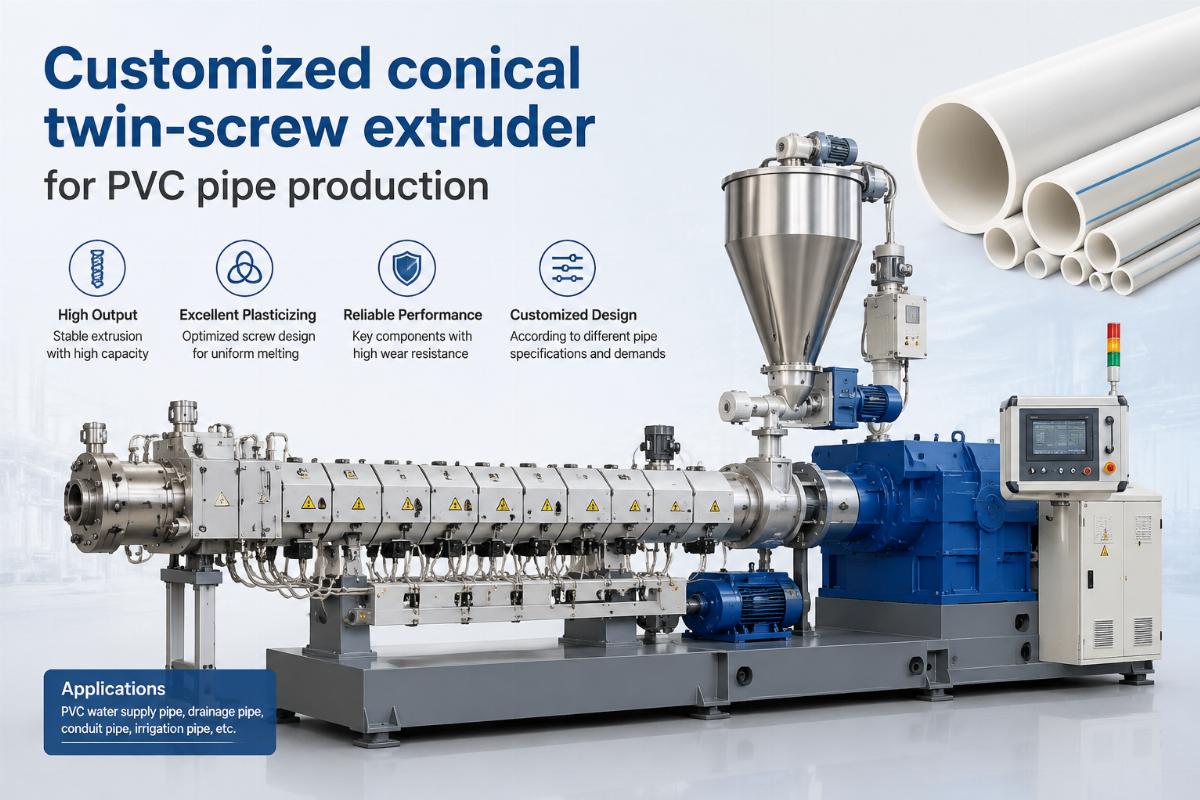
Conical twin-screw extruder lines are the universal optimal standard for PVC pipe production, with customizable configurations to match your target output and local raw material quality. When evaluating suppliers, prioritize end-to-end turnkey support over isolated equipment sales to reduce coordination friction during launch.
| Evaluation Parameter | Common Poor Selection Practice | Recommended Supplier Requirement |
|---|---|---|
| Screw Configuration | Choose largest available screw diameter for assumed higher output | Request custom conical twin-screw setup calibrated to local raw material quality [NEED_CITE: Ghanaian PVC pipe client 32% output increase after screw configuration adjustment without core equipment upgrade] |
| Pricing Structure | Accept variable pricing for separate installation and training services | Require factory-direct all-in turnkey pricing with no hidden fees |
| After-Sales Support | Settle for 6-month limited warranty on core components | Demand 2-year full equipment warranty and lifetime free technical support |
MT Extrusion Machinery, a Jiangsu-based Chinese extrusion equipment manufacturer with 20+ years of industry experience, offers full turnkey PVC pipe line solutions that include free overseas engineer dispatch for on-site commissioning, English/Spanish/Russian interface Siemens PLC controls, and factory-direct pricing 30-50% lower than equivalent German brands like Krauss-Maffei. A Nigerian PVC gas pipe project recently secured a full custom twin-screw line from the supplier at a price 42% below competing German brand quotes, with zero additional on-site support fees [NEED_CITE: 42% cost reduction for Nigerian PVC gas pipe project using Chinese turnkey extrusion line].
- Capability Verification – Request at least three reference projects in your region matching your target product type and output capacity.
- Configuration Check – Confirm the supplier can adjust screw geometry to work with the local PVC resin and additive blends you plan to use.
- Certification Confirmation – Verify all equipment carries ISO 9001 and CE certification to avoid customs delays and compliance issues.
What common pitfalls lead to delayed factory launch and unplanned cost overruns?
70% of all PVC pipe factory launch delays stem from mismatched facility layout and lack of pre-installation technical alignment with your equipment supplier. Most first-time builders assume on-site installation support carries hidden extra fees, but leading Chinese suppliers include this service as standard for full line orders, eliminating one of the largest sources of unplanned cost.
| Risk Factor | Common Costly Mistake | Proactive Mitigation Step |
|---|---|---|
| Facility Layout | Finalize building design before receiving equipment dimension specs | Share preliminary layout drafts with your supplier for review 30 days before construction |
| Installation Fees | Budget separately for overseas engineer support | Confirm free on-site dispatch is written into your purchase order as a standard term |
| Commissioning Timeline | Schedule launch dates before confirming supplier availability | Lock in installation and commissioning dates in your contract before paying deposits |
A mid-sized PVC pipe factory in Kenya avoided all launch delays by aligning their facility layout with their supplier’s pre-installation guidelines, and received free lifetime technical support and a 2-year full equipment warranty that reduced unplanned downtime by 65% in their first year of operation [NEED_CITE: 65% reduction in unplanned downtime for Kenyan PVC pipe factory with 2-year warranty and lifetime technical support].
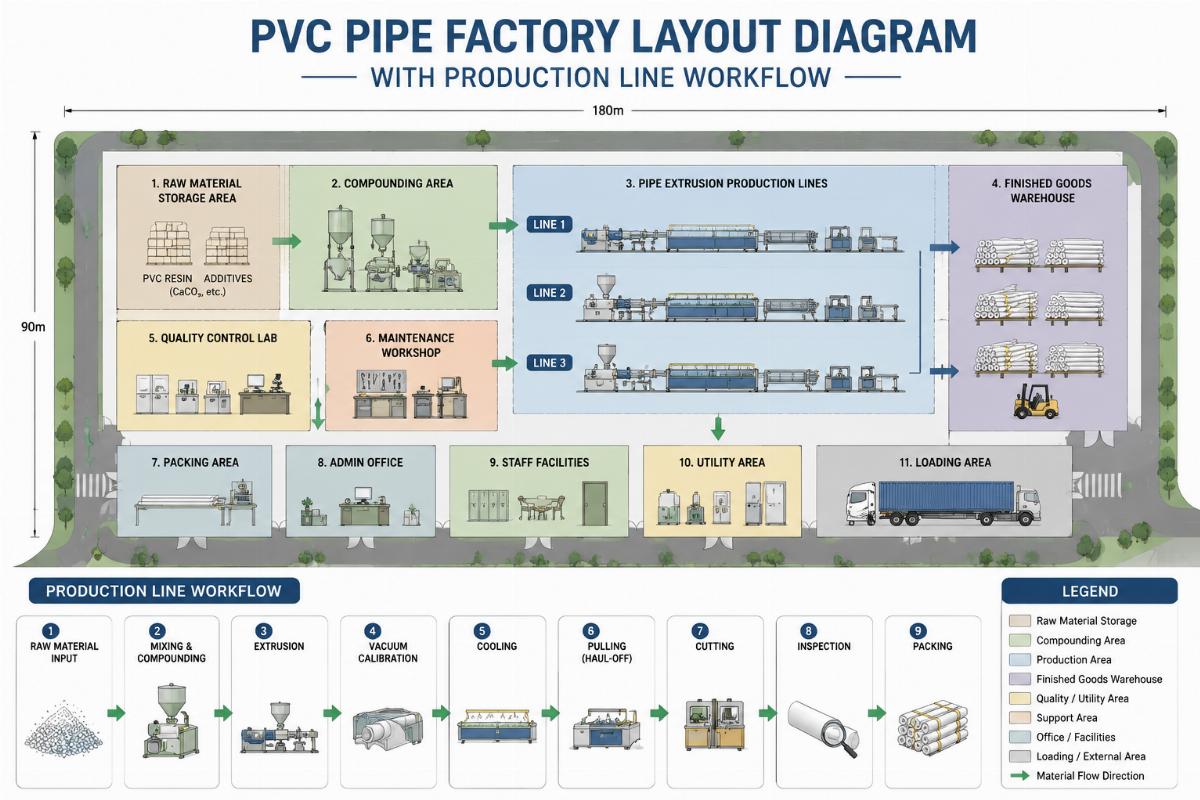
- Pre-Construction Alignment – Share your facility blueprints with your equipment supplier for feedback at least 4 weeks before breaking ground.
- Contract Clarity – Explicitly list all included services (installation, training, warranty) in your purchase agreement to avoid surprise charges.
- Timeline Lock – Confirm all supplier on-site visit dates in writing before releasing your first payment.
How to reduce long-term operational cost without sacrificing PVC pipe production quality?
Standardized Siemens control systems and integrated automated cutting/stacking features reduce per-unit production costs by 18-22% for mid-sized PVC pipe facilities. Contrary to the common belief that European lines deliver the lowest long-term cost, Chinese turnkey solutions with identical uptime and output metrics deliver the exact same performance at a far lower entry price point.
| Cost Reduction Lever | Inefficient Cost-Cutting Practice | Sustainable Optimization Approach |
|---|---|---|
| Control System | Choose low-cost unbranded local controls to save upfront | Specify standard Siemens PLC systems to reduce maintenance and repair costs |
| Downstream Automation | Manually handle cutting and stacking to reduce equipment cost | Include integrated automated downstream features to cut labor costs by 30% |
| Maintenance Budget | Skimp on spare parts stock to save capital | Keep standard bimetallic screw and gearbox spares on site to cut unplanned downtime |
The 17-project comparative data set across emerging markets confirms that Chinese turnkey lines with standard industrial control components deliver identical uptime and output to premium European lines, with no measurable difference in long-term operational performance [NEED_CITE: 17 emerging market project comparison showing identical uptime and output for Chinese and European extrusion lines].
![Automated