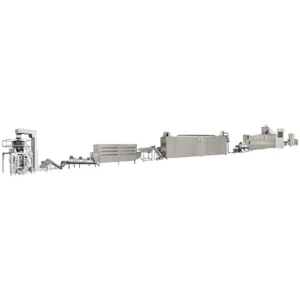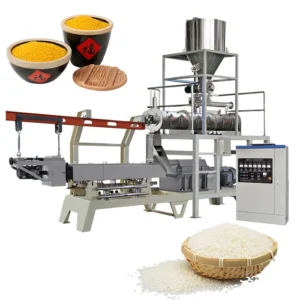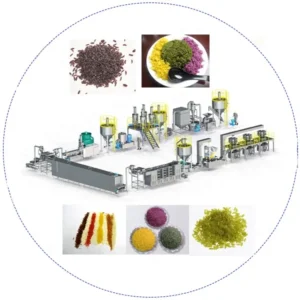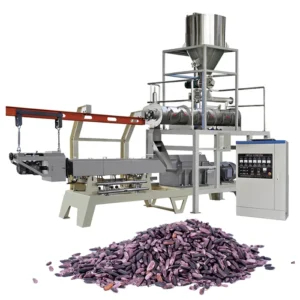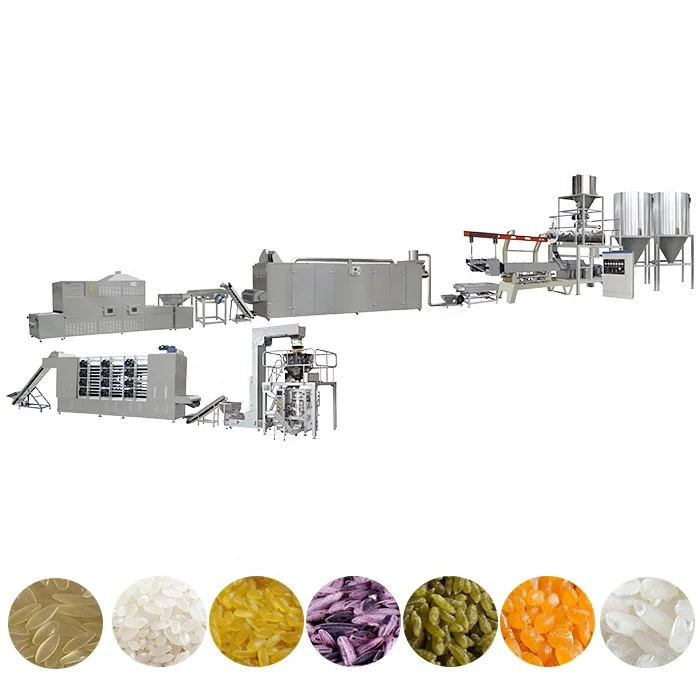
Full Equipment Range — Every station on the artificial rice processing line is throughput-matched and supplied as a coordinated set, so no mixer or dryer bottlenecks the extruder output.
Technical Specifications
| Parameter | Value |
|---|---|
| Product Type | Nutritional and Artificial Rice Processing Line |
| Line Model Options | MT65 / MT70 / MT85 |
| Extruder Screw Type | Twin-screw |
| Control System | PLC and MCC integrated across line stations |
| MT65 Power Consumption | 60 kW |
| MT65 Output | 70–100 kg/h (basis not stated in source — confirm raw material, moisture and pellet format) |
| MT65 Overall Dimensions | 28000 × 1200 × 2200 mm |
| MT70 Power Consumption | 85 kW |
| MT70 Output | 100–120 kg/h (basis not stated in source — confirm raw material, moisture and pellet format) |
| MT70 Overall Dimensions | 30000 × 1500 × 2200 mm |
| MT85 Power Consumption | 165 kW |
| MT85 Output | 200–300 kg/h (basis not stated in source — confirm raw material, moisture and pellet format) |
| MT85 Overall Dimensions | 34000 × 3500 × 4300 mm |
| Mixer Motor Power | 4.0 kW |
| Mixer Batch Output | 3.0–4.0 kg/time (basis not stated in source — confirm raw material density and moisture addition) |
| Mixer Dimensions | 1200 × 900 × 1400 mm |
| Screw Conveyor Motor | 1.1 kW |
| Screw Conveyor Capacity | 0–150 kg/h (basis not stated in source — confirm material bulk density and inclination angle) |
| Screw Conveyor Dimensions | 2500 × 600 × 2300 mm |
| Extruder Die System | Interchangeable moulds for varying rice grain shapes |
| Certification | CE |
Application Suitability
| Application | Material or Output |
|---|---|
| Fortified artificial rice production | Rice flour, broken rice, vitamins, minerals and protein blends |
| Golden rice and nutrient-enhanced grain | Corn, millet and micronutrient premix |
| Buckwheat rice extrusion | Buckwheat flour and starch-based binder |
| Purple potato rice formation | Purple potato powder and grain flour |
| Multi-grain reconstituted rice | Black rice, millet and mixed cereal streams |
What "Nominal Line Capacity" Actually Means for Your Output
Rated capacity is measured on a reference material; your actual blend of millet, whey protein or buckwheat will behave differently inside the extruder barrel.
I once watched a nutritional powder line trial run perfectly on standard corn flour, only to choke on the customer’s real formulation during installation. The moisture absorption rate and fat content were completely different, which shifted the dough viscosity and ruined expansion density. When evaluating an artificial rice processing line equipment supplier, the number on the spec sheet matters less than whether the line has been proven on your specific raw material formulation before it leaves the factory [NEED_CITE: twin-screw extrusion behaviour across varying starch and protein ratios].
Station-by-Station Lineup from Mixing to Packing
This artificial rice processing line equipment set covers every production stage under one specification package. The sequence begins with a ribbon mixer blending the grain flour with fortification premixes, followed by a screw conveyor feeding the twin-screw extruder at a controlled rate. After extrusion, the formed rice kernels pass through shaping, cooking and drying stations before reaching cooling and packing. Each station is selected so its throughput ceiling matches the extruder output, preventing the common situation where a faster extruder floods a slower dryer.
Matching Dryer Capacity to Extruder Output
The drying stage determines final product moisture and shelf stability, yet it is often the first station to create a bottleneck. If the extruder pushes more wet kernels than the dryer can handle in a single pass, operators either slow the entire line or accept unevenly dried output with internal moisture pockets. The nutritional rice extrusion line manufacturer configures the dryer belt length, airflow temperature and residence time to the specific moisture content of the extruded rice kernel, keeping the full line running at a steady rate without product backlog [NEED_CITE: drying residence time and moisture gradient in extruded grain products].
Reading the Specification Sheet Beyond Motor Power
Motor power figures like 60 kW for the MT65 or 165 kW for the MT85 indicate total installed load, but actual energy draw depends on screw speed, barrel temperature profile and raw material friction. The twin-screw configuration matters because the intermeshing screw elements generate shear and heat differently than single-screw designs, making the extruder more adaptable to high-protein or high-fiber flour blends. Interchangeable die moulds allow shape changes — from long-grain to short-grain profiles — without swapping the entire die plate assembly. Meanwhile, the PLC and MCC control system coordinates start-up sequencing and speed matching across mixer, conveyor and extruder, which is critical for maintaining consistent batch density during shift changes.
The Hidden Cost of Assembling Stations from Separate Vendors
When the mixer, extruder and dryer come from different suppliers, throughput mismatches are almost guaranteed. One vendor rates their mixer at a batch weight that does not align with the extruder’s continuous feed rate, forcing operators to idle between batches. Another supplies a dryer sized for a different product density, leaving the rice kernels under-dried or over-dried depending on ambient humidity. These mismatches do not show up on individual machine spec sheets — they only appear during commissioning, when the line refuses to hold its quoted capacity [NEED_CITE: throughput balancing across multi-vendor food processing lines].
Why Source the Full Line from One Equipment Range
Every station on this line is specified as part of a coordinated set, so the mixer batch cycle, screw conveyor feed rate, extruder throughput and dryer residence time are calculated together. Three capacity tiers — MT65, MT70 and MT85 — allow buyers to select a model based on their target daily output and available factory floor length, which ranges from 28 meters to 34 meters. The interchangeable die and mould system means one extruder can produce multiple rice grain shapes, reducing the need for duplicate machines. In-house trial runs on the buyer’s actual raw material formulation take place before shipment, so screw configuration and barrel temperature profiles are set to the real blend rather than a generic reference flour. PLC and MCC control across all stations ensures coordinated start-up, speed synchronization and emergency shutdown logic.
Documentation & Verification
- Line layout drawing showing every station position, conveyor run and utility connection point
- Machine specification sheet for each individual station with motor power and dimensions
- Screw and die configuration record matched to the buyer’s raw material blend
- Trial run report on customer formulation conducted in the testing workshop before dispatch
- Electrical schematic confirming voltage, frequency and control language for the destination market
- CE declaration of conformity for the complete line assembly
Installation, Commissioning & Support
- Floor space from 28 m to 34 m in length requires leveled concrete foundation with drainage
- Three-phase power supply sized to total line consumption between 60 kW and 165 kW
- Stations arrive in modular sections for sequential assembly along the production line axis
- First-run parameter setting covers screw speed, barrel zone temperatures and dryer airflow
- Operator training addresses die changeover, PLC fault diagnosis and MCC reset procedures
- Wear parts inventory includes replacement screw elements, die inserts and conveyor bearings
Preparing Your Line Inquiry
To configure the right artificial rice processing line equipment for your facility, specify the raw material formulation including grain type, protein content and added micronutrients. Confirm the target daily output, available floor length and ceiling height, along with the local voltage and frequency standard. If you plan to produce multiple rice shapes, note which die profiles you need from the start and which can be added later.
Frequently Asked Questions
Q: Which stations are included in the full line, and can I order machines individually?
A: The complete nutritional rice extrusion line manufacturer package covers mixer, screw conveyor, twin-screw extruder, shaping unit, dryer, cooler and packing station. Individual machines can be ordered separately, but throughput matching is calculated for the full set. Ordering standalone units means you assume responsibility for ensuring the upstream and downstream stations can handle the extruder output.
Q: How is throughput matched between the mixer, extruder and dryer?
A: Each station is selected so its maximum throughput aligns with the extruder’s rated output on the target raw material. The mixer batch cycle time feeds the screw conveyor at a continuous rate, while the dryer belt length and airflow are sized to remove moisture from the full extruder output without creating a product queue. This prevents the common bottleneck where one station forces the entire line to slow down.
Q: What raw materials have been tested on this artificial rice processing line?
A: Trial runs have been conducted on rice flour, millet, buckwheat, black rice and blends fortified with vitamins, minerals and protein. Each formulation behaves differently in the twin-screw extruder due to varying starch gelatinization temperatures and moisture absorption rates. A pre-shipment trial on the buyer’s specific recipe confirms the correct screw configuration and barrel temperature profile before the line is dispatched.
Q: How does the die and mould system support different rice grain shapes?
A: The extruder uses interchangeable die plates and mould inserts to produce varying rice profiles — long-grain, short-grain or specialty shapes — on the same base machine. Changing the die does not require replacing the screw configuration or barrel assembly, so shape changeovers are completed during scheduled downtime. The PLC stores parameter recipes for each die type, allowing operators to recall the correct screw speed and temperature settings.
Q: What footprint and utility requirements apply to each model tier?
A: The MT65 line requires approximately 28 meters of floor length with 60 kW total power, while the MT70 extends to 30 meters at 85 kW. The MT85 occupies 34 meters with 165 kW installed load and a wider footprint to accommodate the larger dryer and cooling conveyors. All models require three-phase power, compressed air for pneumatic valves and water supply for barrel temperature control circuits.