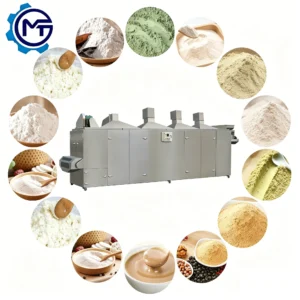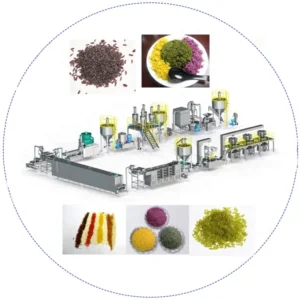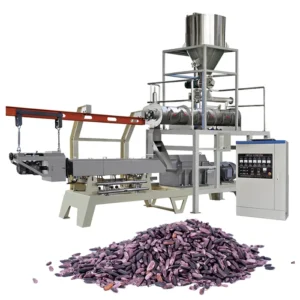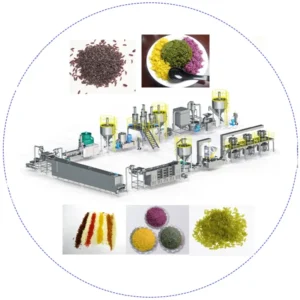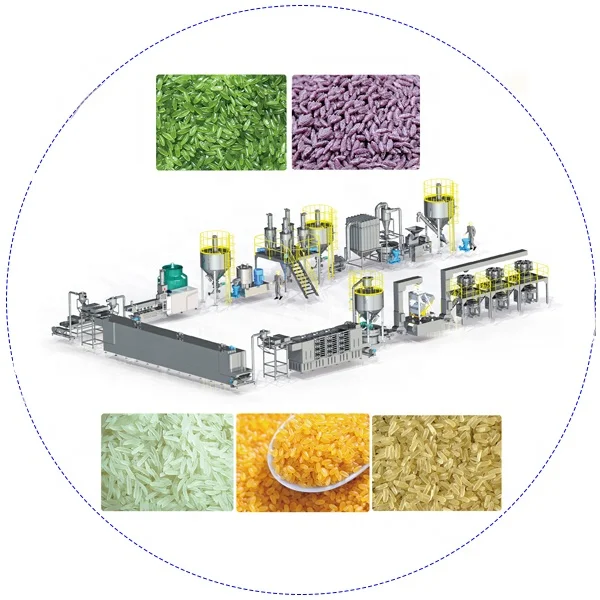
Throughput Matched Across Stations — every supporting unit from batching to packing is sized against the extruder output so no single station bottlenecks the line.
Technical Specifications
| Parameter | Value |
|---|---|
| Product Type | Fortified Rice Kernel Extrusion Production Line |
| Model Range | MT65 / MT70 / MT85 / MT75 / MT95 |
| Installed Power | MT65: 85 kW · MT70: 120 kW · MT85: 235 kW · MT75: 180 kW · MT95: 260 kW |
| Power Consumption | MT65: 60 kW · MT70: 85 kW · MT85: 165 kW · MT75: 135 kW · MT95: 195 kW |
| Output Capacity | MT65: 80–100 kg/h · MT70: 100–120 kg/h · MT85: 200–300 kg/h · MT75: 300–500 kg/h · MT95: 800–1000 kg/h (basis to be confirmed against raw material and moisture content) |
| Overall Dimensions (L×W×H) | MT65: 28×1.2×2.2 m · MT70: 30×1.5×2.2 m · MT85: 34×3.5×4.3 m · MT75: 32×3.5×4.3 m · MT95: 36×3.5×4.3 m |
| Screw Type | Twin screw |
| Feeding System | Single or double screw feeding system available per material |
| Control System | Frequency speed controlling with high automation |
| Lubrication | Automatic lubricating and cooling system |
| Drying Oven Heating Source | Electric or gas |
| Drying Oven Feature | Circulation drying process, frequency motor controls mesh belt speed |
Application Suitability
| Application | Material or Output |
|---|---|
| Fortified rice kernel production | Broken rice and rice bran base with vitamin and mineral micro-nutrient addition |
| Artificial rice manufacturing | Starch-based formulations reconstituted into kernel shapes |
| Nutritional rice processing | Rice, corn, millet, wheat, oats, buckwheat, and bean blends with fortification |
| Reconstituted rice from by-products | Broken rice fractions recovered into uniform kernel output |
Why the Dryer Spec Matters More Than the Extruder Nameplate
A Fortified Rice Production Line is only as fast as its slowest downstream station.
I once walked into a facility where the extruder was pushing product faster than the oven could remove moisture. Kernels piled up on the mesh belt, stuck together, and cracked during cooling. The operator had to throttle the extruder back to match the dryer, which meant the line never reached the output the buyer had planned around. When you survey equipment for a nutritional powder processing line, the drying oven length, heating source, and belt speed range should be evaluated alongside extruder throughput — not after the extruder is already on order. [NEED_CITE: moisture removal rates in multi-pass circulation drying ovens for extruded rice kernels]
Mapping the Full Equipment Range for Rice Kernel Extrusion
This catalogue covers every station a Fortified Rice Production Line requires, starting from the batching and mixing system through twin-screw extrusion, vibrating separation, low-temperature drying, cooling, high-temperature roasting, a second cooling pass, and final packing. Each unit is selected so that material flow between stations remains continuous without buffer accumulation. Buyers reviewing the machine catalogue can identify exactly where each supporting station fits and how it connects to adjacent equipment.
How Circulation Drying and Roasting Stages Shape the Final Kernel
The drying oven uses a circulation process with a frequency-controlled mesh belt, allowing operators to adjust residence time based on kernel size and moisture target. Following low-temperature drying, the high-temperature roasting stage sets the kernel structure and develops surface hardness. [NEED_CITE: starch retrogradation effects during multi-stage drying of extruded rice products] This two-stage thermal sequence prevents the internal cracking that occurs when moisture is driven off too quickly, a common issue in single-pass oven setups processing starch-rich formulations.
Reading the Power and Capacity Data Correctly
The twin-screw design across all five models ensures consistent shear and residence time, which is critical when processing vitamin and mineral premixes into a rice flour base. Installed power ranges from 85 kW on the MT65 to 260 kW on the MT95, while actual power consumption sits notably lower — between 60 kW and 195 kW — depending on load and formulation. The automatic lubricating and cooling system protects the gearbox during continuous runs, reducing the thermal stress that accelerates screw and barrel wear. For facilities choosing between electric and gas heating on the drying oven, the decision affects both utility infrastructure requirements and per-hour operating cost, so confirming the available energy source at the installation site before specifying the oven is essential.
The Cost of Skipping Downstream Capacity Verification
When an extruder is ordered without matching the dryer and cooler to its actual output, the consequences compound. Kernels that enter the dryer too densely packed retain uneven moisture, leading to breakage during the cooling pass. The packing station then receives a mix of intact and fractured kernels, increasing reject rates. [NEED_CITE: post-extrusion moisture uniformity requirements for shelf-stable rice kernels] These problems surface only after installation, when the line is already assembled and reconfiguring stations means new conveyors, structural changes, and production downtime.
Why Source the Full Range from One Equipment Catalogue
Every station on this Fortified Rice Production Line is configured under one supplier, so throughput calculations are cross-checked between mixing output, extruder capacity, dryer belt load, and packing speed before the layout is finalized. Screw configuration and die design are specified to your raw material and target kernel shape, not copied from a generic build. The in-house testing workshop runs trial production on your actual formulation before shipment, so process adjustments happen at the factory rather than on your floor. Electrical schematics and voltage specifications are confirmed for the destination market, and CE documentation supports import compliance. Frequency-controlled drives across extruder, dryer, and conveyor stations allow operators to fine-tune line speed as a single coordinated system.
Documentation & Verification
- Line layout drawing with throughput matched across every station for your selected model
- Screw and die configuration record matched to your rice flour and micro-nutrient formulation
- Electrical schematic with voltage and frequency confirmed for destination market
- Trial run report on your raw material produced in the testing workshop before shipment
- CE declaration of conformity for import clearance documentation
Installation, Commissioning & Support
- Floor space planning based on the selected model dimensions, up to 36 m line length
- Power supply verification against installed power rating, up to 260 kW for the MT95
- Gas or electric oven heating connection matched to available utility infrastructure
- Frequency drive calibration across extruder, dryer belt, and conveyor stations
- Operator training on twin-screw feeding adjustment and automatic lubrication monitoring
- Wear parts list covering screws, dies, and mesh belt sections for first-year spares planning
What We Need to Configure Your Line
Share your primary raw material composition, including the ratio of broken rice or starch base to vitamin and mineral premix, along with your target daily output and available workshop dimensions. Confirm the local voltage and frequency standard, and let us know whether gas or electric heating is preferred for the drying oven. If you have existing upstream or downstream equipment that must integrate with the new line, provide the connection point specifications so the layout accounts for them.
Frequently Asked Questions
Q: How do I match dryer and cooler capacity to the extruder model I select?
A: The drying oven belt width and length, along with the cooling conveyor stage, are sized to the extruder output range of your chosen model. During line configuration, we calculate the required residence time at your target moisture level and select oven dimensions accordingly, so no station bottlenecks the Fortified Rice Production Line.
Q: What supporting stations are included between extrusion and packing?
A: The line includes a vibrating separator after extrusion, followed by a low-temperature circulation drying oven, a cooling conveyor, a high-temperature roasting stage, and a second cooling pass before packing. Each station is specified in the machine catalogue to match the throughput of the selected extruder model.
Q: How do I choose between single and double screw feeding for my raw material?
A: Single screw feeding works for uniform rice flour blends, while double screw feeding handles premixes containing vitamins, minerals, or ingredients with varying particle sizes. The choice depends on your formulation uniformity requirements, and both options are available across all extruder models in this range.
Q: What utility requirements does each model need?
A: Power supply must accommodate the installed power rating of the selected model, from 85 kW to 260 kW. The drying oven is available with electric or gas heating. Overall line length ranges from 28 m to 36 m, and we provide a detailed utility connection plan during layout confirmation.
Q: Can I survey individual machines or must I purchase the complete line?
A: You can review every station individually in this equipment catalogue. However, we recommend configuring the full Fortified Rice Production Line together so that throughput, power, and control systems are matched across all stations before any single unit goes into production.