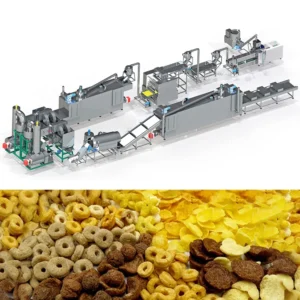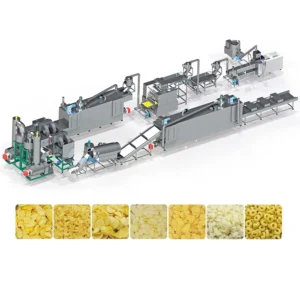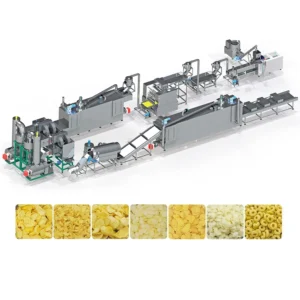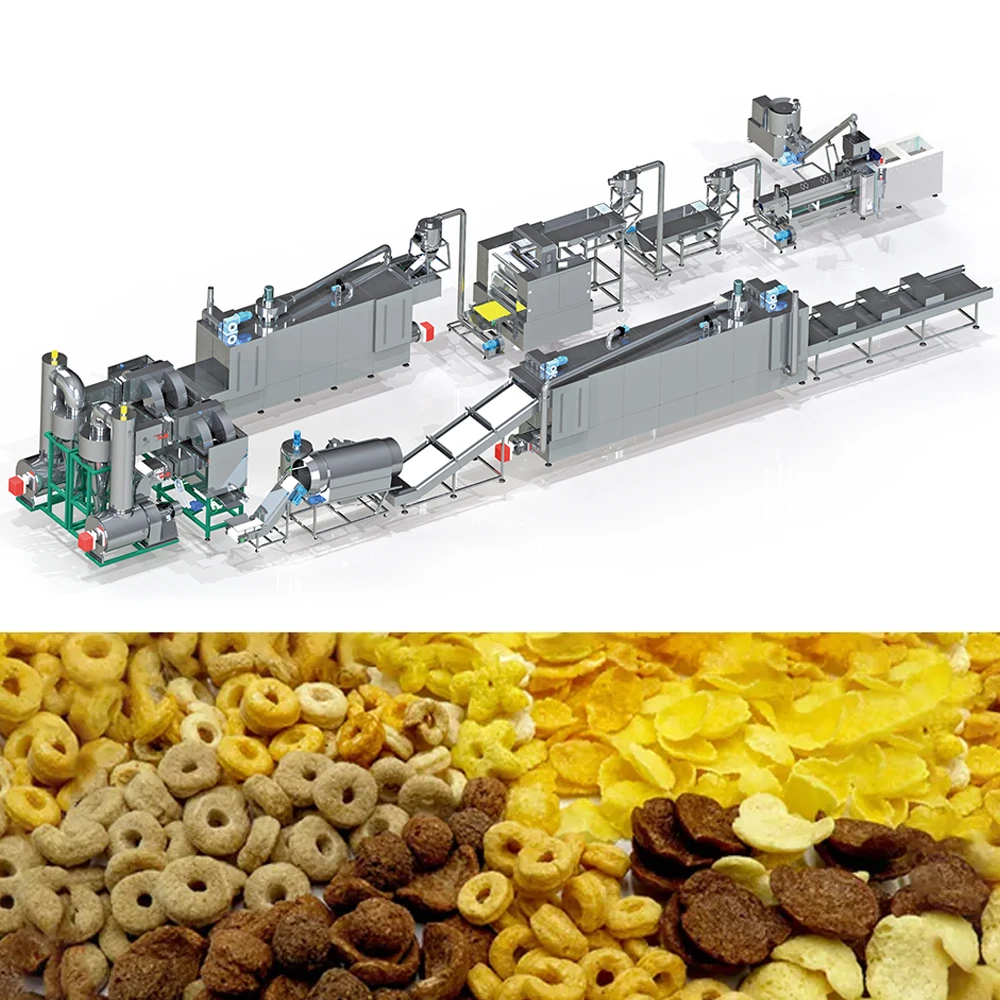
Matched Throughput Across Stations — every supporting unit in this breakfast cereals corn flakes machine range is specified to balance with the extruder output, preventing dryers or coaters from becoming line bottlenecks.
Technical Specifications
| Parameter | Value |
|---|---|
| Product Type | Breakfast Cereals & Corn Flakes Production Line |
| Model Options | MT70 / MT85 / MT75 |
| Screw Type | Twin Screw |
| Installed Power | MT70: 160 kW | MT85: 190 kW | MT75: 210 kW |
| Power Consumption | MT70: 120 kW | MT85: 140 kW | MT75: 150 kW |
| Capacity | MT70: 150–200 kg/hr (basis not stated in source) | MT85: 300–400 kg/hr (basis not stated in source) | MT75: 300–500 kg/hr (basis not stated in source) |
| Overall Dimensions (L×W×H) | MT70: 41 × 1.5 × 2.2 m | MT85: 43 × 1.5 × 3.2 m | MT75: 45 × 1.5 × 3.5 m |
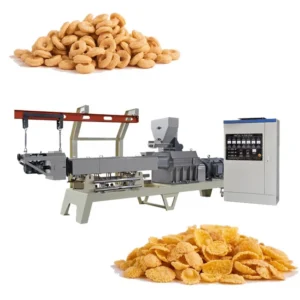
| Extruder Working Principle | Feeding system, extruding system, cutting system, heating system, gearing system, controlling system |
| Control System | PLC control (flaking machinery); MCC & PLC (extruder line) |
| Flaking Machinery | Hydraulic system for double rollers; double motors for separate roller driving; infrared sensor for temperature pipe control |
| Dryer Heating Source | Gas / Electric |
| Hot Air Roasting Oven | Conciliation burner; two separate circulating fans; cyclone dust removal device; vibrating pan with high-temperature spraying tubes |
| Coating System | Double tumble for sugar melting, elevator, coating drum, spraying nozzle |
| Basic Raw Materials | Powder of corn, rice, wheat, oat, barley |
| Line Stations | Mixing → Extruding → Flaking → Drying → Hot Air Roasting → (Sugar Spraying → Sugar Coating → Drying) → Cooling → Packing |
| Voltage Options | 415V 50/60Hz; 440V 50/60Hz; 220V 60Hz (customizable) |
| Assembly State | Turnkey line, full project from pre-treatment to final packing |
| Standards | CE certified; ISO certified |
Application Suitability
| Application | Material or Output |
|---|---|
| Natural corn flakes production | Corn grits and maize powder processed through extrusion, flaking, drying and roasting |
| Sugar-coated corn flakes | Corn or rice base with sugar spray and tumble coating before final drying |
| Instant breakfast cereals | Wheat, oat or barley powder formulated for quick rehydration in milk or hot water |
| Shaped cereal pieces | Ball, tube, stick, ring, fruit loop, star, wheel, flower, heart forms via adjustable extruder mould |
| Fortified breakfast cereal | Blended grain powders with added nutritional premix for institutional or retail markets |
Why Matching Dryer Capacity to Your Extruder Matters More Than You Think
A breakfast cereals corn flakes machine for sale listed at a strong hourly output will underperform the moment the dryer cannot keep pace with the extruder. Specifying each station as an integrated set prevents throughput mismatches that silently cap production.
I watched a line in West Africa where the extruder was pushing out hot, moist flakes faster than the dryer could handle. The moisture content at the dryer exit was high enough to cause clumping in the roaster, which then fouled the coating drum downstream. The buyer spent days adjusting screw speeds to artificially slow the front end, essentially running the extruder below the capacity they had paid for [NEED_CITE: consequences of mismatched station throughput in food extrusion lines]. The line only reached balance after the dryer section was reconfigured.
Sizing the Extruder to Your Target Cereal Format
The MT70, MT85 and MT75 models span distinct capacity tiers, giving buyers room to match extrusion output to the specific cereal product and raw material they intend to process. A twin-screw configuration handles the variable moisture and starch content of corn, wheat, oat and barley powders with greater tolerance than single-screw designs, which matters when raw material supply is inconsistent. Choosing the correct model means the extruder works within its optimal shear and temperature window rather than being pushed past it.
How the Flaking Station Controls Final Product Texture
The hydraulic double-roller flaking machinery uses separate motors for each roller, allowing independent speed adjustment to manage nip pressure on the extruded pellets. An infrared sensor monitors the temperature pipe, keeping roller surface conditions stable across long production runs. Consistent flake thickness directly determines how evenly the product roasts in the hot air oven — thick flakes stay doughy at the centre while thin flakes scorch at the edges [NEED_CITE: flake thickness tolerance and roast uniformity in breakfast cereal processing].
Reading the Power and Dimension Data for Line Planning
The installed power figures across the three models — from 160 kW to 210 kW — reflect the combined demand of the feeding, extruding, cutting, heating and gearing systems within the extruder itself, not the full line. Power consumption figures sit lower because heaters cycle and motors rarely draw peak current simultaneously. The overall line lengths of 41 to 45 metres mean buyers need to confirm floor space and ceiling clearance before committing to a layout, particularly for the MT85 and MT75 where heights reach 3.2 and 3.5 metres respectively to accommodate the roasting and drying ductwork.
The Cost of Underspecifying the Roasting and Coating Stations
The hot air roasting oven relies on a conciliation burner and two separate circulating fans to create the surface bubbling that defines a crisp corn flake. When a buyer sources the roaster separately without confirming air volume and temperature profile against the extruder throughput, the oven either over-dries the product or fails to achieve the required surface texture. Similarly, the coating system — with its double tumble sugar melter, elevator, coating drum and spraying nozzle — must be matched to the line speed, otherwise sugar distribution becomes uneven and rejected product accumulates [NEED_CITE: sugar coating uniformity issues on mismatched cereal lines].
What This Equipment Range Covers Under One Source
Every station from mixing through extrusion, flaking, drying, hot air roasting, sugar coating, cooling and packing is available within this single equipment catalogue, so throughput calculations can be verified across the entire sequence before fabrication. Screw configuration and die design are specified against the buyer’s actual raw material and target product rather than copied from a generic build. An in-house testing workshop allows trial runs on customer-supplied maize, wheat or oat powder before shipment, catching moisture-related issues early. Voltage options spanning 415V, 440V and 220V at 50 or 60Hz accommodate the electrical standards of most export markets. MCC and PLC control architecture is standard across the extruder line, giving operators programmable access to barrel temperature profiles, screw speed and feeder rates.
Documentation & Verification
- Line layout and capacity calculation showing throughput at every station
- Machine specification sheet with screw and die configuration record
- Electrical schematic confirming voltage and frequency for target market
- Factory trial run report conducted on your supplied raw material
- CE declaration of conformity and ISO certificate copies
- Wear parts list covering screws, dies and flaking roller consumables
Installation, Commissioning & Support
- Floor plan verification against 41–45 metre line length and 2.2–3.5 metre height clearance
- Electrical supply confirmed against 160–210 kW installed power and selected voltage option
- Equipment arrives as full line; on-site assembly includes ductwork and conveyor alignment
- First-run commissioning covers barrel temperature profiling and flaking roller calibration
- Operator training on PLC interface for extruder and hydraulic controls for flaking machinery
- Wear parts inventory with replacement schedule for screws, dies and roller surfaces
What to Include in Your Enquiry
To specify the right breakfast cereals corn flakes machine for sale, share your primary raw material along with its typical moisture content and particle size. Confirm your target daily output and whether the product will be natural flakes, sugar-coated, or both. Provide the electrical voltage and frequency standard at your facility, and note any ceiling height restrictions in the production hall.
Frequently Asked Questions
Q: How do I choose between the MT70, MT85 and MT75 extruder models?
A: Selection depends on your target throughput and raw material characteristics. Each model covers a different capacity band, and the correct choice also depends on whether you produce natural flakes, coated cereals or shaped pieces, since coating and drying stations must match extruder output. A trial run on your raw material helps confirm the best fit before order.
Q: How are drying and roasting stations matched to extruder capacity?
A: The dryer and hot air roasting oven are specified with air volume, temperature range and residence time calculated against the extruder output rate. Undersized drying creates moisture buildup that affects roasting uniformity, while oversized units waste energy. Throughput matching across every station is verified during the line layout stage.
Q: Which voltage and frequency options are available?
A: The line supports 415V 50/60Hz, 440V 50/60Hz and 220V 60Hz configurations, with other options available on request. Voltage and frequency must be confirmed before electrical schematic preparation so that motor ratings, heater elements and PLC power supplies are built to match your facility supply.
Q: What stations do I need for sugar-coated versus natural corn flakes?
A: Natural corn flakes require mixing, extruding, flaking, drying, hot air roasting, cooling and packing. Sugar-coated varieties add a sugar spraying and tumble coating stage between roasting and final drying. The coating system includes a double tumble melter, elevator, coating drum and spraying nozzle sized to line speed.
Q: How does the flaking machinery handle different cereal raw materials?
A: The hydraulic double-roller system uses separate motors for each roller and an infrared sensor for temperature pipe control. Roller gap and pressure are adjustable to accommodate corn, wheat, oat or barley pellets at varying moisture levels. Flake thickness is set during commissioning based on your product specification.