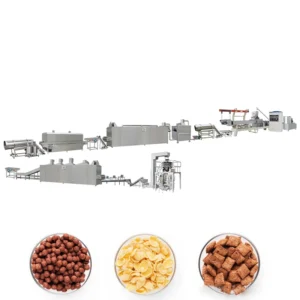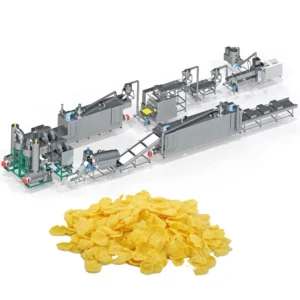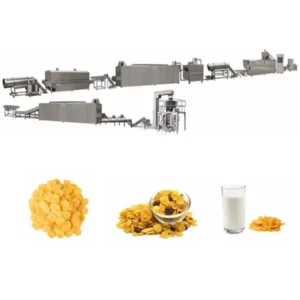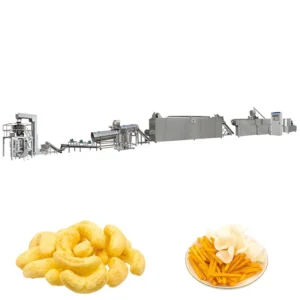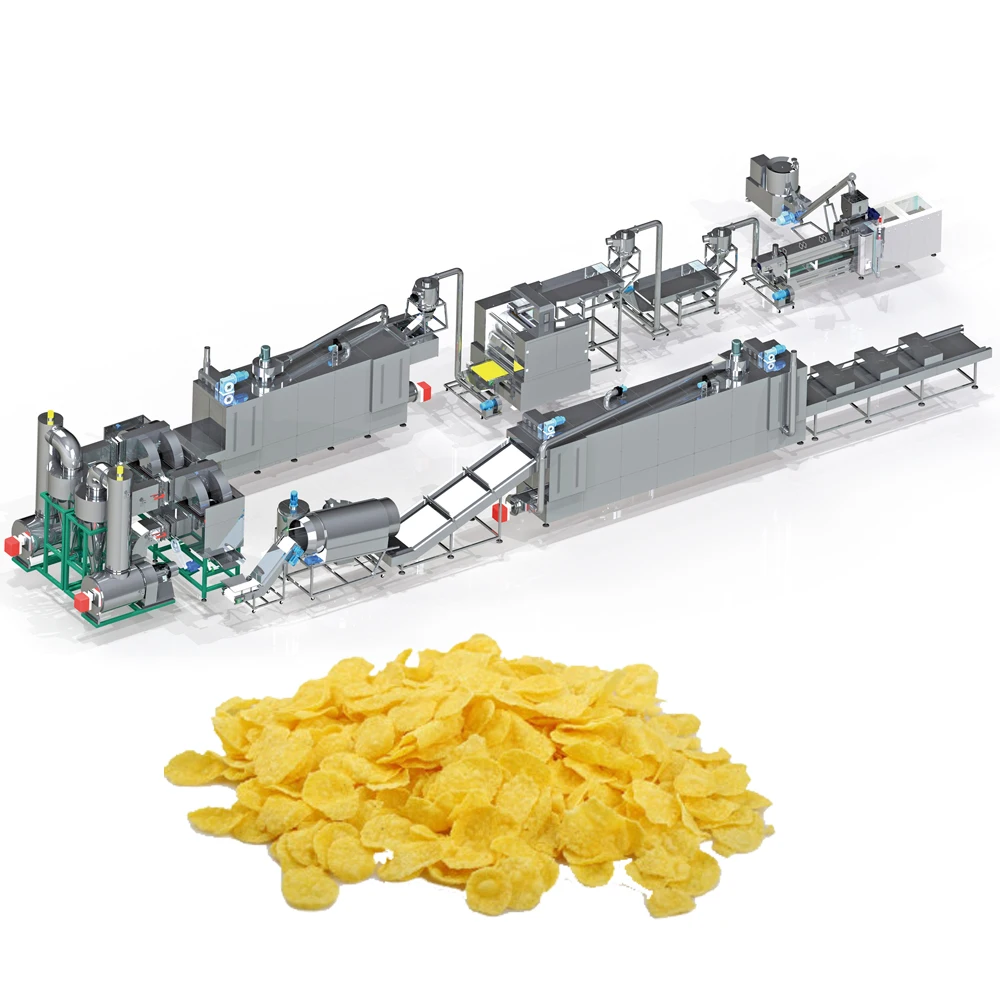
Throughput-matched station design — Every element from mixing through extrusion to packing is specified against the buyer’s raw material and target corn flake density, so the breakfast cereals production line for sale runs without downstream bottlenecks.
Technical Specifications
| Parameter | Value |
|---|---|
| Product Type | Corn Flakes Production Line |
| Available Models | MT70 / MT85 / MT75 |
| Installed Power | MT70 160 kW; MT85 190 kW; MT75 210 kW |
| Power Consumption | MT70 120 kW; MT85 140 kW; MT75 150 kW |
| Output Capacity | MT70 150–200 kg/h; MT85 300–400 kg/h; MT75 300–500 kg/h (basis not stated in source) |
| Overall Dimensions (L×W×H) | MT70 41×1.5×2.2 m; MT85 43×1.5×3.2 m; MT75 45×1.5×3.5 m |
| Extruder Screw Type | Twin Screw |
| Control System | PLC with automatic lubricating and cooling |
| Flaking Machinery | Hydraulic double-roller system, dual-motor independent drive, infrared temperature sensor |
| Dryer Heating Source | Gas or Electric |
| Roasting Oven | Vibrating pan, conciliation burner, dual circulating fans, cyclone dust removal |
| Coating System | Double tumble sugar melter, elevator, coating drum, spraying nozzle |
| Basic Material | Corn, rice, wheat, oat, barley powder |
| Standards | CE, ISO |
Application Suitability
| Application | Material or Output |
|---|---|
| Natural corn flake production | Corn grits and corn powder blends |
| Sugar-coated breakfast cereal | Corn, wheat or oat base with sugar spray coating |
| Shaped cereal formats (ring, ball, star, fruit loop, wheel, flower, heart) | Corn, rice, wheat, oat, barley powder with interchangeable extruder moulds |
| Multi-grain breakfast cereal | Blended cereal powders requiring twin-screw gelatinisation |
Why Matching the Dryer to the Extruder Matters More Than the Headline Capacity
A corn flakes machine manufacturer rating only tells half the story — the dryer and roaster must absorb exactly the moisture the extruder puts out, or the line stalls.
When the flaking station and the roasting oven are sourced from different vendors, moisture handoff is a guess. I have watched lines where the flakes left the roller at the correct thickness but entered an undersized dryer, arriving at the roasting oven too wet to blister properly. The result was batch after batch of soft, under-toasted flakes that could not be packaged [NEED_CITE: moisture transfer requirements between flaking and drying stages in cereal production]. The breakfast cereals production line for sale here is calculated station by station so that extruder output, flaker throughput, dryer residence time and roaster capacity all align.
Station-by-Station Flow for Consistent Flake Texture
Each stage in this corn flakes machine manufacturer catalogue performs a defined function in the gelatinisation-to-crispness chain. The twin-screw extruder cooks the cereal dough under controlled shear and moisture, then the flaking machinery compresses it into uniform sheets using hydraulic pressure and independently driven rollers. From there, the dryer reduces moisture before the hot air roasting oven delivers the final blistering and browning.
How the Roasting Oven Secures the Final Crunch
The roasting oven uses a vibrating pan with high-temperature spraying tubes and a conciliation burner in the combustion chamber. Two separate circulating fans move hot air across the flakes while a cyclone dust removal device captures fines [NEED_CITE: role of cyclone separators in breakfast cereal roasting exhaust systems]. This arrangement keeps the temperature profile even across the pan width, which is what produces consistent blistering rather than scorched edges next to underdone centres.
Reading the Specification Sheet Against Your Raw Material
The twin-screw extruder’s automatic lubricating and cooling function maintains barrel temperature stability during long runs, which directly affects starch gelatinisation consistency across batches. The flaking machinery’s infrared sensor monitors roller temperature continuously, preventing the sheet from sticking or tearing when ambient humidity shifts. Power consumption ranges from 120 kW to 150 kW depending on model, and these figures represent running load rather than installed capacity — a distinction that matters when sizing your transformer and switchgear. The hydraulic double-roller system applies even pressure across the full roller width, which controls final flake thickness and, ultimately, the bite texture the market expects.
What Happens When Stations Are Mismatched
When an extruder runs faster than the downstream flaker can press, cooked dough accumulates and cools below the temperature needed for clean sheeting. I have seen this create a sticky mass that jams the roller and forces a full line stop for cleanup. On the other end, a roasting oven that cannot keep pace with the dryer output forces operators to slow the entire line, meaning the extruder runs below its designed throughput and the corn flakes machine manufacturer capacity rating becomes irrelevant [NEED_CITE: effects of throughput imbalance on twin-screw extruder barrel wear].
Why Procure the Full Range From One Source
The complete equipment range means extruder, flaker, dryer, roaster and coating drum are specified against the same throughput target rather than ordered from separate catalogues. Screw configuration and die design are matched to the buyer’s specific cereal powder blend, not copied from a generic build. The in-house testing workshop runs trial production on the buyer’s raw material before shipment, catching density or texture issues before the line leaves the factory. PLC control across stations allows one operator interface to monitor moisture, temperature and speed at every point. Documentation includes a screw and die configuration record so replacements are ordered correctly when wear parts are due.
Documentation & Verification
- Line layout with throughput calculation showing matched capacity at every station
- Screw and die configuration record specific to your cereal powder blend
- Electrical schematic confirming voltage and frequency for your local grid
- Trial run report produced on your raw material in the testing workshop before dispatch
- CE declaration of conformity and ISO certificate for import clearance
- Operation and maintenance manual with wear parts list and replacement intervals
Installation, Commissioning & Support
- Foundation and floor space planned around the MT75 footprint of 45×1.5×3.5 m and station sequence
- Dedicated power circuit sized to the 150 kW running load with local voltage and frequency confirmed
- Modular station delivery with assembly sequence planned to fit your workshop ceiling height
- First-run parameter setting covering extruder barrel zones, flaker roller gap and roaster temperature profile
- Operator training on PLC interface, hydraulic roller adjustment and automatic lubrication monitoring
- Wear parts inventory including screws, dies and spraying nozzles supplied with initial order
Preparing Your Line Enquiry
To get a layout and capacity proposal that reflects your actual conditions, share the cereal powder blend you plan to run, the target hourly output you need, and the floor area available in your facility. Confirm your local voltage and frequency along with the preferred control language so the PLC interface and electrical components are specified correctly before production starts. If you have existing upstream or downstream equipment that the new line must integrate with, include those details so the station matching accounts for every connection point.
Frequently Asked Questions
Q: Which stations are included in the line and how is throughput balanced?
A: The line covers mixing, extruding, flaking, drying, hot air roasting, sugar coating, cooling and packing. Each station is sized so its maximum throughput matches the extruder output, preventing bottlenecks. The corn flakes machine manufacturer provides a capacity calculation showing the matched rate at every point.
Q: What capacity options are available and on what basis?
A: Three models are listed — MT70 at 150–200 kg/h, MT85 at 300–400 kg/h, and MT75 at 300–500 kg/h. The raw material type and moisture basis for these figures should be confirmed during the proposal stage, as different cereal blends and target flake densities affect actual running output.
Q: How are the extruder and flaker adjusted for different cereal blends?
A: Screw configuration, die design and barrel temperature profile are set according to the buyer’s specific powder blend and target product. The flaking machinery uses hydraulic pressure and infrared temperature control to maintain consistent sheet thickness across corn, wheat, oat or multi-grain blends.
Q: What electrical and control specifications are confirmed before shipment?
A: Voltage, frequency, control language and PLC interface settings are confirmed during the specification phase. An electrical schematic is provided showing all connections so your electrician can prepare the site before the equipment arrives.
Q: How are replacement wear parts handled after installation?
A: A wear parts list covering screws, dies and spraying nozzles is supplied with the documentation package. The screw and die configuration record ensures correct replacements are ordered when service intervals are reached.