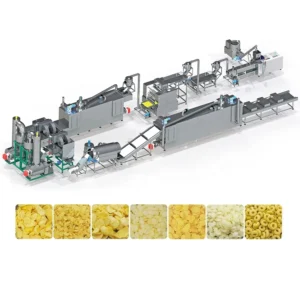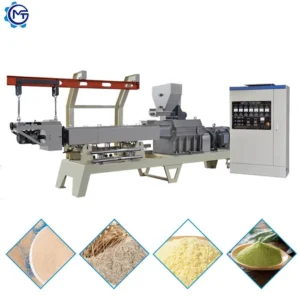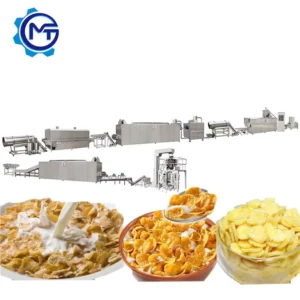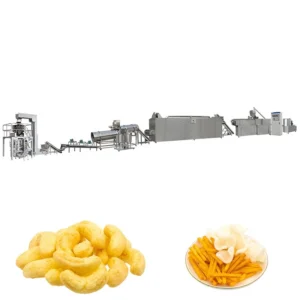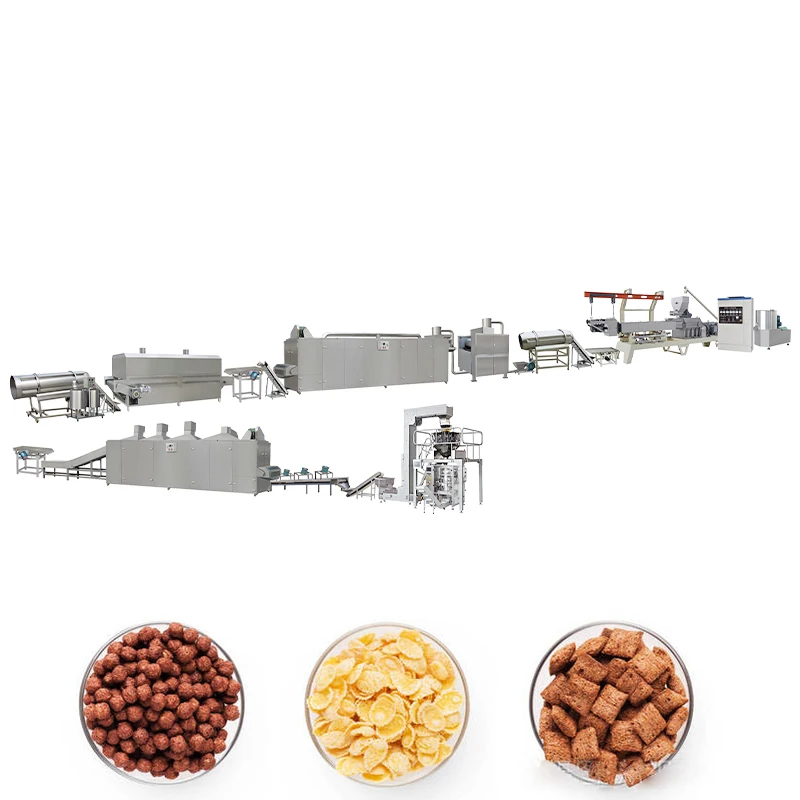
Throughput-Matched Stations — Every machine on this corn flakes line, from the mixer to the packing station, is specified under one supplier so capacity holds across the full sequence instead of breaking at the weakest link.
Technical Specifications
| Parameter | Value |
|---|---|
| Product Type | Corn Flakes Production Line |
| Model | MT75 |
| Extruder Type | Twin-screw |
| Installed Power (Line Options) | MT70: 160 kW / MT85: 190 kW / MT75: 210 kW |
| Power Consumption (Line Options) | MT70: 120 kW / MT85: 140 kW / MT75: 150 kW |
| Capacity Range | 100–500 kg/h with different model machines (basis not stated in source — confirm raw material, moisture content and pellet format) |
| Overall Dimensions (Line) | MT70: 41 × 1.5 × 2.2 m / MT85: 43 × 1.5 × 3.2 m / MT75: 45 × 1.5 × 3.5 m |
| Control System | PLC and MCC control |
| Flaking Machinery | Hydraulic double-roller system, dual motor drive, infrared temperature control |
| Dryer Heating Source | Gas or Electric |
| Hot Air Roasting Oven | Vibrating pan, conciliation burner, dual circulating fans, cyclone dust removal |
| Coating System | Double tumble sugar melter, elevator, coating drum, spraying nozzle |
| Extruder Features | Automatic lubricating, cooling function |
| Basic Raw Materials | Corn, rice, wheat, oat, barley powder |
| Assembly State | Complete production line, fully automatic |
| Layout | Customized to customer factory size |
| Voltage | Customized to local supply (value to be confirmed) |
| Standards | CE, ISO |
Application Suitability
| Application | Material or Output |
|---|---|
| Natural corn flakes production | Corn powder through extrusion, flaking, drying and roasting |
| Sugar-coated corn flakes | Corn-based pellets with sugar spraying and coating stages |
| Shaped breakfast cereals | Rice, wheat, oat, barley blends into ball, tube, ring, star, fruit loop, flower and heart shapes |
| Existing line upgrades | Individual stations — extruder, flaker, dryer, coating drum — replaced within operating cereal lines |
What "300 kg/h on Paper" Means When the Corn Grits Arrive
Rated capacity only holds when the raw material matches the screw and die configuration used during testing.
I watched a South American buyer lose an entire first week of production because the corn flour particle size at his plant was nothing like the sample he mailed us. The flakes came out uneven, cracking in the roaster and turning into dust at packing. We had to re-tune the conditioning moisture and roller gap before the line stabilized [NEED_CITE: raw material variability effects on extrusion output]. A breakfast cereal corn flakes machine full equipment range listed at a single number tells you nothing about how it will perform on your specific corn source. That is why the machine specification sheet and trial run report on the buyer’s actual material matter more than the headline figure.
Matching Every Station from Batching to Packing
When a buyer surveys a breakfast cereal corn flakes machine full equipment range, the focus usually lands on the extruder. But the flaker downstream must handle exactly what the extruder pushes out, and the roaster must dry at the same rate the coating drum receives product. The hydraulic double-roller flaking system here uses separate motors for each roller and an infrared sensor to hold temperature evenly across the roll face, which keeps flake thickness consistent when throughput changes. If the flaker cannot keep pace, material backs up at the extruder die and gelatinisation drops off.
How Screw and Die Design Shape the Final Flake
The twin-screw extruder processes corn, rice, wheat, oat and barley powders, and each material demands a different screw element arrangement and die opening. A high-fat corn blend needs more shear than a lean rice formula, so the screw configuration record must be written to the buyer’s actual recipe before the barrel is assembled. Automatic lubricating and cooling on the MT75 keep the gearbox stable through long runs, but that only matters if the screw profile itself is matched to the starch behaviour of the incoming material [NEED_CITE: twin-screw extrusion screw configuration principles]. The die determines pellet diameter going into the flaker, and pellet diameter sets the final flake thickness after pressing.
Reading the Power and Dimension Data for Line Planning
Installed power on the MT75 line sits at 210 kW with running consumption around 150 kW, which tells a plant engineer the transformer headroom and cable sizing needed before the line arrives. Overall dimensions of 45 × 1.5 × 3.5 m define the minimum bay length and ceiling clearance, but the hot air roasting oven with its cyclone dust removal adds ductwork that must be routed above the line. Voltage and frequency must be confirmed against local supply because a 50 Hz motor on a 60 Hz grid changes conveyor speeds and roaster fan curves. The PLC and MCC control cabinets need dedicated circuits separate from the heating loads to prevent voltage sag from resetting the logic controller during startup.
The Cost of Skipping a Trial Run
A line shipped without a trial run on the buyer’s raw material is essentially a prototype arriving at the dock. I have seen flaking rollers set for one corn variety produce paper-thin flakes on another, and those thin flakes scorch in the roaster within minutes. The sugar coating drum then receives uneven pieces that tumble into broken fragments instead of glossy, intact cereal. Replacing worn screws and dies after a failed first run costs less in parts than in the weeks of lost production and market credibility [NEED_CITE: extrusion wear parts replacement timing and production downtime]. Every cereal manufacturer expanding from one format to another faces the same risk when assumptions replace actual material tests.
Why Sourcing the Full Range from One Builder Matters
Complete lines from mixing through packing under a single supplier mean throughput is calculated across every station rather than guessed between separate vendors. Screw configuration and die design are specified to the buyer’s raw material and target flake or shape, not copied from a generic build. The in-house testing workshop allows trial runs on customer-supplied corn or oat blends before the machines leave the factory, so product development starts before installation rather than after. Twin-screw expertise across corn flakes, shaped cereals, and snack formats means the same engineering team handles the extruder and every downstream station. Pre-sales consultation covers line layout, utility planning and phased installation scheduling so the factory floor is ready when crates arrive.
Documentation & Verification
- Line layout and capacity calculation matching every station to your corn blend and target output
- Machine specification sheet with installed power, consumption and dimensions for each unit
- Screw and die configuration record written to your raw material sample test results
- Electrical schematic and voltage confirmation before production begins
- Trial run report on your actual corn or cereal flour before dispatch
- Factory test record and packing photographs for customs documentation support
Installation, Commissioning & Support
- MT75 line requires a minimum 45 m bay length with 3.5 m clearance and level concrete flooring
- Dedicated circuits for 210 kW installed load with separate PLC and MCC supply
- Line ships in modular sections with flaker, roaster and coating drum assembled on-site
- First-run commissioning includes roller gap, roaster temperature and coating spray calibration
- Operator training covers screw element changes and die swap procedures for shape variety
- Wear parts list provided with lead times for screws, dies and flaker roller sleeves
What We Need to Move Forward
Send us your corn or cereal flour sample, the target flake dimensions and your daily output goal so we can run the material in the testing workshop and confirm which extruder model fits. We also need your local voltage and frequency, factory floor dimensions with ceiling height, and whether you plan to run natural or sugar-coated product — that determines how many dryer and coating passes the layout requires.
Frequently Asked Questions
Q: How is capacity verified across each station so the line holds rated output on my raw material?
A: We run your actual corn or cereal sample through the testing workshop before shipment. The trial run report documents extruder throughput, flake thickness, roaster residence time and coating coverage so every station is verified against your material, not a generic benchmark.
Q: How do I choose the right extruder model based on my target capacity and factory footprint?
A: The MT70, MT85 and MT75 differ in installed power, running consumption and overall line dimensions. We match the model to your confirmed raw material throughput and available floor space, then build the downstream stations to that output.
Q: What voltage, frequency and control language options are confirmed before shipment?
A: Voltage and frequency are confirmed against your local grid during the specification stage. The PLC and MCC control panels are wired accordingly, and the HMI language is set to match your operators before the cabinets leave the factory.
Q: Can individual machines be purchased separately to upgrade or expand an existing line?
A: Yes. The extruder, hydraulic flaker, hot air roasting oven and coating drum are each available as standalone units. We supply a machine specification sheet for each so throughput can be matched to your operating line.
Q: What supporting equipment is included and how is throughput matched?
A: The full range covers mixing and batching systems, conveying, dryers, flavouring drums, cooling and packing stations. Each unit is sized to the extruder output confirmed during the trial run so no station bottlenecks the sequence.