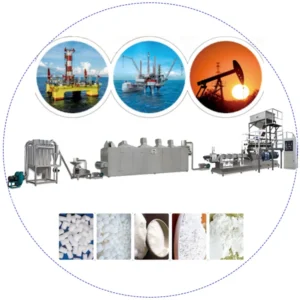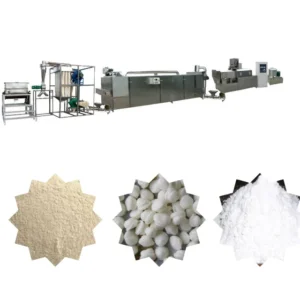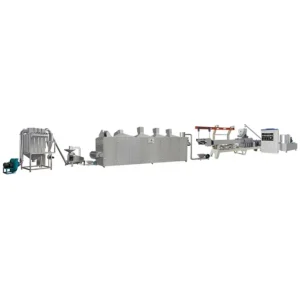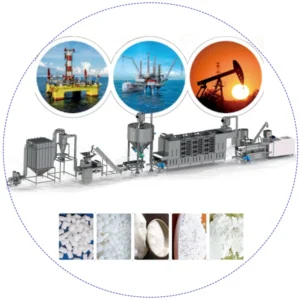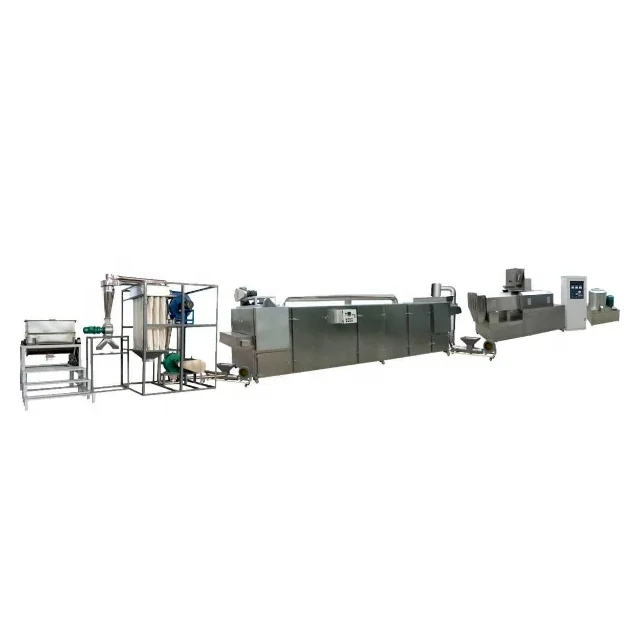
Matched Throughput Design — Every station from the twin-screw extruder to the pulse grinder is sized against the same raw material formulation, preventing the mid-line bottlenecks that stall unmatched assemblies.
Technical Specifications
| Parameter | Value |
|---|---|
| Product Type | Modified Starch Processing Production Line |
| Extruder Type | Twin screw |
| Rated Power | 45–200 kW |
| Capacity | 100–1500 kg/h (basis not stated in source — confirm raw material formulation and moisture content) |
| Equipment Weight | 1000–5000 kg (source value — verify against final line configuration) |
| Voltage | 220–440 V, tri-phase |
| Contact Material | Food-grade stainless steel (304) |
| Fuel Options | Gas / diesel / electricity / steam (confirmed at quotation) |
| Line Stations | Twin-screw extruder, cooling conveyor, pulse grinder |
| Assembly State | Complete production line |
| Certification | CE, ISO |
Application Suitability
| Application | Material or Output |
|---|---|
| Food-grade modified starch for thickener and stabiliser blends | Corn flour, rice flour with controlled gelatinisation |
| Industrial starch for oil drilling fluid additives | Corn flour, soybean flour processed for viscosity modification |
| Pre-gelatinised starch for paper-making coatings | Nutritional grain flours requiring uniform particle size |
| Modified starch for fortified food and infant formula bases | Blended grain flours with functional property targets |
Why the Nominal Capacity Figure Fails Modified Starch Buyers
A modified starch processing line full equipment range only delivers its quoted output when every station is matched to the buyer’s actual formulation and moisture profile.
I have walked into plants across Latin America where the extruder nameplate promised a certain throughput, yet the cooling conveyor downstream could not keep pace, forcing operators to throttle the entire line back. Starch behaves differently from snack dough or pet food kibble — its gelatinisation window is narrow, and the grind stage demands a specific particle fineness that upstream moisture directly controls. When vendors quote capacity based on a generic grain rather than your specific corn or rice flour blend, the number on the contract means very little once raw material hits the hopper [NEED_CITE: twin-screw extrusion behaviour on high-amylose starch formulations]. A modified starch processing line full equipment range configured without a formulation-specific trial run leaves you discovering the real throughput on your own factory floor, at your own cost.
Screw Configuration and Barrel Profile for Starch Gelatinisation
The twin-screw extruder in this line uses an adjustable screw configuration that can be re-sequenced to control shear intensity and residence time inside the barrel. Starch granules require a precise balance of mechanical shear and thermal input to reach full gelatinisation without degrading the polymer chains that give modified starch its functional value. Operators adjust the screw element sequence — mixing blocks, conveying segments, and reverse-flight zones — to match the amylose content and particle size of the incoming flour. This flexibility means the same modified starch processing line full equipment range can shift between corn-based and rice-based formulations by reconfiguring internal elements rather than replacing hardware.
Cooling Conveyor and Pulse Grinder Integration
After extrusion, the hot extrudate enters a cooling conveyor equipped with wind-knife air drying that brings the material to ambient temperature without thermal shock. Rapid or uneven cooling can cause retrogradation in starch, altering the water-binding properties that downstream food or industrial users depend on. The pulse grinder downstream uses cyclone discharge and an integrated dust collector to achieve fine, uniform particle size while keeping the milling environment sealed. This two-stage post-extrusion handling ensures the modified starch retains its target colour, solubility, and viscosity profile through to the packing station [NEED_CITE: effect of post-extrusion cooling rate on starch retrogradation].
Reading the Specification Sheet for Starch Processing
The rated power band of 45–200 kW reflects the range of extruder models available within the line, where higher-kW units handle greater throughput volumes or higher-amylose raw materials that demand more mechanical energy for gelatinisation. Voltage configurability across 220–440 V tri-phase means the electrical package can be specified to match the local utility standard before the line is built, avoiding costly transformer additions at the installation site. Food-grade 304 stainless steel across all contact surfaces prevents iron ion contamination that would discolour light starch products and fail food-safety audits. The fuel option selection — gas, diesel, electricity, or steam — determines dryer thermal input and should be confirmed during quotation based on local energy cost and availability. Twin-screw architecture provides the self-wiping action necessary when processing sticky gelatinised starch, reducing clean-out time between formulation changeovers compared to single-screw designs.
The Cost of Ignoring Supporting Station Capacity
When the cooling conveyor or grinder is undersized relative to the extruder output, starch accumulates mid-line, forcing unplanned shutdowns that degrade product already inside the barrel. Retrogradation starts within minutes if hot extrudate sits without airflow, and regrinding partially degraded starch introduces off-spec fines that fail viscosity testing. I have seen processors in Mexico and Colombia replace an entire cooling section six months after commissioning because the original vendor only calculated throughput on the extruder side [NEED_CITE: mid-line bottleneck costs in starch extrusion plants]. The modified starch processing line full equipment range avoids this by matching every station to the same formulation-based capacity target from the start.
Why Source This Line Through a Single Equipment Supplier
Every station — extruder, cooling conveyor, pulse grinder — is specified under one supplier, so throughput calculations account for the actual transfer rate between stages rather than relying on independent vendor nameplates. Screw configuration and die design are documented against your raw material before shipment, not copied from a generic starch build. The in-house testing workshop runs your flour formulation through the extruder before the line ships, generating a trial run report you can review before accepting delivery. Electrical schematics and voltage confirmation sheets are prepared against your factory utility specification, eliminating commissioning delays caused by mismatched power supply. Wear parts lists for screws, dies, and grinder screens ship with the line, so the first replacement order does not become an emergency search.
Documentation & Verification
- Line layout and capacity calculation matched to your starch formulation and target output
- Screw and die configuration record specific to your raw material before shipment
- Electrical schematic and voltage confirmation sheet aligned to your factory supply
- Trial run report on your corn or rice flour conducted in the testing workshop
- CE declaration of conformity and ISO certificate included with shipping documentation
Installation, Commissioning & Support
- Foundation and floor space planning based on the full line footprint including grinder cyclone clearance
- Dedicated tri-phase circuit sized to the confirmed 45–200 kW extruder motor and supporting station loads
- Assembly and alignment of cooling conveyor wind-knife sections verified during on-site commissioning
- First-run parameter setting for barrel temperature zones and screw speed on your actual starch formulation
- Operator training covering screw reconfiguration procedure for formulation changeovers
- Wear parts inventory for twin-screw elements, die plates, and grinder screens supplied at delivery
Preparing Your Inquiry
To move from a general inquiry to a line configuration proposal, share your raw material type and typical moisture content, your target daily output, and the local voltage and frequency at your plant. If you have existing upstream mixing or downstream packing equipment, include those specifications so the modified starch processing line full equipment range can be matched to your current station capacities.
Frequently Asked Questions
Q: How is capacity verified on my specific starch raw material and formulation?
A: Before shipment, your raw material is run through the twin-screw extruder in the in-house testing workshop. The trial run report documents actual throughput, barrel temperature profile, and product quality against your specification, so you confirm real output before the line leaves the factory.
Q: What voltage and frequency configurations are available for my target market?
A: The line is configurable across 220–440 V tri-phase. Your factory utility specification is confirmed during the quotation stage, and the electrical schematic is prepared to match local standards, preventing commissioning delays caused by power supply mismatch.
Q: Which supporting stations are included to ensure balanced throughput across the full line?
A: The standard range covers the twin-screw extruder, cooling conveyor with wind-knife air drying, and pulse grinder with cyclone discharge. Each station is sized against the same formulation-based capacity target so no single point constrains overall output.
Q: Can a trial run be performed on my raw material before shipment?
A: Yes. The in-house testing workshop processes your actual corn, rice, or blended grain flour through the configured extruder. You receive a trial run report showing throughput, particle characteristics, and functional properties before accepting delivery.
Q: What spare wear parts are supplied, and how are replacements sourced after commissioning?
A: A wear parts list covering screw elements, die plates, and grinder screens ships with the line. Replacement components are sourced from the same supplier using the configuration record established during your trial run, ensuring dimensional and material consistency.