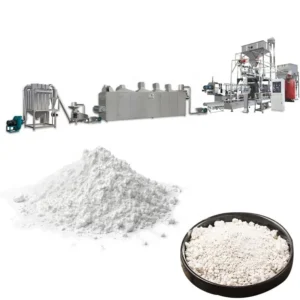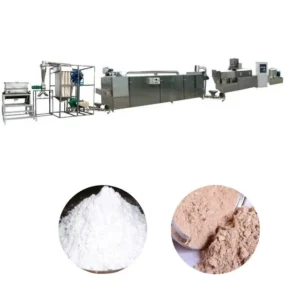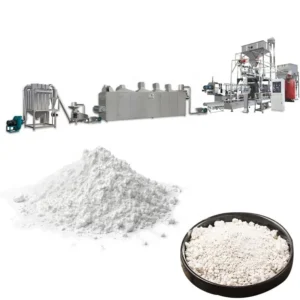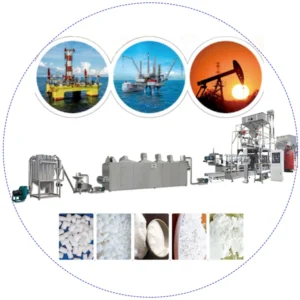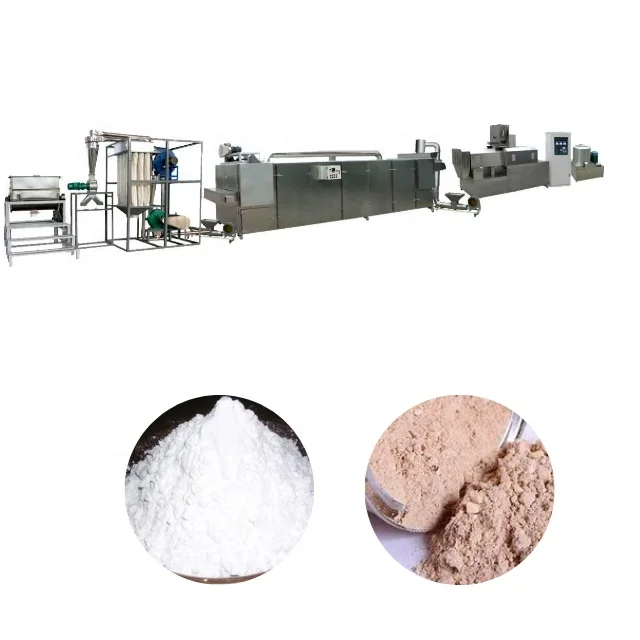
Matching throughput at every station — this modified starch processing line full equipment range is specified station by station so the twin-screw extruder, cooling conveyor, and pulse grinder operate at balanced capacity on your actual raw material.
Technical Specifications
| Parameter | Value |
|---|---|
| Product Type | Modified Starch Processing Production Line |
| Extruder Type | Twin screw extruder |
| Raw Materials | Corn flour, rice flour, soybean flour, corn starch, wheat flour, additive materials |
| Power Range | 45–200 kW |
| Capacity Range | 100–1500 kg/h (basis not stated in source — confirm raw material type, moisture content, and target modification level) |
| Voltage | 220–440V, tri-phase (frequency to be confirmed: 50 Hz / 60 Hz) |
| Food Contact Material | Food grade stainless steel (conveyors with PVC exceptions noted) |
| Fuel Options | Gas, diesel, electricity, steam (to be confirmed at quotation) |
| Assembly State | Complete production line |
| Standards | CE, ISO |
Application Suitability
| Application | Material or Output |
|---|---|
| Food-grade modified starch for bakery and sauce thickening | Corn starch, wheat flour with controlled gelatinisation |
| Industrial starch for oil drilling fluids | Corn flour and soybean flour at elevated barrel temperatures |
| Paper-making surface sizing starch | Rice flour and corn starch with post-grind particle control |
| Nutritional fortified starch blends | Soybean flour mixed with corn starch and additive materials |
| Pre-gelatinised cold-water swelling starch | Wheat flour and corn starch at high shear screw configuration |
What the Modified Starch Processing Line Full Equipment Range Reveals About Station Matching
A line only runs at the speed of its weakest station. I have watched starch processors spend weeks commissioning an extruder that delivers consistent gelatinisation only to discover the cooling conveyor cannot handle the output volume, leaving hot product backing up into the grinder. The bottleneck is rarely the headline machine. When sourcing a modified starch processing line full equipment range, the question should always be whether the downstream stations were selected to match the extruder throughput on the specific flour or starch being processed, not on a generic capacity chart.
The cooling stage matters more than buyers assume. Starch that enters the grinder above ambient temperature clumps on the hammer surfaces and skews particle size distribution. Without adequate wind-knife surface moisture removal, the pulse classifier cannot maintain cut-point accuracy [NEED_CITE: thermal limits on starch grinding equipment]. Every station in this range — twin screw extruder, cooling conveyor, and pulse grinder — must be evaluated as a chain rather than as individual purchases.
Raw Material Adaptability Across Flour and Starch Types
The twin-screw extruder in this modified starch processing line full equipment range handles corn flour, rice flour, soybean flour, corn starch, wheat flour, and additive materials. Different starches gelatinise at different temperatures — corn starch typically around a lower threshold than cassava or potato derivatives — and the screw configuration and barrel heating zones must be matched accordingly. Running wheat flour on a screw profile designed for pure corn starch produces uneven shear and incomplete modification.
This is where most specification mismatches happen. The buyer sends a raw material sample, and the supplier quotes a screw set that was developed for a different client’s recipe. The result is starch that never reaches target viscosity no matter how many hours the line runs. Confirming screw configuration and die design against the buyer’s actual raw material before shipment eliminates this class of failure.
Barrel Temperature Control and Gelatinisation Precision
Modified starch quality depends on holding the material within a narrow temperature window through the extruder barrel. Each zone must be set according to the raw material’s gelatinisation profile. Soybean flour blended with corn starch, for example, responds differently to shear heating than pure rice flour. The twin-screw design allows multiple heating zones and controlled residence time, which is necessary when the target product must meet a specific viscosity or swelling specification [NEED_CITE: gelatinisation temperature ranges for common industrial starches].
Inadequate zone control produces batches that pass visual inspection but fail downstream rheology testing. This is particularly critical for oil drilling starch, where fluid-loss properties are non-negotiable.
Interpreting the Power and Capacity Figures
The 45–200 kW power range spans single-extruder setups through higher-throughput configurations with larger barrel diameters and longer screw assemblies. Power draw correlates directly with the mechanical shear applied to the starch — higher shear means more complete molecular modification but also greater wear on screw elements. The capacity figure of 100–1500 kg/h should never be treated as a fixed output number. It shifts depending on raw material density, inlet moisture, target modification degree, and whether the starch is destined for food, paper, or oil drilling applications.
Tri-phase voltage from 220–440V must be confirmed against the buyer’s local supply before production begins. A motor wound for 380V/50Hz connected to a 440V/60Hz supply will overspeed, overheat, and fail its first thermal protection trip within hours. Frequency confirmation is not a paperwork detail — it is a commissioning prerequisite.
The Hidden Cost of Unmatched Stations
When the cooling conveyor lacks sufficient length or fan capacity, starch enters the pulse grinder above target temperature. The classifier then returns oversized particles for regrinding, which recycles heat back into the system and degrades product quality progressively through the shift. Buyers rarely trace this back to the cooling stage [NEED_CITE: effects of feed temperature on starch grinding efficiency]. The grinder specification sheet may list an acceptable throughput, but that figure assumes correctly cooled input. Specifying each station against real process conditions rather than catalogue ratings prevents this category of silent failure.
Why Procurement Through This Range Differs
Every station in this modified starch processing line full equipment range is documented with a machine specification sheet that captures voltage, frequency, and utility requirements for the buyer’s site. The screw and die configuration record is written against the buyer’s raw material, not copied from a generic build. The in-house testing workshop runs trial production on customer-supplied flour or starch before dispatch, generating a trial run report that confirms gelatinisation behaviour and throughput under real conditions.
CE and ISO documentation accompanies shipment, and the line layout includes capacity calculation across all stations so the extruder, cooling conveyor, and pulse grinder are demonstrably matched. Wear parts lists for extruder screws, dies, and grinder components ship with the line so the first replacement cycle is planned, not reactive.
Documentation & Verification
- Line layout and capacity calculation matching twin-screw extruder output to cooling conveyor and grinder throughput
- Screw and die configuration record written against buyer’s specified flour or starch type
- Electrical schematic with confirmed voltage, frequency, and control language before production
- Trial run report on customer raw material showing gelatinisation and viscosity data
- Wear parts list covering extruder screws, dies, and pulse grinder hammers and screens
- CE declaration of conformity and ISO certificate for customs and site acceptance
Installation, Commissioning & Support
- Foundation requirements based on extruder weight range of 1000–5000 kg and vibration characteristics
- Dedicated electrical circuit sized to the confirmed 45–200 kW motor and local voltage supply
- Station-by-station alignment of cooling conveyor to grinder feed height during on-site assembly
- First-run parameter setting for barrel temperature zones matched to buyer’s raw material recipe
- Operator training on screw configuration changeover for different starch modification targets
- Planned spare parts schedule for extruder wear elements and grinder classifier screens
What to Include in Your Enquiry
To configure this modified starch processing line full equipment range accurately, specify the raw material type and any blending ratios, the target application whether food-grade, paper, or oil drilling starch, and the required daily or shift output. Confirm local voltage and frequency, and indicate whether your facility uses gas, steam, or electric heating so the dryer and barrel zones are matched accordingly. If you have existing upstream mixing or downstream packing equipment, include dimensions and throughput so the line integrates without modification.
Frequently Asked Questions
Q: What stations are included in a complete modified starch processing line and how do they connect?
A: The core sequence is a twin-screw extruder for gelatinisation and modification, a cooling conveyor with wind-knife surface moisture removal, and a pulse grinder with cyclone discharge and dust collector. Upstream mixing and batching systems and downstream packing stations are available as supporting equipment to complete the production flow from raw material intake to finished bag.
Q: How is the capacity range rated and what assumptions apply?
A: The 100–1500 kg/h figure depends on raw material type, inlet moisture, and target modification level. Corn starch at lower modification targets processes faster than soybean flour blends at high shear settings. Capacity should be confirmed against the buyer’s specific recipe and required end-product viscosity before the line is configured.
Q: Can voltage and frequency be matched to my local power supply?
A: The line supports tri-phase voltage from 220–440V. Frequency must be confirmed as 50 Hz or 60 Hz before motor winding and control panel assembly. Supplying the correct local electrical specification at enquiry stage ensures all motors, heaters, and PLC components are built to match.
Q: What is the difference between food-grade and industrial-grade line configurations?
A: Food-grade configurations use food-grade stainless steel throughout all contact surfaces, including the extruder barrel, cooling conveyor, and grinder internals. Industrial-grade setups for oil drilling or paper starch may allow PVC conveyor sections and different surface finish standards. The raw material and end-use application determine which configuration is specified.
Q: Which supporting equipment is available to complete the line beyond the core stations?
A: Mixing and batching systems, screw conveyors, dryers, cooling tunnels, and packing stations are all available to integrate with the extruder, cooling conveyor, and pulse grinder. Each supporting station is specified against the core line throughput so no single unit becomes a bottleneck during continuous production.