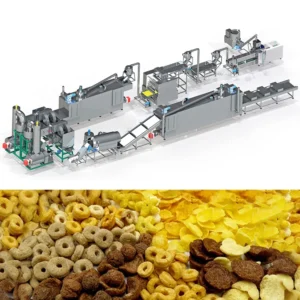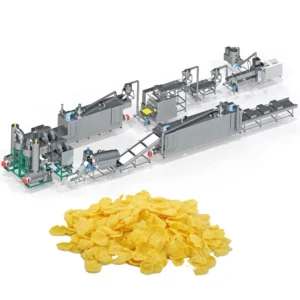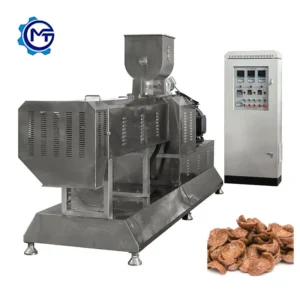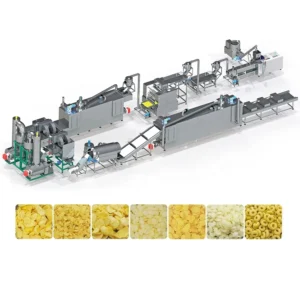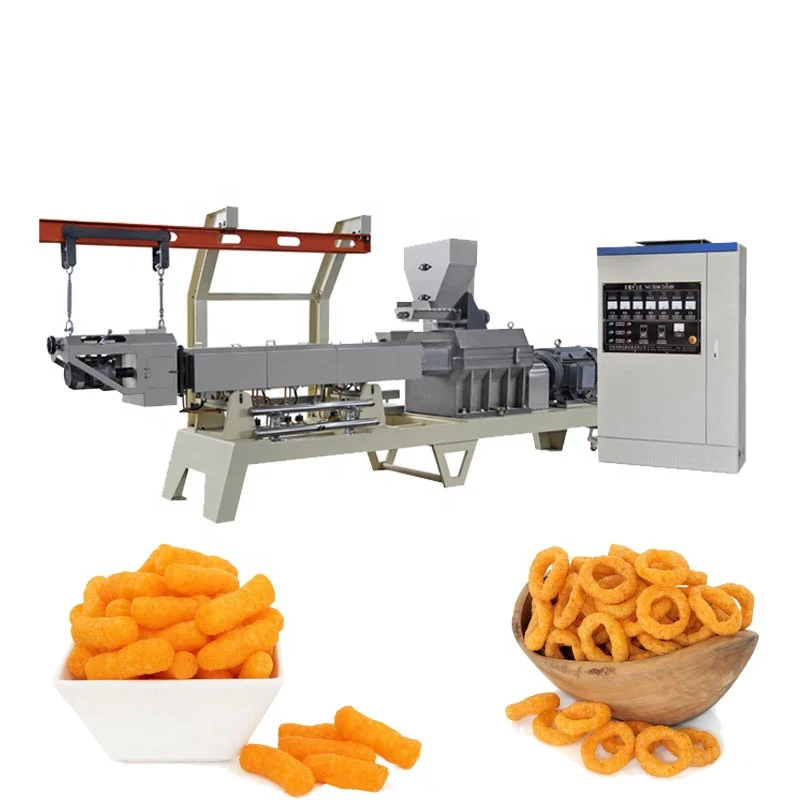
Integrated Line Matching — Every station from the twin-screw extruder through the sugar coating drum is sized to the same throughput basis, preventing the bottleneck that occurs when machines are sourced from separate vendors.
Technical Specifications
| Parameter | Value |
|---|---|
| Product Type | Corn Flakes and Breakfast Cereal Production Line |
| Models Available | MT70, MT85, MT75 |
| Extruder Screw Type | Twin-screw |
| Installed Power | MT70: 160 kW; MT85: 190 kW; MT75: 210 kW |
| Power Consumption | MT70: 120 kW; MT85: 140 kW; MT75: 150 kW |
| Output Capacity | MT70: 150–200 kg/h (basis not stated in source); MT85: 300–400 kg/h (basis not stated in source); MT75: 300–500 kg/h (basis not stated in source) |
| Overall Dimensions | MT70: 41 × 1.5 × 2.2 m; MT85: 43 × 1.5 × 3.2 m; MT75: 45 × 1.5 × 3.5 m |
| Basic Raw Materials | Corn, rice, wheat, oat, barley powder |
| Control System | PLC control (flaking and line automation) |
| Flaking System | Hydraulic double-roller, dual independent motors, infrared sensor temperature control |
| Hot Air Roasting Oven | Vibrating pan, conciliation burner, dual circulating fans, cyclone dust removal |
| Coating System | Double tumble sugar melting, elevator, coating drum, spraying nozzle |
| Dryer Heating Source | Gas, Electric |
| Extruder Features | Automatic lubricating and cooling, wear-resistant screw technology |
| Standards | CE, ISO |
Application Suitability
| Application | Material or Output |
|---|---|
| Natural corn flakes production | Corn grits, corn flour |
| Sugar-coated breakfast cereals | Corn, rice, wheat base with sugar coating |
| Multi-grain cereal formats | Oat, barley, wheat, rice blends |
| Shaped cereal snacks | Ball, tube, stick, ring, fruit loop, star, wheel, flower, heart via extruder mould adjustment |
| Instant porridge and hot cereal | Rice, oat, and multi-grain powder formulations |
Why the Dryer Capacity Question Matters More Than the Extruder Output
A corn flakes breakfast cereal machine full equipment range only performs to its rated throughput when every downstream station is matched to the extruder’s actual output on the buyer’s raw material.
An extruder that produces wet dough pieces faster than the dryer can remove moisture creates a backlog that forces the entire line to slow down. The flaking rollers then receive inconsistently conditioned material, producing uneven flake thickness. When the roasting oven and coating drum are also undersized, the bottleneck compounds at every station. [NEED_CITE: throughput matching principles in continuous food processing lines] I have seen lines where the extruder was the correct model but the dryer was one tier below, and the buyer spent the first months after commissioning running the extruder at partial capacity just to keep the line moving.
Every Station in the Catalogue
This corn flakes breakfast cereal machine full equipment range covers the complete sequence: mixing and batching, twin-screw extrusion, flaking, drying, hot air roasting, sugar coating, cooling, and packing. Each station is selected and configured so that its maximum throughput aligns with the extruder output rather than operating as an independent unit. The line layout document confirms capacity at every transfer point.
From Single Machines to Matched Lines
Buyers surveying equipment before specifying a line need to see how each station connects. The mixing system feeds the extruder at a controlled rate. The flaking machinery receives material from the dryer at a moisture level that allows consistent sheet thickness. The hot air roasting oven uses a vibrating pan with dual circulating fans and a cyclone dust removal device to develop surface blistering without scorching. [NEED_CITE: cereal flaking and roasting process parameters] The sugar coating system includes a double tumble melter, a dedicated elevator, and a spraying drum sized to handle the full output from the roasting stage.
Reading the Specifications Against Your Raw Material
The twin-screw extruder processes corn, rice, wheat, oat, and barley powder into shaped pellets before flaking. The screw configuration and die design must be matched to the specific raw material blend and target product density. Installed power ranges from 160 kW on the MT70 to 210 kW on the MT75, with corresponding power consumption figures that affect utility planning. The flaking machinery uses a hydraulic system for roller pressure adjustment and infrared sensors for temperature regulation, which together control flake thickness and surface quality. Automatic lubricating and cooling on the extruder supports continuous operation across different cereal formulations without manual intervention between batches. [NEED_CITE: twin-screw extrusion screw configuration for cereal starch gelatinisation]
The Cost of Mismatched Upstream and Downstream Equipment
When a buyer purchases an extruder without confirming that the dryer and coating drum can handle the same throughput, the line stalls at the transfer point. Wet extruded pieces accumulate on conveyors, losing temperature and moisture uniformly. The flaking rollers then receive material outside the specified conditioning window, producing flakes that break during roasting or fail to achieve the expected crispness. [NEED_CITE: moisture content impact on cereal flake integrity during roasting] The roasting oven then processes uneven flakes, resulting in a mix of over-browned and under-toasted product that falls outside market specification.
Sourcing the Full Range from One Equipment Supplier
Every station in this line comes from a single manufacturing source, which means throughput calculations are done across the entire sequence rather than per machine. Screw configuration and die design are specified to the buyer’s raw material blend and target cereal format before production begins. An in-house testing workshop runs trial production on the buyer’s actual raw material before shipment, verifying that the extruder, flaking mill, and dryer work together under real conditions. The PLC and MCC control systems are configured to the buyer’s voltage, frequency, and language requirements before dispatch. Documentation includes line layout and capacity calculations, screw and die configuration records, and electrical schematics matched to the destination market. [NEED_CITE: pre-shipment factory testing protocols for food extrusion lines]
Documentation & Verification
- Line layout and capacity calculation confirming throughput match across every station
- Machine specification sheet with screw and die configuration for your cereal formulation
- Electrical schematic with voltage and frequency confirmed for your market
- Trial run report on your raw material verifying output before shipment
- CE declaration of conformity and ISO certificate for import clearance
- Operation and maintenance manual with wear parts list and replacement schedule
Installation, Commissioning & Support
- Floor space and foundation planning based on the 41–45 m line footprint and station weights
- Dedicated electrical circuits sized for 160–210 kW installed power per model tier
- Twin-screw extruder assembly, barrel alignment, and screw insertion supervised on site
- Flaking roller pressure and infrared sensor calibration during first production run
- Hot air roasting oven burner tuning and cyclone dust removal system commissioning
- PLC interface language and MCC control logic confirmed before operator training begins
- Wear parts list covering screws, dies, and flaking roller surfaces with stocking guidance
What to Include in Your Inquiry
To size the correct corn flakes breakfast cereal machine full equipment range for your facility, provide the raw material blend you plan to run, the target hourly output, and the final product format you intend to produce. Include your local voltage and frequency so the electrical system can be configured before build. If you have existing upstream or downstream equipment you want to integrate, share the model and throughput so the line can be matched at the connection points.
Frequently Asked Questions
Q: How is the capacity of each station verified, and what raw material basis is used?
A: Each station is sized against the extruder output calculated for the buyer’s specific raw material blend and moisture content. A trial run in the testing workshop confirms that the extruder, flaking mill, dryer, and coating drum all hold the same throughput on the actual material before the line ships.
Q: Which line stations can be configured, and how is throughput balanced between them?
A: The line includes mixing, twin-screw extrusion, flaking, drying, hot air roasting, sugar coating, cooling, and packing. Throughput is balanced by calculating the maximum sustainable output of each station against the extruder capacity and selecting dryer, oven, and coating drum sizes that match rather than constrain.
Q: What voltage, frequency, and control language options are available for the PLC and MCC systems?
A: Voltage and frequency are configured to the buyer’s local supply standard before production. The PLC interface language is confirmed during the specification stage so operators can read the control screen in their working language from the first day of commissioning.
Q: Can the extruder die and mould be swapped to produce multiple breakfast cereal shapes on the same line?
A: The extruder accepts interchangeable dies that produce shapes including ball, tube, stick, ring, fruit loop, star, wheel, flower, and heart. The die swap is done at the extruder cutting station, and downstream flaking and roasting parameters are adjusted to match the new pellet geometry.
Q: What supporting equipment is available for mixing, conveying, cooling, and packing integration?
A: The catalogue covers mixing and batching systems, belt and screw conveyors, cooling conveyors, and packing stations. Each supporting unit is selected to match the line throughput so material flows continuously between the extruder, flaking mill, dryer, roasting oven, and coating drum without accumulation.