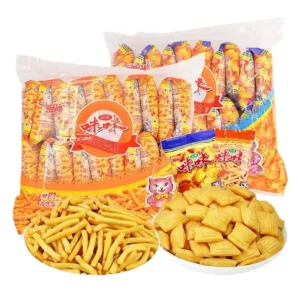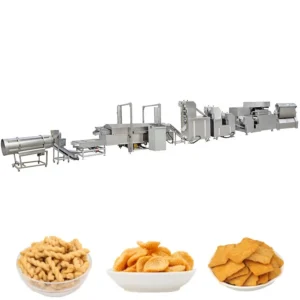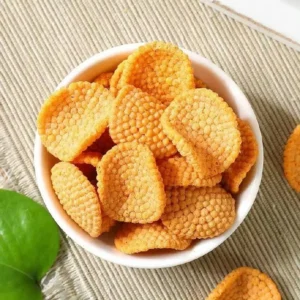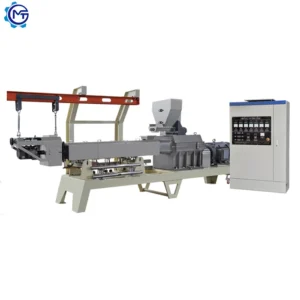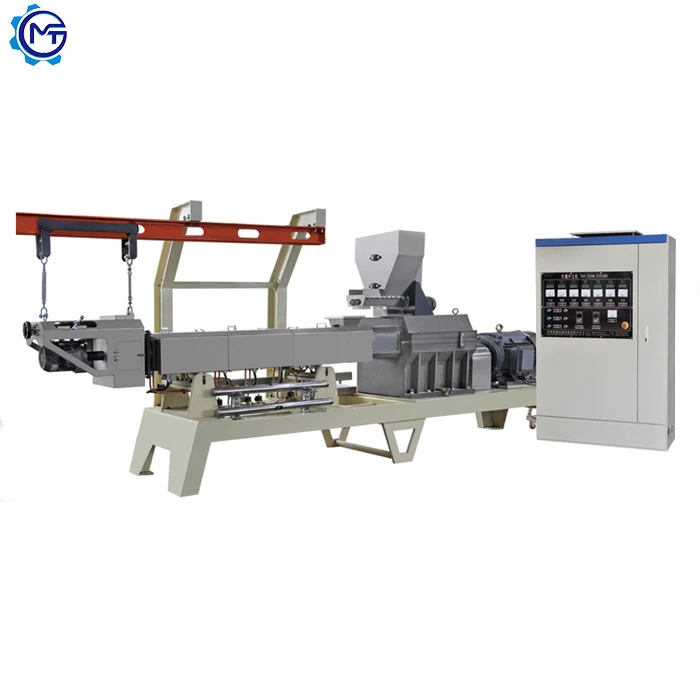
Line-Wide Throughput Matching — every station from mixer to packer is sized against the extruder’s actual output so no single unit bottlenecks the puffed snack production line equipment for sale.
Technical Specifications
| Parameter | Value |
|---|---|
| Model | MT100/MT120 |
| Product Type | Puffed Snack Production Line with Single Screw Extruder |
| Extruder Type | Single Screw Extruder (high and low pressure screw configuration) |
| Rated Power | 50–70 kW (electric heating) |
| Power (gas/diesel option) | 50–60 kW |
| Voltage & Frequency | Three phases 380 V / 50 Hz; Single phase 220 V / 50 Hz (customizable to customer local voltage) |
| Output Capacity | 120 kg/h (basis not stated in source — confirm raw material type and moisture content) |
| Overall Dimensions (L × W × H) | 12,000–26,000 × 1,200 × 2,200 mm |
| Material of Construction | Food-grade stainless steel 201 / 304 |
| Energy Options | Electricity / Gas / Diesel / Steam |
| Electrical Components | Siemens (China-made) or China top-brand motors; Delixi or Delta inverters |
| Die Configuration | Adjustable dies for multiple shapes (screw shell, round tube, square tube, ring, cartoon shapes) |
| Raw Materials | Wheat flour, corn starch, potato starch |
| Line Stations | Mixer → Screw Conveyor → Single Screw Extruder → Pulling and Cutting Machine → Automatic Fryer → Automatic Flavoring Line → Cooling → Packing |
| Assembly State | Complete production line |
| Standards | CE, ISO 9001 |
Application Suitability
| Application | Material or Output |
|---|---|
| Crispy grid crust and wafer sheets | Wheat flour and corn starch blends |
| Vegan salad strips and ribbon snacks | Potato starch and wheat flour mixtures |
| Rice cakes and flatbread crisps | Rice flour and starch composites |
| Golgappa / pani puri shells | Wheat flour with controlled moisture |
| Screw shells, round and square tubes | Corn starch and potato starch bases |
| Cartoon-shaped fried puffed snacks | Multi-starch formulations with food-color additives |
| Non-fried secondary puffing products | Starch-based pellets dried without frying |
What a Capacity Figure Hides When the Line Is Assembled Station by Station
A rated number on the extruder means nothing if the fryer or flavoring drum cannot keep pace.
Buyers who source individual machines from different vendors often discover that the single screw extruder pushes product faster than the downstream fryer can handle, creating a backlog of cut pieces that cool and lose moisture before they reach the oil. The pulling and cutting machine then runs in bursts rather than continuously, and the entire puffed snack production line equipment for sale settles at a real throughput well below the quoted figure. I have watched starch-based snack lines lose hours every shift to this exact mismatch because no one was responsible for matching station to station. [NEED_CITE: extrusion line throughput balancing across stations]
How the Single Screw Extruder Handles Starch Variability
The MT100/MT120 extruder uses a high and low pressure screw configuration, which broadens the range of starch sources it can process without pre-conditioning. Wheat flour, corn starch, and potato starch each gelatinise at different temperatures and moisture levels; a single-profile screw would force the operator to compromise on one material to favour another. With dual pressure zones the barrel can maintain consistent shear across blends, so a switch from a potato-heavy recipe to a corn-dominant formula does not require a full screw swap.
Die Flexibility Without a Full Changeover Day
The adjustable die assembly on this puffed snack production line equipment for sale lets the operator move between grid crust, tube, ring, and custom cartoon geometries within the same shift. Each die plate bolts onto a shared adapter, and the pulling and cutting station is fitted with interchangeable blades that match the profile leaving the die. On a starch-based line, that swap typically takes less time than a barrel clean-out, keeping the line productive across short seasonal runs and contract packing orders. [NEED_CITE: starch extrusion die changeover procedures]
Reading the Spec Sheet Against Actual Production Conditions
The rated power band of 50–70 kW under electric heating tells you the thermal headroom the barrel zones have for bringing dense starch pastes up to gelatinisation temperature. If your workshop runs gas or diesel, the available power shifts to 50–60 kW and the heating ramp profile changes accordingly — an important detail when you are planning utility infrastructure. Food-grade stainless steel 201 or 304 contact parts resist the mild acidity of fermented starch slurries, and the line length ranging from 12 to 26 metres means you need to confirm conveyor span against your building column spacing before the machines leave the factory. Siemens or China top-brand motors paired with Delixi or Delta inverters give the operator speed control across the extruder and pulling station so that cut length stays consistent even when extrusion pressure fluctuates.
The Cost of Skipping Downstream Sizing
When the fryer belt speed is slower than the extruder output, half-cooked pieces pile up on the transfer conveyor and stick together before the oil bath. The flavoring drum then receives unevenly fried product, and seasoning coats some pieces heavily while others barely pick up any powder. Operators compensate by slowing the extruder, which drops barrel pressure and produces dense, under-expanded snacks that do not match the target crunch profile. [NEED_CITE: fryer-extruder throughput mismatch effects on snack texture]
Why This Line Stays Under One Supplier
Every station on the MT100/MT120 line is selected so that the mixer batch cycle feeds the screw conveyor at a rate the extruder can absorb, the fryer belt speed matches cut-piece output, and the flavoring drum volume handles the same hourly weight. The in-house testing workshop runs your actual starch blend through the complete sequence before shipment, producing a trial report you can review before the crates are sealed. Voltage and control language are confirmed against your local grid during the specification stage rather than at commissioning. Spare screws, dies, cutting blades, and fryer belt links are listed with reorder codes so replacements ship without a second round of engineering questions.
Documentation & Verification
- Line layout showing station spacing matched to your building column grid
- Screw and die configuration record for each snack geometry you plan to run
- Electrical schematic with confirmed voltage, frequency, and panel language
- Factory trial report on your raw starch blend before dispatch
- CE declaration of conformity and ISO certificate for customs clearance
Installation, Commissioning & Support
- 12–26 m line length requires level epoxy floor and column-free span confirmation
- Three-phase 380 V / 50 Hz dedicated circuit sized for 70 kW peak extruder draw
- Stations shipped as individual skids for sequential assembly on site
- First-run parameter log covers barrel zones, fryer oil temperature, and drum speed
- Operator training on die swap, blade alignment, and fryer belt tension
- Wear parts list with screws, dies, blades, and belt links tagged with reorder codes
- Scheduled maintenance intervals for gearboxes and fryer filtration system
What to Prepare Before Requesting a Quotation
To size the line correctly, share your primary starch type and any secondary flour in the recipe, along with the moisture range you plan to extrude at. Confirm your workshop supply voltage, frequency, and the language your operators read on a control screen. If you have an existing packing machine, send its infeed height and belt width so the cooling conveyor can be matched.
Frequently Asked Questions
Q: How is the 120 kg/h output capacity verified, and what raw material is it based on?
A: The 120 kg/h figure is recorded during factory testing, but the source document does not state which starch blend or moisture content was used. Before you compare this line against alternatives, request a trial run report on your own raw material so the capacity reflects your actual recipe and target product density.
Q: Can the voltage, frequency, and control panel language be confirmed before shipment?
A: Yes. The electrical schematic is finalized after the buyer confirms local grid voltage and frequency. The control panel language is set to the operator’s preferred language during production, so the first day of commissioning does not start with a translation exercise on the shop floor.
Q: How are the fryer and flavoring stations sized to avoid bottlenecking the extruder?
A: Each downstream station is calculated against the extruder’s output on your specific starch recipe. The fryer belt speed and oil volume are matched so cut pieces enter at a steady rate, and the flavoring drum diameter is chosen to handle the same hourly weight without product buildup.
Q: Is a trial run on my raw material conducted before dispatch?
A: The testing workshop runs your starch blend through the full line sequence — mixing, extrusion, cutting, frying, and flavoring. You receive a trial report with product samples and process parameters before the machines are crated, so recipe adjustments happen in the factory rather than at your facility.
Q: What spare wear parts are included, and how long does a reorder take?
A: The shipment includes spare screws, dies, cutting blades, and fryer belt links sized to your die configuration. Each part carries a reorder code so replacements can be quoted and shipped directly, avoiding the multi-week delays that idle an entire production line.