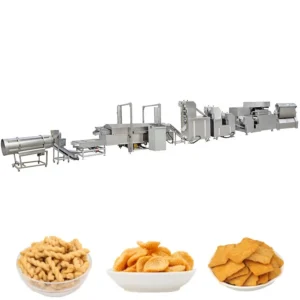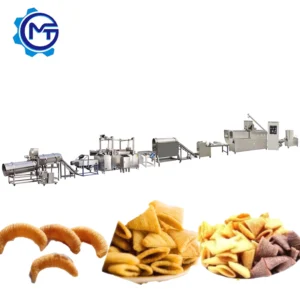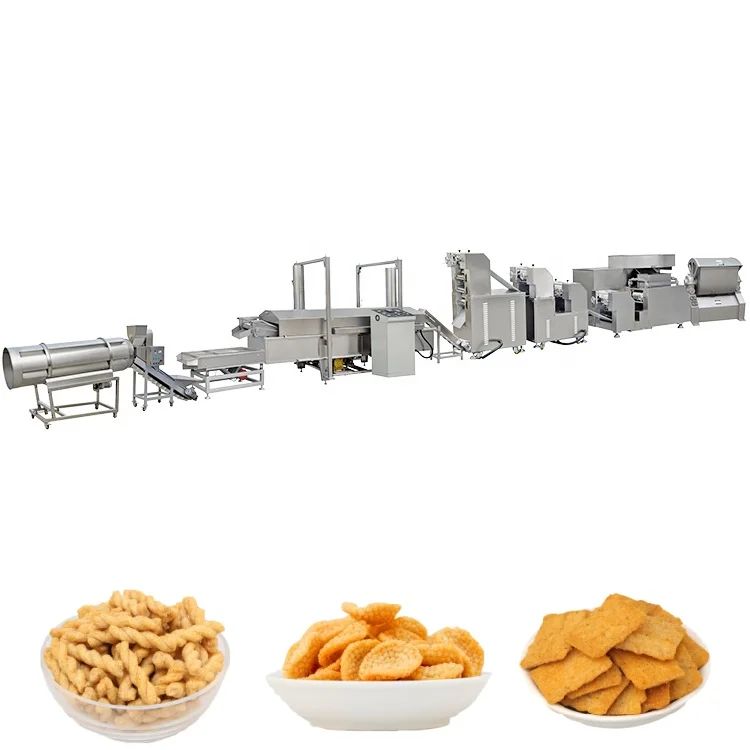
Throughput Matched — every station from mixer to fryer sized to the extruder output so your 3D pellet chips line runs without bottlenecks.
Technical Specifications
| Parameter | Value |
|---|---|
| Model | MT-65 / MT-70 / MT-85 / MT-75 / MT-95 |
| Product Type | Fried 3D Pellet Chips Snack Food Production Line |
| Main Motor Power | 100 kW (MT-65) / 130 kW (MT-70) / 180 kW (MT-85) / 185 kW (MT-75) / 280 kW (MT-95) |
| Output Capacity | 120-150 kg/h (MT-65) / 200-250 kg/h (MT-70) / 300-500 kg/h (MT-85) / 400-500 kg/h (MT-75) / 800-1000 kg/h (MT-95) (basis to be confirmed with raw material and moisture content) |
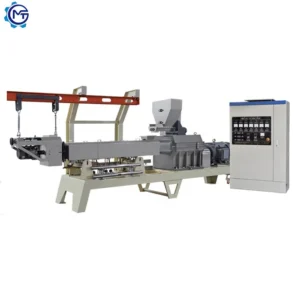
| Screw Type | Twin screw (co-rotating, sectional modules) |
| Cutter Power | 1.47 kW |
| Cutter Dimensions | 2500×600×1100 mm |
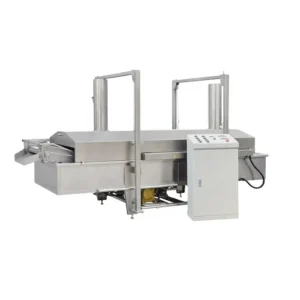
| Fryer Belt Width | 600 mm stainless steel belt |
| Fryer Heating Options | Electricity / Fuel gas / Diesel |
| Voltage & Frequency | Customizable (e.g. 3ph 380V 50Hz, 3ph 380V 60Hz, 3ph 415V 60Hz, 3ph 220V 60Hz) |
| Material Contact Parts | Food-grade stainless steel |
| Drying Method | Gas / Electric / Diesel heating |
| Warranty | 1 year complete warranty with lifetime maintenance service |
| Certification | CE |
Application Suitability
| Application | Material or Output |
|---|---|
| Bugles and corn chip snacks | Corn flour, wheat flour, corn starch |
| Shell and wave-shaped fried pellets | Potato starch, potato powder, rice flour |
| Screw and tube-shaped 3D snacks | Blended grain and starch formulations |
| Industrial fried pellet production | Continuous frying of pre-extruded and dried semi-finished pellets |
What "Nominal Capacity" Leaves Out on a Frying Chips Making Machine Full Equipment Range
The number on the quote means nothing unless it was tested on your exact flour blend.
I have watched too many buyers sign for a fried chips making machine full equipment range based on a capacity figure that only works on the supplier’s standard test starch. The moment they switch to their own corn and wheat blend back at the factory, the extruder surges, the pellets crack instead of puffing, and the fryer cannot keep up. The line then sits idle while parameters are redeveloped from scratch [NEED_CITE: starch gelatinisation behaviour under different moisture and shear profiles].
How the Complete Machine Range Covers Every Station
When you survey a fried chips making machine full equipment range, the extruder is only one piece. The mixing station must feed the extruder at a steady rate, the cutter must shape pellets fast enough to prevent a backlog, and the fryer must have enough belt length and oil volume to handle peak throughput. If any station is undersized, the entire line bottlenecks.
Matching the Fryer to the Extruder Output
The fryer on this range uses a 600 mm stainless steel mesh belt with adjustable speed and temperature. That width accommodates the pellet volume produced by the higher-tier models, and the uniform roller feeding keeps pellets submerged evenly so colour and oil uptake stay consistent across the batch [NEED_CITE: continuous fryer oil turnover rates for snack pellet lines].
Reading the Motor and Screw Specs
The co-rotating twin-screw design uses sectional modules that can be rearranged for different transport, mixing, de-gassing, and cooking zones. A 100 kW motor on the MT-65 suits lower-volume runs, while the 280 kW motor on the MT-95 provides the shear energy needed for high-throughput starch gelatinisation. The barrel temperature profile and screw configuration together determine how thoroughly the raw material cooks before it reaches the die.
The Hidden Cost of Skipping a Trial Run
When a line is shipped without a trial on the buyer’s raw material, the first weeks of production become a costly experiment. Pellet density drifts, fryer oil degrades faster from uneven moisture, and the cutter rollers wear prematurely from harder-than-expected dough. Those hidden costs erase any savings from a lower purchase price [NEED_CITE: snack extrusion trial run protocols before equipment dispatch].
Why Source the Full Range from One Supplier
Throughput matching across stations is engineered before the line ships, not improvised on the factory floor. Screw and die configurations are specified to the buyer’s raw material and target pellet shape, not copied from a generic build. An in-house testing workshop allows trial runs on customer-supplied flour blends before dispatch. Twin-screw expertise spans pet food, aquatic feed, and snack applications, so cross-industry lessons inform screw geometry choices. Pre-sales consultation covers layout, utility planning, and phased installation rather than stopping at a machine quote.
Documentation & Verification
- Line layout and capacity calculation confirming throughput match from mixer through fryer to packing
- Screw and die configuration record specified to your flour blend and target pellet shape
- Machine specification sheet with voltage, frequency, and control language confirmed for your market
- Trial run report on your raw material conducted in the testing workshop before shipment
- CE declaration of conformity and ISO certificate for customs and regulatory clearance
Installation, Commissioning & Support
- Foundation and floor space planned around the longest station footprint, up to 30 m for the MT-95
- Dedicated power circuit sized for the chosen extruder motor, up to 280 kW, plus fryer heating load
- Cutter rollers swapped on-site during commissioning to dial in the target pellet shape
- Fryer belt speed and oil temperature tuned against actual pellet moisture after drying
- Operator training covers screw module changes, die swaps, and fryer oil filtration cycles
- Wear parts list supplied with recommended spare screws, dies, and cutter roller sets
Preparing Your Inquiry
Share your target pellet shape, the exact flour or starch blend you plan to run, and your daily production target so the line can be sized station by station. Include your local voltage and frequency standard, and let us know if you need control panels in a specific language. If you can send a sample of your raw material, we will run a trial before finalising the configuration.
Frequently Asked Questions
Q: How is output capacity verified on my actual raw material?
A: Before shipment, your flour blend is run through the extruder in our testing workshop. We record throughput, pellet density, and fryer behaviour, then adjust screw modules and die design until the line holds the quoted capacity on your material, not just on standard test starch.
Q: How do I select the right extruder model for my capacity target?
A: We match the model to your daily output goal and raw material characteristics. Higher-moisture or harder-to-gelatinise blends need more shear energy, which points to larger motor tiers. The range spans five models from 100 kW to 280 kW to cover small-batch to continuous production.
Q: Can the line voltage and frequency match my local power supply?
A: Yes. Voltage and frequency are configured to your market standard — for example 3ph 380V 50Hz or 3ph 415V 60Hz. The control panel language is also set before shipment so operators can read alarms and parameters without translation delays.
Q: How is throughput matched between extruder, cutter, and fryer?
A: Each station is sized against the extruder’s verified output. The cutter runs fast enough to prevent pellet backlog, and the fryer belt length and oil volume handle peak throughput. The layout document shows the calculated match before you commit.
Q: What downstream equipment completes the line?
A: Flavouring drums, cooling conveyors, and packing stations are available to close the loop from fryer to sealed bag. Each is matched to the fryer’s exit rate so product never queues or cools unevenly before seasoning.