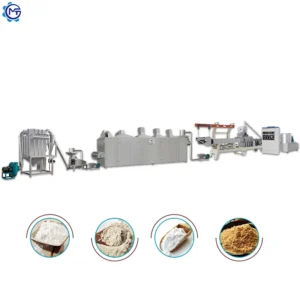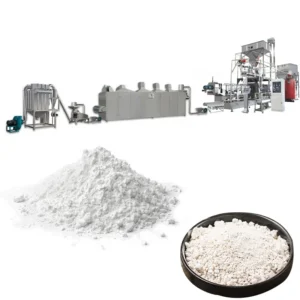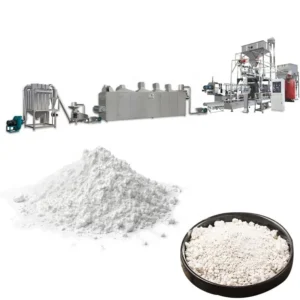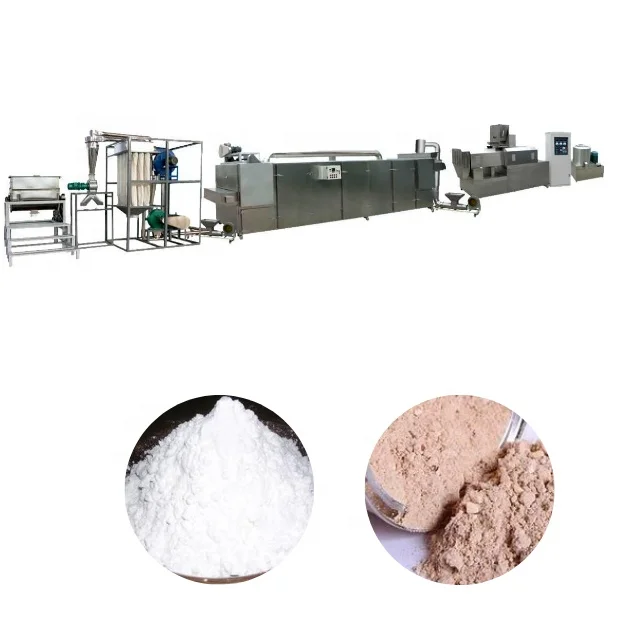
Integrated Station Matching — Every machine in this modified starch processing line full equipment range is sized against your actual raw material moisture and target degree of modification, not just a nameplate figure.
Technical Specifications
| Parameter | Value |
|---|---|
| Product Type | Modified Starch Processing Line (Twin-Screw Extrusion Based) |
| Line Configuration | Mixing / Batching → Twin-Screw Extruder → Cooling Conveyor → Pulse Grinder → Packing |
| Rated Power Range | 45–200 kW (depending on station configuration) |
| Output Capacity | 100–1500 kg/h (basis not stated in source — confirm raw material formulation, moisture content and target degree of modification) |
| Extruder Type | Twin-screw (single-screw variants available within the supplier range) |
| Voltage & Frequency | 220–440 V, tri-phase (exact Hz and configuration confirmed per destination market) |
| Control System | PLC-based automation with integrated MCC |
| Food-Contact Surfaces | Food-grade stainless steel; PVC permitted on select conveyor sections |
| Heating Options | Gas / diesel / electricity / steam (specified at quotation stage) |
| Equipment Weight | 1000–5000 kg (verify against final line configuration) |
| Assembly State | Modular station-by-station layout |
| Interface Language | Multi-language available, confirmed at order |
| Certification | CE, ISO |
Application Suitability
| Application | Material or Output |
|---|---|
| Food-grade pre-gelatinised starch | Corn, wheat, potato and rice starch feedstocks for bakery, sauce and dairy additives |
| Industrial modified starch | Oil drilling fluid additives requiring controlled viscosity profiles |
| Papermaking sizing starch | Modified starch for surface sizing and coating applications |
| Nutrition-fortified starch blends | Soybean flour and grain flour blending with starch base |
| Specialty functional starch | Custom degree of modification for specific thickening and binding requirements |
Why Nominal Throughput Numbers Can Mislead Your Line Design
A modified starch processing line full equipment range is only as reliable as the throughput match across every station. The real question is never what the extruder can push per hour in isolation, but what your specific starch formulation allows the entire line to sustain.
I once worked with a buyer producing food-grade modified starch who ordered a line based on our catalogue capacity figures. Their raw material had a higher moisture content than typical, and the extruder could not hold the rated output on that formulation. The cooling conveyor was suddenly overloaded, the grinder fell behind, and the whole line ran in stops and starts. After that experience, I insisted on receiving the customer’s actual material for bench testing before locking in any station specification [NEED_CITE: starch gelatinisation behaviour across different moisture contents].
Every starch raw material behaves differently under shear and heat. Corn starch gelatinises at a different temperature window than potato starch. Wheat starch demands a specific barrel profile to reach the target degree of modification without over-degrading the polymer chains. If the line configuration ignores these variables, the result is a bottleneck that no amount of operator adjustment can fix.
How Each Station Fits the Modification Process
The twin-screw extruder serves as the core reactor in a modified starch processing line full equipment range. Screw configuration, barrel temperature zones and residence time are all adjusted to the feedstock — whether you are processing corn, wheat, potato or rice starch. The right screw profile controls shear intensity, which directly determines the degree of starch molecule modification achieved during extrusion.
Downstream, the cooling conveyor uses wind-knife air drying to strip surface moisture without exposing the starch to thermal degradation. This matters because pre-gelatinised starch is sensitive to residual heat; too much warmth at this stage reverses part of the modification. The pulse grinder then reduces the cooled product to a consistent particle size, with an integrated cyclone discharge and dust collector keeping the workshop environment controlled.
Matching the Line to Food-Grade and Industrial-Grade Output
A food-grade modified starch line and an industrial-grade line share the same station sequence but diverge sharply on material contact surfaces, cleaning protocols and final particle size requirements [NEED_CITE: food safety standards for starch processing equipment]. For food-grade production, every product contact zone uses food-grade stainless steel, and the line must support washdown routines between batches. Industrial starch for oil drilling mud or papermaking sizing tolerates different contact materials and often runs at coarser grind specifications.
The PLC control system stores separate recipes for each product grade, allowing operators to switch barrel temperature profiles, screw speed and grinder settings without manual recalibration at every station. This flexibility means a single modified starch processing line full equipment range can serve multiple end markets, provided the initial specification accounts for all target products.
Reading the Specifications That Actually Matter
Power ratings across the 45–200 kW envelope tell you where the line sits in terms of scale, but the more useful figure is how that power is distributed. The extruder motor consumes the largest share, and its rated kW directly correlates to the torque available for high-viscosity starch melts. Underpowered extruders stall when processing potato starch, which demands higher shear energy than corn starch.
Voltage and frequency must match the destination market exactly before production begins. A 440 V machine shipped to a 380 V facility will run but at reduced torque, causing inconsistent modification degrees across batches. The control interface language, confirmed at order, ensures operators read alarm messages and recipe parameters in their working language, reducing commissioning delays.
Heating options — gas, diesel, electricity or steam — affect both operating cost and temperature precision. Steam heating delivers the most uniform barrel temperature profile, which is critical when the target modification requires tight thermal control within a narrow window [NEED_CITE: industrial heating methods for food extrusion barrels].
The Hidden Cost of Misaligned Station Capacity
When the extruder is specified without matching dryer or grinder capacity, the line develops a choke point that forces the entire system to run below its potential. I have seen starch processors add shifts to compensate, driving up labour and energy costs while the bottleneck remains unresolved. The extruder sits idle part of each cycle, waiting for the grinder to clear the backlog.
Voltage mismatches discovered at commissioning can delay production by weeks while transformers are sourced or control panels are reconfigured [NEED_CITE: common causes of commissioning delays in food processing plants]. These are problems that surface only because the initial specification conversation skipped the utility confirmation step. Buying the cheapest station from one vendor and the next station from another almost always leaves a throughput gap that no single supplier takes responsibility for closing.
What This Equipment Range Actually Delivers
Every station in the modified starch processing line full equipment range is supplied or coordinated by a single source, so throughput figures are matched across the mixer, extruder, cooler, grinder and packer before the line ships. No station is oversized to inflate a catalogue number, and none is undersized to cut a quotation.
Screw configuration and die design are specified against your raw material sample, not copied from a generic build. The in-house testing workshop runs your actual starch formulation through the extruder before shipment, producing a trial run report that documents achievable throughput and modification degree on your material. This step catches moisture-related capacity shortfalls before they appear on your factory floor.
The MCC and PLC control architecture integrates every station under one automation layer, so recipe changes propagate from batching through packing without manual intervention at each machine. Pre-sales engineering, on-site installation, commissioning and ongoing wear parts supply are handled through a single project channel.
Documentation & Verification
- Line layout and capacity calculation matched to your starch formulation and target output
- Screw and die configuration record specific to your feedstock and modification degree
- Electrical schematic with voltage, frequency and control language confirmed before production
- Factory test record from in-house trial run on your supplied raw material
- CE declaration of conformity and ISO certificate for the complete line
- Wear parts list with replacement intervals for screws, dies and grinder components
Installation, Commissioning & Support
- Foundation and floor space planning based on the modular station layout and equipment weight range
- Dedicated power circuits sized for the 45–200 kW line rating and confirmed voltage specification
- Station-by-station assembly with alignment verification between extruder discharge and cooling conveyor
- First-run parameter setting for barrel temperature, screw speed and grinder gap using your raw material
- Operator training on PLC recipe management across all stations including batching and packing
- Spare screw elements, dies and grinder screens supplied with initial shipment for first replacement cycle
What We Need From Your Side to Quote Accurately
To configure a modified starch processing line full equipment range that holds its throughput on your material, share the type of starch feedstock you will process, its typical moisture content and your target degree of modification. Confirm your facility’s voltage, frequency and available floor space so we can match station dimensions and power supply to your site conditions. If you can send a raw material sample, the testing workshop will run a trial and return a performance report before any production commitment is made.
Frequently Asked Questions
Q: How is each station sized so the line holds its rated capacity on my specific starch formulation?
A: Every station is sized against the throughput that your raw material actually allows through the extruder, not a generic catalogue figure. We run your sample in the testing workshop, measure the achievable output and degree of modification, then match the cooling conveyor, grinder and packing station to that verified rate.
Q: Which stations are supplied in-house versus sourced, and how is throughput matched?
A: The twin-screw extruder, cooling conveyor and pulse grinder are core supplied stations. Mixing, batching and packing equipment are integrated into the line under a single responsibility. Throughput is balanced across all stations during the layout phase so no machine becomes a bottleneck when running your material.
Q: What voltage, frequency and control language options are available for my destination market?
A: The line supports 220–440 V tri-phase configurations. Exact frequency and control panel language are confirmed at order to match your local utility standard and operator requirements, ensuring no commissioning delays from electrical mismatches.
Q: Can the extruder handle both food-grade and industrial-grade modified starch on the same line?
A: Yes, provided the initial specification covers both product targets. The PLC stores separate recipes for each grade, adjusting barrel temperature and screw speed accordingly. Food-grade contact materials are maintained throughout if food production is included in your scope.
Q: Is a trial run on my raw material possible before shipment, and which stations are included?
A: The in-house testing workshop conducts trial runs on your supplied starch sample using the extruder station. The resulting report documents throughput, modification degree and product quality, and those verified figures then drive the sizing of all downstream stations before final shipment.