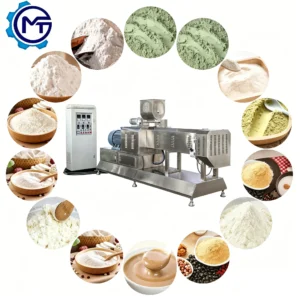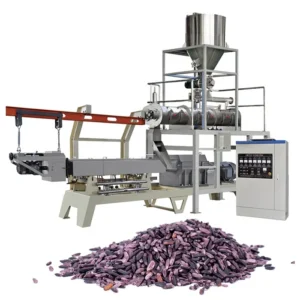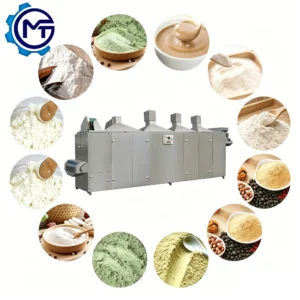
Screw Configuration Matched to Raw Material — our engineers adjust screw pitch, die geometry, and temperature zones specifically for your fortified rice formulation before the line ships.
Technical Specifications
| Parameter | Value |
|---|---|
| Model | MT65 / MT70 / MT85 / MT75 / MT95 |
| Product Type | Artificial Fortified Rice Extrusion Production Line |
| Screw Type | Twin-screw |
| Line Stations | Mixing, Extruding, Vibrating, Low Temperature Drying, Cooling, High Temperature Roasting, Cooling, Packing |
| Control System | Frequency speed controlling, high automation |
| Lubrication System | Automatic lubricating and cooling |
| Heating Source (Dryer) | Electric or gas |
| Dryer Feature | Circulation drying, frequency motor controls mesh belt speed |
| Capacity (MT65) | 80–100 kg/hr (basis to be confirmed with raw material formulation and moisture content) |
| Installed Power (MT65) | 85 kW |
| Power Consumption (MT65) | 60 kW |
| Dimensions (MT65) | 28 × 1.2 × 2.2 m |
| Capacity (MT70) | 100–120 kg/hr (basis to be confirmed) |
| Installed Power (MT70) | 120 kW |
| Power Consumption (MT70) | 85 kW |
| Dimensions (MT70) | 30 × 1.5 × 2.2 m |
| Capacity (MT85) | 200–300 kg/hr (basis to be confirmed) |
| Installed Power (MT85) | 235 kW |
| Power Consumption (MT85) | 165 kW |
| Dimensions (MT85) | 34 × 3.5 × 4.3 m |
| Capacity (MT75) | 300–500 kg/hr (basis to be confirmed) |
| Installed Power (MT75) | 180 kW |
| Power Consumption (MT75) | 135 kW |
| Dimensions (MT75) | 32 × 3.5 × 4.3 m |
| Capacity (MT95) | 800–1000 kg/hr (basis to be confirmed) |
| Installed Power (MT95) | 260 kW |
| Power Consumption (MT95) | 195 kW |
| Dimensions (MT95) | 36 × 3.5 × 4.3 m |
| Basic Material Compatibility | Broken rice, rice, corn, millet, wheat, oats, buckwheat, bean, starch as main ingredient; vitamin and mineral as part of ingredient |
Application Suitability
| Application | Material or Output |
|---|---|
| Fortified rice kernels for nutrition programmes | Broken rice and rice bran blended with vitamins and minerals |
| Artificial rice from grain by-products | Crushed corn, millet, or buckwheat with starch binder |
| Nutritional rice analogues | Wheat and oat flour with protein and micronutrient addition |
| Infant and weaning rice cereals | Rice flour with iron, zinc, and B-vitamin premix |
What "800 kg/hr" Leaves Out About Fortified Rice Lines
The capacity number on the nameplate means nothing until it is verified on your exact formulation with its actual moisture content and protein ratio.
I worked on a nutritional powder project last year where the buyer sent us a standard rice flour spec, but their real recipe included a significant share of whey protein isolate. The expansion behaviour changed completely — the die pressure spiked, the extrudate surface turned rough, and we had to rework the screw speed and barrel temperature profile from scratch. That is the reason we now ask for the full raw material breakdown before proposing any fortified rice production line equipment configuration. Without a trial run on your actual premix, throughput figures remain theoretical [NEED_CITE: raw material moisture and protein content effects on twin-screw extrusion output].
Eight Stations, One Throughput Calculation
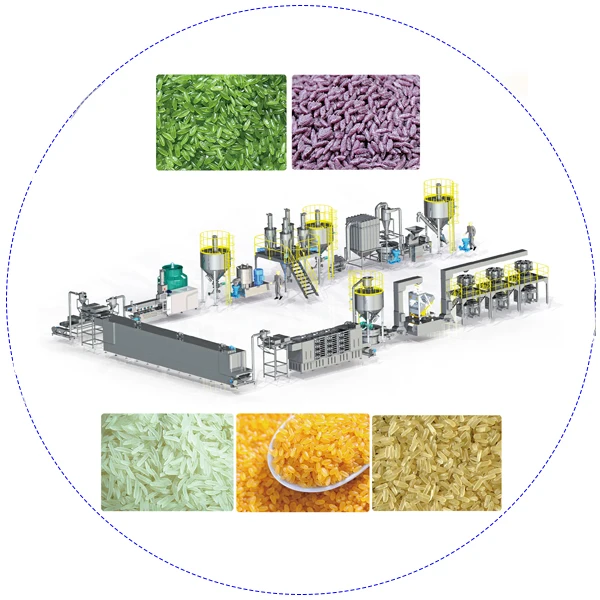
Every artificial rice extruder machine in this series connects eight distinct processing stations in sequence: mixing, extruding, vibrating, low temperature drying, cooling, high temperature roasting, a second cooling stage, and packing. The critical engineering question is whether each station can sustain the throughput the extruder pushes into it. A dryer that cannot remove moisture fast enough will back material up into the vibrating conveyor, and an undersized roasting unit will force the entire line to slow down. Our line layouts calculate residence time and capacity at each point so the rated extruder output actually reaches the packing station.
How the Drying and Roasting Stages Shape the Final Kernel
The low temperature drying stage uses a circulation oven where a frequency-controlled motor adjusts mesh belt speed, letting operators fine-tune moisture removal without case-hardening the kernel surface. After cooling, the high temperature roasting stage develops the final colour and aroma that consumers associate with natural rice. Switching the dryer heating source between electric and gas allows the line to adapt to local utility costs and availability [NEED_CITE: industrial drying energy source selection for food processing facilities]. This two-stage thermal approach keeps the vitamin and mineral premix intact while producing a kernel that cooks and tastes like conventional rice.
Reading the Specification Table Against Your Production Target
The five models span from the MT65 at 85 kW installed power to the MT95 at 260 kW, but motor rating alone does not determine which unit fits your project. The screw diameter and length-to-diameter ratio inside each barrel govern how long the material stays under heat and shear, which directly affects starch gelatinisation and the degree of expansion at the die face. For formulations with a high share of heat-sensitive vitamins, a shorter residence time on a smaller model may preserve nutrient content better than running slowly on a larger one. The automatic lubricating and cooling system across all models maintains bearing temperature during continuous shifts, preventing unplanned stops that would otherwise interrupt a nutrition programme delivery schedule.
The Hidden Cost of a Mismatched Line Configuration
When the extruder, dryer, and roasting oven are sourced from separate vendors, nobody takes responsibility for the throughput gap between them. I have walked into plants where the fortified rice production line equipment extruder was rated for several hundred kilograms per hour, but the dryer belt was too narrow to carry that volume and kernels piled up at the transfer chute. The operator then slowed the extruder to match the dryer, cutting actual output well below what was paid for. These bottlenecks are invisible on paper and only appear after commissioning [NEED_CITE: throughput balancing across food extrusion line stations].
Why Buyers Source the Full Line Here
Every station from the batching mixer to the packing scale is specified under one supplier, so throughput calculations stay in a single set of engineering hands. Screw configuration and die geometry are documented against your raw material sample, not copied from a generic build. Before dispatch, the line runs a trial on your actual formulation in our testing workshop, producing a written report you can review before the crate is sealed. Electrical schematics confirm voltage, frequency, and control language for your destination market. CE and ISO documentation ships with every consignment.
Documentation & Verification
- Line layout drawing with throughput calculation across all eight stations
- Screw and die configuration record matched to your raw material formulation
- Trial run report on customer-supplied premix before shipment
- Electrical schematic with confirmed voltage and control panel language
- CE declaration of conformity and ISO certificate
- Operation and maintenance manual with wear parts list
Installation, Commissioning & Support
- Foundation plan aligned with the MT65 footprint of 28 × 1.2 m or the MT95 at 36 × 3.5 m
- Dedicated power circuit sized to the model’s installed power, up to 260 kW for the MT95
- Sectional delivery with on-site assembly of dryer and roasting oven modules
- First-run parameter setting for screw speed, barrel zones, and mesh belt frequency
- Operator training covering die changes and automatic lubrication system checks
- Wear parts list identifying screws, dies, and cutter bearings for first replacement order
Preparing Your Inquiry
To size the right model and configure the line accurately, share your complete raw material recipe including the percentage of starch base, protein addition, and micronutrient premix. Specify your target daily output and the number of operating shifts so we can select from the MT65 through MT95 range. Include your facility voltage and frequency, and let us know whether the dryer should run on electric or gas heating.
Frequently Asked Questions
Q: How is capacity verified across the complete line from extruder to packing station?
A: We calculate residence time and throughput at every station — mixing, extruding, drying, roasting, cooling, and packing — using your raw material density and moisture content. The figures are documented in the line layout so you can see where each stage matches or constrains the extruder output before the order is placed.
Q: What supporting equipment is included and how is throughput balanced between stations?
A: The line includes the mixer, twin-screw extruder, vibrating conveyor, circulation dryer, two cooling conveyors, a high temperature roasting oven, and a packing station. Each unit is sized so the material flow rate leaving the extruder can be absorbed by the dryer belt width and the roasting oven dwell time without bottlenecking.
Q: Can the dryer heating source be configured for electric or gas based on local utility availability?
A: Yes. The circulation drying oven can be built with electric heating elements or a gas burner system. We confirm your local gas pressure and supply standards during the specification stage so the correct burner assembly is installed before the artificial rice extruder machine leaves the factory.
Q: How do I select the right model from MT65 to MT95 based on my production target?
A: Model selection depends on your confirmed formulation output, not just a headline capacity figure. We cross-reference your raw material bulk density, moisture content, and desired kernel size against each model’s screw geometry and motor power to recommend the unit that meets your target without over-sizing.
Q: What is included in the complete line delivery versus what needs separate procurement?
A: The delivery covers all eight stations from raw material intake to the packing scale, plus the control cabinets, cable sets, and spare wear parts for the first replacement cycle. The buyer typically provides the incoming power supply, compressed air source, and any local exhaust ventilation required by site regulations.