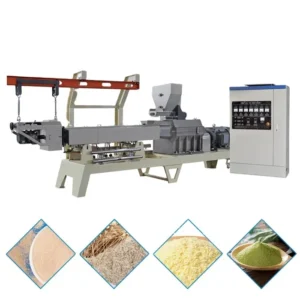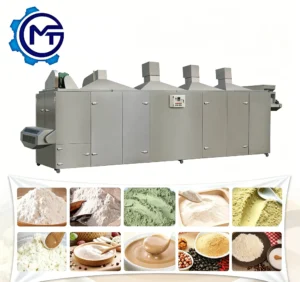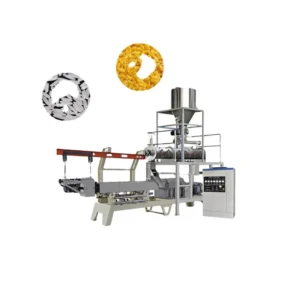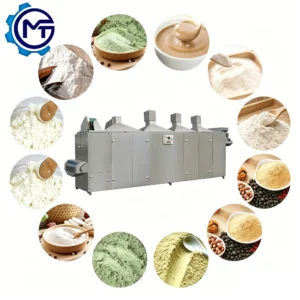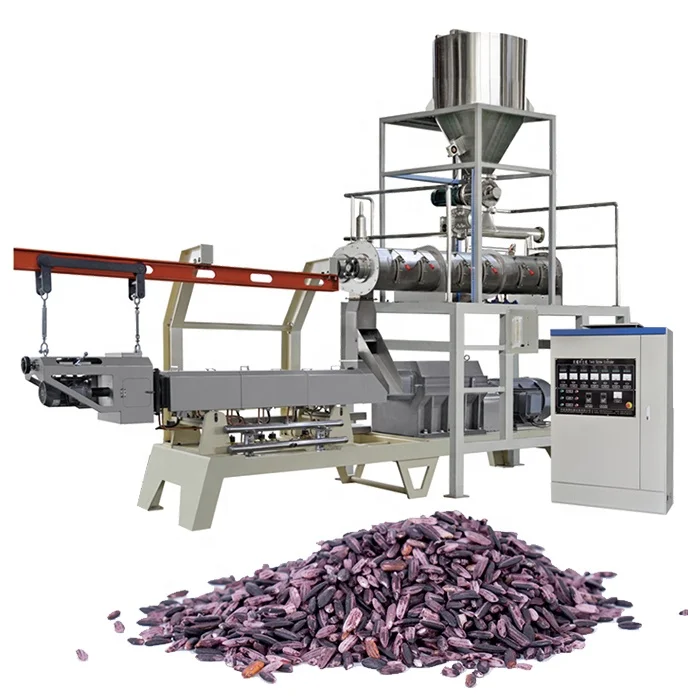
Complete Line Matching — Every station from the batching mixer to the packing scale is sized to the selected extruder model, preventing the downstream bottlenecks that typically stall artificial rice lines.
Technical Specifications
| Parameter | Value |
|---|---|
| Model | MT65 |
| Product Type | Artificial Nutritious Rice Production Line |
| Machine Type | Twin-screw extruder line |
| Installed Power | 85 kW |
| Power Consumption | 60 kW |
| Output Capacity | 80–100 kg/h (basis not stated in source — confirm raw material formulation & moisture content) |
| Overall Dimensions | 28 × 1.2 × 2.2 m |
| Control System | Frequency speed controlling, automatic lubricating and cooling system |
| Screw Type | Twin-screw |
| Heating Source (Dryer) | Electric or gas |
| Line Stations | Mixing, Extruding, Vibrating, Low temperature drying, Cooling, High temperature roasting, Cooling, Packing |
| Raw Materials Supported | Broken rice, corn, millet, wheat, oats, buckwheat, bean, starch; vitamin and mineral supplementary ingredients |
| Final Products | Artificial rice, fortified rice kernels |
| Standards | CE, ISO |
Application Suitability
| Application | Material or Output |
|---|---|
| Fortified rice programs | Vitamin- and mineral-enriched kernels from broken rice base |
| Grain reprocessing | Artificial rice from corn, millet, wheat, or mixed grain blends |
| Nutrition supplementation | Pre-cooked nutritious rice using oat, buckwheat, or bean formulations |
| Breakfast cereal base | Extruded rice-shaped pellets for further coating or roasting |
Why "80–100 kg/h" Means Nothing Without the Formulation
The capacity figure only holds when your exact raw material blend and moisture content match the test conditions.
I spent a week in a Peruvian plant chasing an output problem that turned out to be a formulation issue. The line ran fine on plain rice flour during the factory trial, but the customer’s actual premix included a heavy load of vitamins and minerals that changed the melt viscosity entirely. Expansion dropped, throughput followed, and the dryer could not keep pace. Once we re-tuned the screw profile and adjusted barrel temperatures to the real formulation, the line settled into a stable rhythm. That is why the artificial rice production line equipment catalogue always asks for your exact recipe before quoting a model. [NEED_CITE: effect of micronutrient loading on extrusion melt viscosity]
How Twin-Screw Extrusion Shapes the Rice Kernel
Twin-screw extrusion provides the shear and residence time control needed to fully gelatinise starch while incorporating micro-nutrients evenly through the matrix. The MT65 uses a co-rotating screw set whose configuration is matched to the specific grain base — broken rice behaves very differently from corn or buckwheat in terms of gelatinisation temperature and melt elasticity. Die design then determines the final kernel geometry, and the vibrating station immediately after extrusion prevents clumping before the product enters the dryer. This level of control over the artificial rice production line equipment catalogue ensures each kernel holds its shape through drying and roasting.
Drying and Roasting Sequence Explained
The line runs a low-temperature drying stage first, reducing surface moisture gradually so the kernel skin does not crack or case-harden. After cooling, a high-temperature roasting step develops the final texture and colour, followed by a second cooling pass before packing. Skipping the first drying stage or running the dryer too hot causes surface fissures that lead to breakage during transport and storage. The dryer is available with electric or gas heating, selected based on the utility infrastructure at your facility. Getting the drying curve right is as important as the extrusion parameters themselves. [NEED_CITE: starch retrogradation and drying curve for extruded rice products]
Reading the Specs That Actually Matter
Installed power of 85 kW and power consumption of 60 kW on the MT65 tell you the motor is sized with headroom for the high-torque moments that occur when a dense, mineral-loaded formulation passes through the compression zone of the screws. The frequency speed control lets operators dial screw RPM to the material — a slower screw speed extends residence time for harder grains like buckwheat, while a faster speed suits softer rice or corn blends. The automatic lubricating and cooling system keeps the gearbox and barrel sections within safe operating temperature during continuous runs, which matters when you are producing fortified rice for multi-shift schedules. Overall line dimensions of 28 × 1.2 × 2.2 m define the minimum floor space, but you also need clearance for the raw material staging area upstream and the packing table downstream.
What Happens When Downstream Equipment Is Undersized
A common failure mode on artificial rice lines is an extruder that runs fine but feeds into a dryer that cannot remove moisture fast enough. The product piles up on the vibrating conveyor, kernels stick together, and you end up shutting down the extruder to let the dryer catch up. The same problem appears in reverse when the roasting oven is oversized for a low-capacity extruder — the product over-dries and becomes brittle. This is why matching every station to the selected model is non-negotiable. Buyers who assemble lines from separate vendors often discover these mismatches only after installation. [NEED_CITE: throughput balancing in continuous extrusion lines]
Why Source the Full Line from One Supplier
Meiteng builds the entire artificial rice production line equipment catalogue under one roof, so the mixer capacity, extruder output, dryer belt length, and packing speed are all calculated against the same throughput target. Screw configuration and die design are specified to your raw material formulation before production begins, not copied from a generic build. The in-house testing workshop runs trial production on your actual premix before shipment, catching the kind of expansion and viscosity issues I dealt with in Peru before the machines ever leave the factory. Electrical schematics are confirmed against your local voltage and frequency, and the control language is set before wiring. CE and ISO documentation ships with every line.
Documentation & Verification
- Machine specification sheet confirming installed power, consumption, and dimensions for the selected model
- Screw and die configuration record matched to your grain base and micro-nutrient formulation
- Electrical schematic with voltage, frequency, and control language confirmed for your site
- Trial run report on your actual raw material blend produced in the testing workshop
- Factory test record documenting continuous run stability before crating
- CE declaration of conformity and ISO certificate included in the shipping packet
Installation, Commissioning & Support
- Floor space of 28 × 1.2 × 2.2 m minimum, with additional clearance for material staging and packing
- Dedicated electrical circuit rated for 85 kW installed power with confirmed voltage and frequency
- Line arrives in modular sections for on-site assembly and alignment of all stations
- First-run commissioning includes screw speed tuning and barrel temperature profiling to your formulation
- Operator training covers frequency speed adjustment, automatic lubrication checks, and dryer settings
- Wear parts list with reorder codes for screws, dies, and dryer belt sections
- Maintenance schedule for gearbox oil, cooling system inspection, and heating element checks
What to Include in Your Inquiry
Send your raw material formulation with percentages for each grain and micro-nutrient component, along with the target moisture content of the finished kernel. Specify your daily production volume and whether you operate single or multiple shifts. Include your facility’s voltage, frequency, and any control language requirements. If you have existing upstream milling or downstream packing equipment, share the interface specifications so the line can be matched accordingly.
Frequently Asked Questions
Q: How do I choose the right extruder model for my artificial rice project?
A: Start with your target hourly output and the specific grain blend you plan to use. The MT65 suits smaller runs, while larger models in the range handle higher volumes. The selection also depends on whether your formulation includes heavy mineral loading, which affects screw torque requirements. A trial run on your actual material in the testing workshop confirms the right model before commitment.
Q: What supporting equipment is required to avoid line bottlenecks?
A: Every station — mixer, vibrating conveyor, dryer, roaster, cooler, and packer — must be matched to the extruder output. An undersized dryer causes product backup, while an oversized roaster over-dries the kernels. The artificial rice production line equipment catalogue provides matched sets so throughput is balanced across every stage of the process.
Q: Why must voltage and frequency be confirmed before shipment?
A: Motor windings, heating elements, and control transformers are all built to a specific voltage and frequency. Shipping a machine wired for 380V/50Hz to a site running 440V/60Hz causes immediate motor damage or control failure. The electrical schematic is reviewed and confirmed against your local utility standard before the wiring phase begins.
Q: How is the dryer heating source selected?
A: Electric heating suits facilities with stable, high-capacity electrical supply and lower gas infrastructure. Gas heating is preferred where electricity costs are high or gas lines are already installed. The choice affects the dryer’s thermal response time and operating cost, and both options are available for this line configuration.
Q: What documentation comes with the complete production line?
A: You receive a machine specification sheet, screw and die configuration record, electrical schematic, trial run report on your raw material, CE declaration, ISO certificate, factory test record, operation manual, wear parts list, and packing photographs. All documents are provided in the agreed control language.