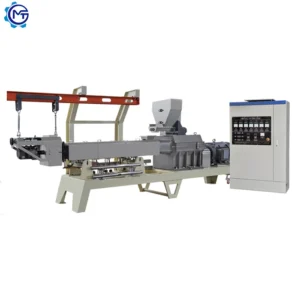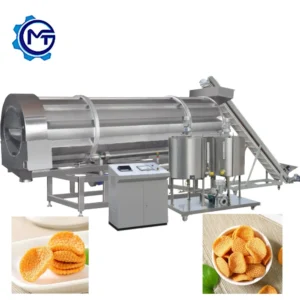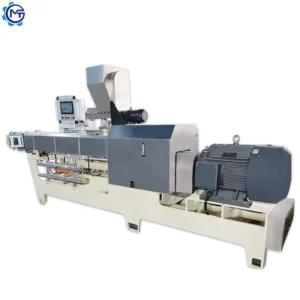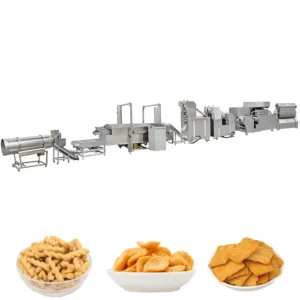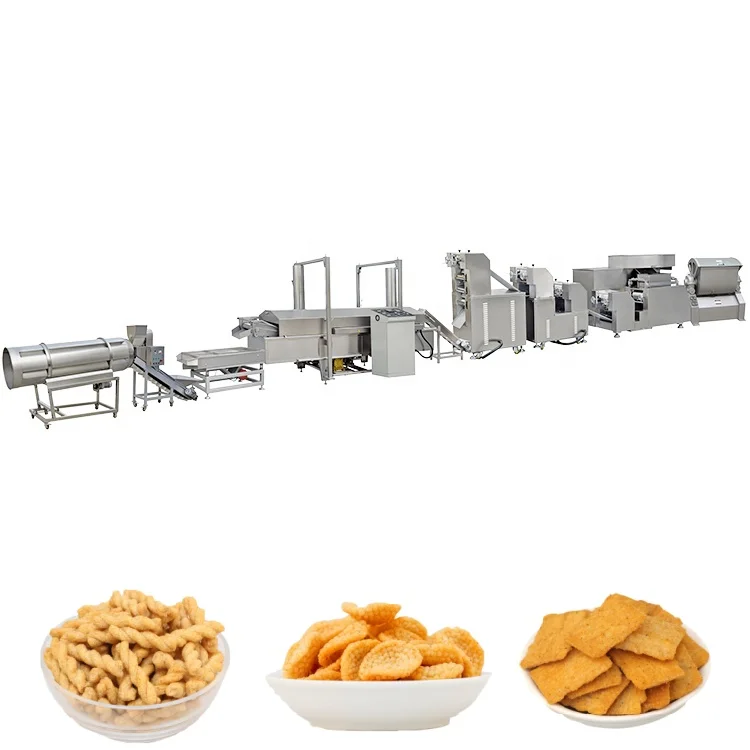
Throughput-Matched Extrusion and Frying Stations — Every segment from the single screw extruder to the automatic fryer is sized so the line runs at a steady rhythm without one station starving or flooding the next.
Technical Specifications
| Parameter | Value |
|---|---|
| Product Type | Single Screw Extruder Fried Puffed Food Production Line |
| Model | MT100/MT120 |
| Extruder Type | Single screw extruder |
| Screw Configuration | High and low pressure screw |
| Rated Power | 50-70 kW (electric heating); 50-60 kW (gas or diesel heating) (basis to be confirmed) |
| Voltage & Frequency | Three phases 380V/50Hz, Single phase 220V/50Hz (customizable to customer local voltage) |
| Control System | Delta inverter; Delixi electrical components |
| Motor | Siemens (made in China) or China top brand |
| Overall Dimensions (L×W×H) | 12000-26000 × 1200 × 2200 mm |
| Output Capacity | 120 kg/h (basis not stated in source) |
| Material | Food grade stainless steel 201/304 |
| Energy Options | Electricity / Gas / Diesel / Steam |
| Die Configuration | Adjustable dies for multiple shapes (screw shell, round tube, square tube, ring, cartoon shapes) |
| Raw Materials | Wheat flour, corn starch, potato starch |
| Certification | CE, ISO 9001 |
| Warranty | One year |
Application Suitability
| Application | Material or Output |
|---|---|
| Salad sticks / Pani puri / Golgappa | Wheat flour, corn starch |
| Secondary puffing fried snacks | Potato starch, corn starch blends |
| Shaped extruded and fried snacks | Screw shell, round tube, square tube, ring, cartoon shapes |
| Snack and pasta extrusion formats | Wheat flour and starch combinations |
What "120 kg/h" Leaves Out About a Fried Puffed Food Production Line Equipment for Sale
Capacity numbers on paper mean very little if the starch blend in your silo behaves differently than the one used to rate the machine.
I have watched buyers sign off on a fried puffed food production line equipment for sale based on a brochure figure, only to find the actual throughput drops once their specific flour moisture and starch ratio hit the barrel. The single screw extruder might push the nominal volume, but if the pulling and cutting machine or the automatic fryer downstream cannot keep pace, the whole line stutters. Conversely, if the fryer is oversized and the extruder cannot feed it, you burn energy heating oil that sits idle.
Matching throughput across every station is where most off-the-shelf lines fail. The extruder, fryer, and flavoring drum each have their own ideal feed rate, and those rates shift with raw material density, moisture content, and target expansion [NEED_CITE: starch gelatinisation and expansion behaviour under varying moisture levels]. A line that looks balanced on a quotation sheet can bottle-neck the moment you swap from corn starch to a wheat-potato blend.
How the Single Screw Barrel Handles Starch Variability
The MT100/MT120 uses a high and low pressure screw configuration inside a single barrel, which means the same extruder can process wheat flour, corn starch, and potato starch without a full screw swap. The high pressure zone compresses and gelatinises the starch, while the low pressure zone controls expansion as the dough exits the die. This flexibility matters when a snack manufacturer wants to run salad sticks on Monday and a potato-starch-based pani puri dough on Wednesday.
Die changeover on the extruder head lets operators switch between screw shell, round tube, square tube, ring, and custom cartoon shapes. The adjustable die system means you are not locked into one product format for the life of the machine, which is exactly what a contract snack producer needs when retail customers rotate seasonal SKUs.
Energy Source Selection and Its Effect on Line Power Draw
The line supports electricity, gas, diesel, and steam as heating media. When electric heating is selected, rated power sits in the 50-70 kW range; switching to gas or diesel brings that figure to 50-60 kW [NEED_CITE: industrial fryer energy consumption across heating media]. The choice is rarely just about the electricity bill — it is about what utility infrastructure your facility already has and what local energy costs look like over a multi-year production horizon.
A producer in a region with unstable grid supply often prefers gas or diesel for the fryer segment, keeping electric load focused on the extruder motor and control panel. The Delta inverter and Delixi electrical components on the control side are specified to handle the starting current of the main motor without tripping breakers, provided the incoming supply matches the confirmed voltage and frequency.
Reading the Specs That Actually Matter on the Shop Floor
The overall line length stretches between 12 and 26 metres depending on how many conveyor segments and cooling stations are included. That footprint determines whether the line fits an existing bay or requires a new build, so measuring available floor space before finalising the layout is non-negotiable. The 1200 mm width and 2200 mm height are consistent across configurations, which helps when planning overhead clearance for ventilation hoods above the fryer.
Food grade stainless steel 201/304 construction on all product contact surfaces is not just a hygiene checkbox — it affects how the line withstands the hot oil vapour and steam that a frying chips making machine environment generates daily. Grade 304 resists corrosion better in high-humidity zones near the fryer and flavoring drum, while 201 is often sufficient for the mixing and conveying segments where exposure is lower.
The motor specification — Siemens made in China or a comparable domestic brand — directly influences spare part sourcing in your region. If your maintenance team already stocks bearings and seals for Siemens frames, lead time for a motor swap drops from weeks to hours. The control system language is another detail that gets overlooked until the first morning of production, when operators stare at a panel displaying instructions in a language they cannot read [NEED_CITE: control panel language configuration for export machinery].
The Hidden Cost of Skipping a Pre-Shipment Trial Run
I once visited a site where a fried snack line had been running for three months at barely half its expected output. The root cause was a corn flour blend with higher moisture than the generic test material used at the factory. The extruder barrel temperature profile was set for a drier feed, so the dough never reached proper gelatinisation before hitting the die. Expansion was weak, the fryer could not achieve the target crunch, and the flavoring drum ended up coating a dense, under-puffed pellet that the market rejected.
A trial run on the buyer’s actual raw material before shipment would have flagged the moisture mismatch. The screw configuration and barrel temperature curve could have been adjusted while the machine was still in the testing workshop, not after it was bolted to the floor overseas [NEED_CITE: importance of pre-shipment extrusion trial runs on customer raw material].
Why Buyers Source This Line from One Supplier
Every station — mixer, screw conveyor, single screw extruder, pulling and cutting machine, automatic fryer, automatic flavoring line, and cooling conveyor — is specified and assembled under one roof, so throughput is matched rather than guessed. The screw and die configuration is documented against your target product shape and raw material blend before production starts, not copied from a generic template.
An in-house testing workshop allows trial runs on your flour or starch before the line is crated, producing a written report that travels with the shipment. The electrical schematic, voltage confirmation, and control language are locked in during the order stage so there are no surprises when the electrician opens the panel on installation day. CE and ISO 9001 documentation accompanies every line, satisfying import compliance requirements without last-minute scrambles.
Documentation & Verification
- Line layout and capacity calculation matched to your raw material blend and target snack shape
- Screw and die configuration record specifying pressure zones for your starch type
- Electrical schematic confirming voltage, frequency, and control panel language
- Trial run report on your actual flour or starch blend before dispatch
- Factory test record covering every station from mixer to cooling conveyor
- CE declaration of conformity and ISO 9001 certificate for customs clearance
Installation, Commissioning & Support
- Floor plan showing the 12-26 metre line length and utility connection points for your bay
- Dedicated circuit sizing for 50-70 kW electric heating or gas line routing for fryer segment
- Delta inverter parameter setup and Delixi component commissioning on first power-up
- Die changeover training for operators switching between screw shell, ring, and cartoon shapes
- Wear parts list covering screws, dies, and cutting blades with first replacement cycle guidance
- Stainless steel 201/304 surface care schedule for fryer and flavoring zones
What to Include in Your Inquiry
Send your raw material type — wheat flour, corn starch, potato starch, or a blend — along with the target moisture content you typically work with. Specify the snack shapes you plan to run and the daily output volume your market demands. Confirm your facility’s voltage, frequency, and whether you need the control panel in a specific language. If you have existing upstream or downstream equipment that the new line must connect to, include those dimensions and feed rates so the layout can be drawn around them.
Frequently Asked Questions
Q: How is the output capacity of this fried puffed food production line equipment for sale verified?
A: The capacity figure is based on a specific raw material and moisture level that must be confirmed for your application. MT runs a trial using your actual flour or starch blend in the testing workshop before shipment, and the measured throughput is documented in a report that ships with the line.
Q: Can the line voltage and control language be configured for my facility?
A: Yes. The standard offering covers three-phase 380V/50Hz and single-phase 220V/50Hz, with custom voltage available on request. Control panel language is confirmed during the order stage so operators can read the Delta inverter interface from day one.
Q: What shapes can the die system produce, and how long does a changeover take?
A: Adjustable dies cover screw shell, round tube, square tube, ring, and custom cartoon shapes. Changeover involves swapping the die plate and adjusting the cutting machine — a task trained operators complete during a normal product transition window.
Q: How are the extruder, fryer, and flavoring stations matched to avoid bottlenecks?
A: Each station is sized based on the throughput confirmed during the trial run on your raw material. The fryer belt speed, oil volume, and flavoring drum rotation are all calculated to keep pace with the extruder output at your specific dough density and expansion rate.
Q: What does the in-house trial run cover before the line ships?
A: The trial processes your raw material through the extruder, cutter, and fryer at production settings. The resulting report records throughput, product expansion, oil absorption, and any screw or temperature adjustments made to meet your target texture and density.