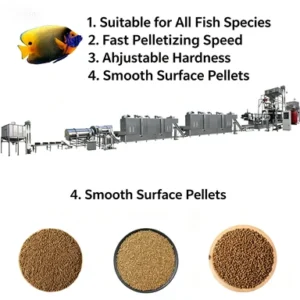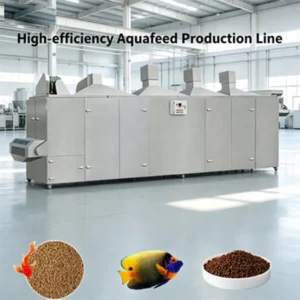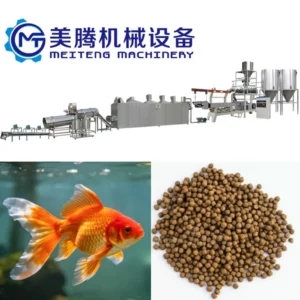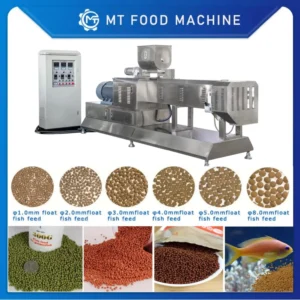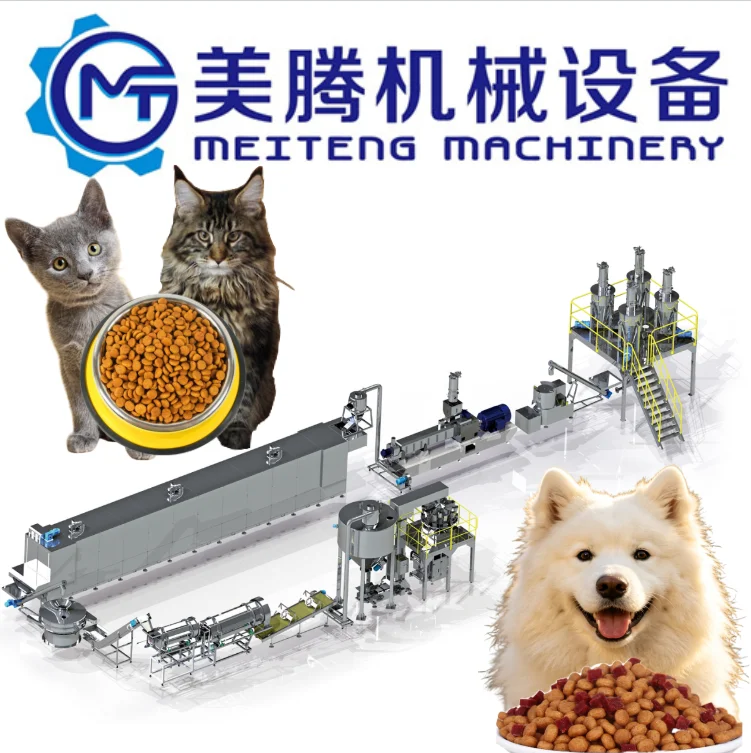
Full-Line Equipment Matching — Every station from batching to packaging is engineered to the same throughput baseline, preventing the bottleneck effect when an extruder outpaces its dryer or flavouring drum.
Technical Specifications
| Parameter | Value |
|---|---|
| Product Type | Pet Food Extrusion Production Line |
| Capacity Range | 150 kg/h – 3 T/h (basis not stated in source — confirm raw material type, moisture content, and product format) |
| Automation Level | Fully automated from mixing through extrusion, drying, and packaging |
| Control System | Available with PLC or MCC control |
| Recipe Adaptability | Dry kibble, semi-moist pet food, and pet treats |
| Construction Material | Food-grade contact surfaces throughout |
| Assembly State | Complete integrated line (mixing, extrusion, drying, flavouring, cooling, packaging) |
| Energy Feature | Energy-saving design across heating and drive systems |
| Maintenance Design | Modular components for quick cleaning and recipe changeover |
| Standards | CE, FDA |
Application Suitability
| Application | Material or Output |
|---|---|
| Dry kibble production for dogs and cats | Corn, meat meal, soy protein, wheat flour at controlled moisture |
| Semi-moist pet food and treats | High-moisture dough with humectants and meat slurry |
| Bird feed pellets | Seed blends, grain flour, vitamin premix |
| Aquatic feed for ornamental fish | Fish meal, starch, shrimp meal with floating or sinking density targets |
| Cattle supplement pellets | Grain-based mash with mineral and urea additives |
What Happens When Stations Are Not Throughput-Matched
A pet food making machine full equipment range only performs as well as its slowest station.
I once visited a plant where the twin-screw extruder was rated well above the dryer’s actual evaporation capacity. The extruder pushed product faster than the dryer could remove moisture, so kibble left the line above specification and spoiled in the bag. The owner had sourced each station from a different vendor, and nobody had checked whether the numbers aligned under real running conditions [NEED_CITE: throughput matching across extrusion line stations]. When you evaluate a pet food making machine full equipment range, the capacity of every individual station must be calculated against the same raw material profile and target moisture level, not quoted in isolation.
Station Coverage From Raw Material Intake to Final Pack
A complete pet food making machine full equipment range begins with the batching and mixing station, where raw materials are weighed and blended to a consistent recipe before entering the extruder barrel. The extrusion station itself handles cooking, forming, and expansion in one continuous process. Downstream, the dryer removes surface and internal moisture to a shelf-stable level, the flavouring drum applies fat and palatant coatings, and the cooling conveyor stabilises the product before it enters the packaging station. Having every station designed by one manufacturer means the conveyor widths, belt speeds, and hold times are calculated together rather than guessed at separately.
Modular Design and Recipe Changeover Flexibility
Quick recipe changeover matters when a single line must produce kibble for puppies, adult dogs, and cats across the same shift. Modular barrel sections and interchangeable die plates allow operators to switch product format without a full line teardown [NEED_CITE: extrusion changeover time benchmarks in pet food plants]. Food-grade construction across all contact surfaces means cleaning between recipes does not require aggressive chemicals that could leave residue. The control system stores recipe parameters so that barrel temperature zones, screw speed, and feeder rates recall to the same values every time a product is selected.
Reading the Specifications Against Your Raw Material
The capacity range spans from small-batch trial production to high-volume continuous output, but the actual achievable throughput depends entirely on the raw material composition. High-protein formulations with meat meal above a certain ratio tend to increase melt viscosity inside the barrel, which reduces volumetric output compared to a starch-dominant recipe running at the same screw speed. The control system plays a direct role in batch consistency: PLC-managed temperature zones and feeder synchronisation hold the extrusion conditions steady across long runs, while manual control leaves more room for operator-dependent variation. Die geometry and screw element arrangement together determine the shear profile, which governs how thoroughly starches gelatinise and how much expansion occurs as the product exits the die face. Moisture content at the barrel inlet is equally critical — too low and expansion becomes unpredictable, too high and the dryer must work beyond its design duty.
The Hidden Cost of Specifying Stations Separately
When the extruder, dryer, and coating drum come from different suppliers, the integration risk falls entirely on the buyer. A flavouring drum that cannot keep up with extruder output forces the extruder to idle, wasting energy and creating uneven product residence time in the barrel [NEED_CITE: line imbalance effects on extruded food quality]. Electrical incompatibility between control cabinets from different vendors can delay commissioning by days while wiring and signal protocols are reconciled. Spare parts sourcing becomes a separate negotiation with each supplier, and a worn screw element from one vendor may not match the barrel liner supplied by another.
Why Source the Full Equipment Range Here
Every station is sized to the same capacity calculation, so the pet food making machine full equipment range arrives as a balanced system rather than a collection of individual machines. Screw configuration and die design are specified to your actual raw material blend, not copied from a generic template. The in-house testing workshop runs your raw material before shipment, generating a trial report that confirms achievable output and product texture under real conditions. Food-grade contact materials are standard across every station, not offered as an optional extra. Pre-sales engineering covers line layout and utility planning, and on-site commissioning includes operator training on the specific recipes you intend to run [NEED_CITE: CE machinery directive requirements for food processing equipment].
Documentation & Verification
- Line layout drawing with throughput calculation for each station matched to your recipe
- Screw and die configuration record tied to your raw material blend
- Electrical schematic confirming voltage, frequency, and control language for your facility
- Factory trial run report on your actual raw material before dispatch
- CE declaration of conformity and ISO certificate for the complete line
- Wear parts list with first replacement intervals for screws, dies, and dryer belts
Installation, Commissioning & Support
- Foundation and floor space plan based on the integrated line footprint and utility connection points
- Dedicated electrical circuits sized for the PLC-controlled extruder drive and dryer heating loads
- Modular station assembly allowing sequential installation as building work is completed
- First-run parameter setting on your raw material with an engineer present to adjust screw speed and barrel temperatures
- Operator training covering recipe recall, die changeover, and daily cleaning of food-grade contact surfaces
- Wear parts kit including spare screw elements and die plates scheduled for delivery before first replacement is due
Before You Request a Quote
To configure a pet food making machine full equipment range that fits your production target, share your raw material formulation including protein and moisture levels, the kibble size or treat shape you intend to produce, and your target daily output. Confirm the voltage and frequency available at your facility, and whether your control operators need a specific language interface. If you already run upstream or downstream equipment that must integrate with the new line, provide the make and model so the connection points can be designed accordingly.
Frequently Asked Questions
Q: How is output capacity verified, and what raw material and product format is it based on?
A: We run your actual raw material in our testing workshop and record the achievable throughput on the specific kibble size or treat shape you require. The trial report documents screw speed, barrel temperature, and moisture levels at the measured output, so the quoted capacity reflects your recipe rather than a generic benchmark.
Q: Which stations are included, and how is throughput balanced between them?
A: The line covers batching, mixing, extrusion, drying, flavouring, cooling, and packaging. Each station is calculated to handle the same mass flow based on your raw material density and target moisture, so no single station creates a bottleneck that forces the rest of the line to idle.
Q: What voltage, frequency, and control language options are available for the target market?
A: Electrical specifications are confirmed during the proposal stage to match your facility supply. The control system supports multiple language interfaces, and the electrical schematic is issued for your approval before production begins so that commissioning proceeds without rewiring delays.
Q: Can individual machines be ordered separately, or only as a full line?
A: Individual stations such as the extruder, dryer, or flavouring drum can be ordered separately to expand an existing line. We match the new station’s throughput and control interface to your current equipment so that integration does not require replacing upstream or downstream machines.
Q: What spare and wear parts are supplied, and how is the first replacement scheduled?
A: A wear parts kit including screw elements, die plates, and dryer components ships with the line. The wear parts list documents expected service intervals based on your raw material abrasiveness, and we schedule the first replenishment shipment before the original parts reach end of life.