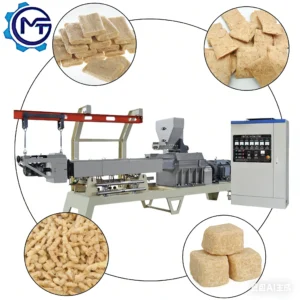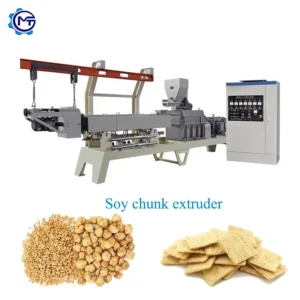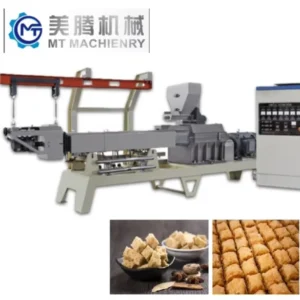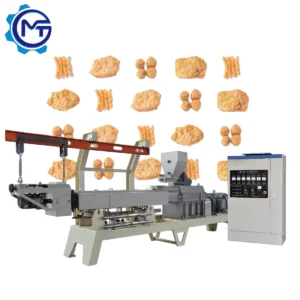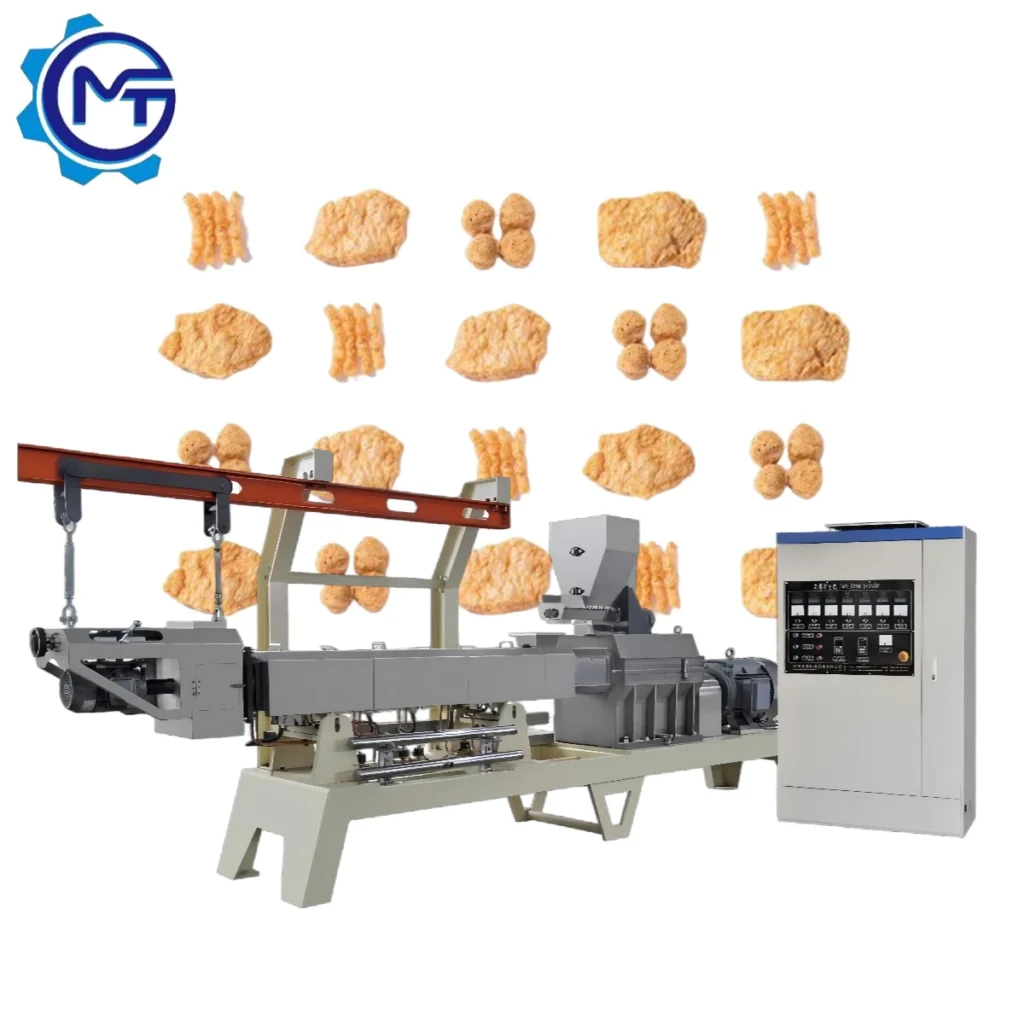
Screw And Die Matched To Raw Material — every twin-screw configuration and die geometry in this line is selected against the buyer’s actual soy or pea protein blend before build.
Technical Specifications
| Parameter | Value |
|---|---|
| Product Type | Textured Soy Protein Production Line |
| Extruder Type | Twin-screw |
| Control System | PLC intelligent control available with configurable language |
| Application Scope | Suitable for multiple plant-based protein formats (basis not stated in source) |
| Output Capacity | Rated capacity based on specific raw material formulation (basis to be confirmed) |
| Contact Materials | Food-grade across all product-contact stations |
| Line Stations | Mixing, extrusion, drying, cooling, packing (full configuration to be confirmed) |
| Certification | CE and ISO referenced (specific line certification to be confirmed) |
Application Suitability
| Application | Material or Output |
|---|---|
| Vegetarian meat nugget manufacturing | Soy protein isolate and wheat gluten blends |
| Textured soy protein production | Defatted soy flour and soy protein concentrate |
| Plant-based meat alternative processing | Pea protein, soy protein, and starch mixtures |
| Meat-free patty and strip formats | High-moisture and low-moisture protein doughs |
Why Extruder Capacity Alone Will Not Build A Working Line
A Textured Soy Protein Production Line equipment range only delivers when every station matches throughput, not just the extruder barrel.
Buyers often lock in an extruder based on a nameplate kilogram-per-hour figure, then discover the downstream dryer cannot keep up when the actual protein blend retains more moisture than the test sample. I have watched a line stall at the drying stage because the belt length was spec’d for a standard soy grit formulation while the customer was running a high-fiber blend that demanded longer residence time. The extruder was never the bottleneck; the dryer was. That mismatch cost two weeks of on-site rework before throughput stabilized [NEED_CITE: importance of throughput matching across extrusion line stations].
How Twin-Screw Geometry Creates Meat-Like Fiber Structure
The twin-screw configuration in this Textured Soy Protein Production Line equipment range applies controlled shear and heat across multiple barrel zones, aligning protein molecules into layered fibrous strands. Barrel temperature profiles and screw pitch are adjusted to the specific protein blend so that gelatinisation and texturisation occur in sequence rather than simultaneously. This staged transformation is what separates a crumbly extrudate from one that tears apart like muscle tissue.
Why Downstream Stations Define The Final Product Density
After extrusion, the drying and cooling stages set the moisture content and structural firmness that the market expects from vegetarian meat nuggets. A dryer that is too short leaves the core soft; a cooler that is too aggressive causes surface cracking. Each station in this line is sized against the extruder’s actual output on the buyer’s formulation, preventing the density drift that causes floating feed to sink or kibble to fall outside specification [NEED_CITE: moisture and density control in post-extrusion drying].
Reading The Specs That Actually Matter For Protein Extrusion
The L:D ratio of the twin-screw barrel determines how long the protein dough stays under shear, directly influencing fiber development length and uniformity. A shorter barrel may suffice for low-moisture soy grits but will under-texturize high-moisture pea protein blends that need extended residence. The die configuration controls cross-sectional shape and expansion ratio — a round die with small orifices produces dense nuggets while a slit die yields flatter strips suitable for shredding. PLC intelligent control allows operators to save and recall temperature and screw-speed recipes for each formulation, reducing batch-to-batch variation across shift changes. Food-grade contact materials throughout the product path prevent metallic contamination that would fail a food safety audit.
What Happens When Voltage And Control Language Are Confirmed Too Late
Shipping an extrusion line without locking in the destination country’s voltage and frequency means the motor may run at the wrong speed, altering screw RPM and shear energy enough to change the entire protein texture. I have seen a commissioning delayed by weeks because the PLC interface arrived in a language the local operators could not read, forcing a firmware swap on site. These are not engineering failures; they are communication failures that a pre-shipment confirmation checklist would have prevented [NEED_CITE: voltage and frequency standards by export market].
Why The Full Equipment Range Matters For Line Integrity
Sourcing a twin-screw extruder from one vendor and a dryer from another often means the mechanical and electrical interfaces are improvised during installation. This Textured Soy Protein Production Line equipment range keeps every station under one supplier, so conveyor heights, electrical interlocks, and PLC communication protocols are designed as a single system rather than patched together. Screw configuration and die geometry are documented against the buyer’s specific raw material, not copied from a generic build. An in-house testing workshop runs trial batches on the customer’s actual protein blend before shipment, catching formulation issues early rather than during commissioning. Pre-sales line layout and capacity calculation ensure each station’s throughput is balanced before metal is cut. Ongoing maintenance support and wear parts supply prevent the line from stalling when the first screw replacement is due.
Documentation & Verification
- Line layout drawing with station-by-station throughput matched to your protein formulation
- Screw and die configuration record specific to your soy or pea protein blend
- Electrical schematic confirming voltage, frequency, and PLC language for your facility
- Factory trial run report on your raw material before shipment
- CE declaration of conformity and ISO certificate for the complete line
Installation, Commissioning & Support
- Foundation and floor space plan based on the full line footprint including dryer belt length
- Dedicated power circuit spec covering extruder motor, dryer heating elements, and PLC panel
- Modular station delivery allowing phased assembly in low-ceiling workshops
- First-run parameter setting on your soy protein formulation by commissioning engineers
- Operator training covering PLC recipe recall, barrel zone temperature adjustment, and die changeover
- Wear parts list with lead times for screws, dies, and dryer belt segments
What To Include In Your Next Inquiry
To configure a Textured Soy Protein Production Line equipment range that matches your production target, share your raw material formulation including protein content and moisture percentage, your target daily output, and the finished product format such as nuggets, patties, or strips. Include your local voltage and frequency, preferred PLC language, and whether you need a trial run on your own material before shipment.
Frequently Asked Questions
Q: What supporting stations are included in the full line range?
A: The line covers mixing and batching systems, twin-screw extrusion, conveying, drying, cooling, and packing stations. Each station is sized against the extruder’s actual output on your protein formulation so that no single point bottlenecks the throughput. Flavouring and coating drums can be added where the product format requires post-drying seasoning.
Q: How do you match extruder capacity with downstream dryer throughput?
A: Dryer belt length, air temperature, and residence time are calculated against the moisture content of the extrudate as it leaves the die. High-moisture protein blends demand longer drying zones. The dryer spec is locked only after the extruder output and formulation are confirmed, preventing the mismatch that causes product to exit the line soft or cracked.
Q: Which equipment models suit different production scales?
A: The twin-screw extruder range spans multiple capacity tiers to cover pilot-scale development through full commercial output. Selection depends on your target hourly throughput on your specific raw material, not on a generic nameplate figure. Each tier maps to a matching dryer, cooler, and packing station so the line stays balanced.
Q: How are screw configuration and die design selected for different proteins?
A: Screw pitch, kneading block arrangement, and barrel zone count are chosen based on whether the raw material is soy isolate, pea protein, or a blended formulation. Die orifice shape and size control the expansion ratio and cross-section. Trial runs in the testing workshop validate the configuration before the line ships [NEED_CITE: screw configuration matching for plant protein extrusion].