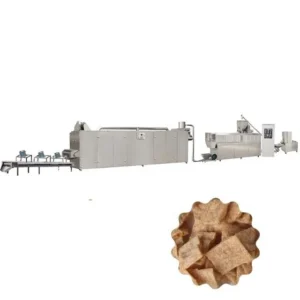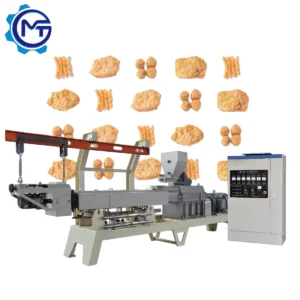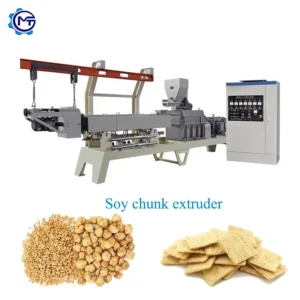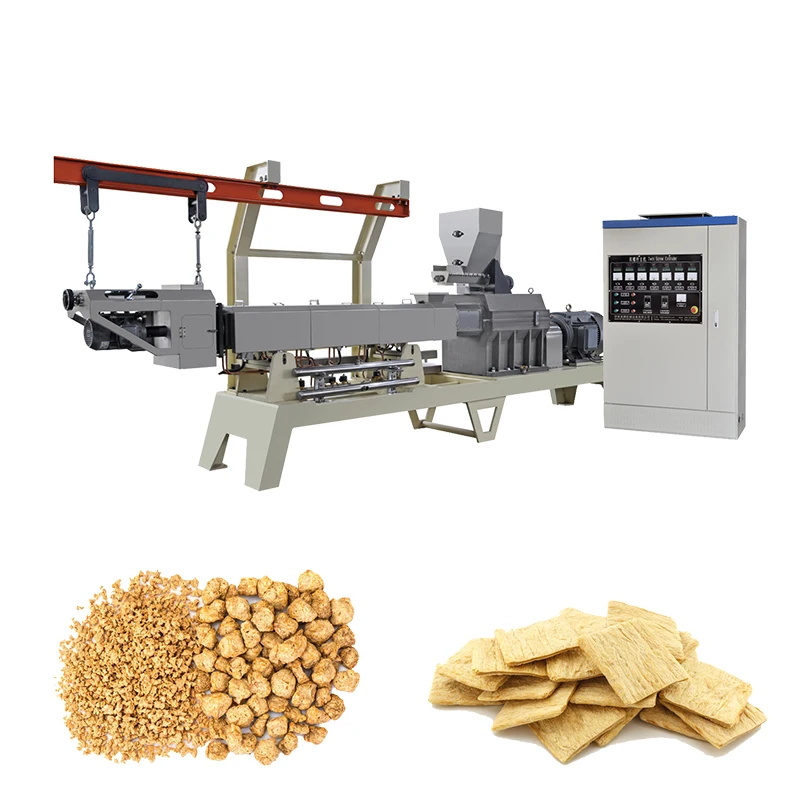
Integrated station sizing — Every mixer, extruder, and dryer in this line is matched by throughput calculation rather than sourced as standalone units.
Technical Specifications
| Parameter | Value |
|---|---|
| Model | MT65 / MT70 / MT85 |
| Product Type | Textured Vegetable Protein Production Line |
| Screw Configuration | Twin-screw extrusion |
| Installed Power | MT65: 85 kW; MT70: 120 kW; MT85: 195 kW |
| Actual Power Consumption | MT65: 65 kW; MT70: 90 kW; MT85: 165 kW |
| Output Capacity | MT65: 150–200 kg/h (basis not stated in source — confirm raw material formulation and moisture content); MT70: 200–300 kg/h (basis not stated in source); MT85: 600–800 kg/h (basis not stated in source) |
| Overall Dimensions (L×W×H) | MT65: 18000×1300×2300 mm; MT70: 20000×1500×2400 mm; MT85: 24000×3500×4300 mm |
| Powder Mixer | Tank volume 150 kg; Mixing time 10 min per batch; Rotary speed 385 rpm; Power 4 kW |
| High-temperature Roaster | Effective belt length 3.5 m; Far infrared heater 3.9 kW × 24; Gas consumption 6.8 m³/h |
| Material of Construction | Stainless steel food-grade contact surfaces |
| Control System | Available with PLC or MCC control (verify configuration) |
| Assembly State | Complete line from batching to packing |
| Certification | CE; ISO |
Application Suitability
| Application | Material or Output |
|---|---|
| Soy chunk and TVP production | Low-temperature soybean meal, peanut meal |
| Vegetarian meat analogues | Formulated plant protein blends for ham and sausage applications |
| Quick-frozen food ingredients | Textured protein pieces for ready meals and canned products |
| Snack food protein enrichment | High-protein extruded pieces from legume and grain blends |
Why the Downstream Equipment Decides Your Real Output
A textured vegetable protein production line only runs as fast as its slowest station.
I spent years on factory floors across Southeast Asia watching extruders sit idle while operators waited on upstream mixers or downstream dryers. One soy chunk producer had a twin-screw extruder rated well above their target, yet the line never reached half that figure. The powder mixer could not feed fast enough, and the dryer belt was too short to handle the extrudate volume. The bottleneck was never the extruder itself — it was every station around it. When stations are specified in isolation, someone always loses capacity to a mismatch [NEED_CITE: line throughput balancing principles in food extrusion].
How Protein Molecules Change Under Twin-Screw Shear
The twin-screw configuration subjects soy or peanut meal to high temperature, high pressure, and intense mechanical shear inside the barrel. Spherical protein molecules unfold and realign into fibrous chain structures that give TVP its characteristic bite. The screw profile and die geometry must match the specific raw material — a setup optimized for soybean meal may not produce the same fibre alignment from a peanut-dominant blend.
Moisture, Residence Time, and Fibre Formation
Moisture content entering the barrel directly affects how completely the protein denatures. Too little moisture and the material scorches before full restructuring; too much and the extrudate emerges soft, unable to hold a meaty texture after drying. Residence time inside the barrel — governed by screw speed and barrel length — determines whether every particle receives uniform treatment. Inconsistent feed from the mixer creates pockets of under-processed material that show up as soft spots in the finished soy chunk [NEED_CITE: protein denaturation behaviour in high-moisture extrusion].
Reading the Power Figures for Your Utility Plan
The gap between installed power and actual consumption across the three models reflects motor headroom for start-up torque and formulation variation. MT65 draws 65 kW in steady operation while carrying 85 kW installed — that margin prevents tripping when a denser batch enters the barrel. For facility planning, use actual consumption figures to size transformers and cable runs, and keep installed power in mind for breaker ratings. Voltage and frequency must be confirmed against the local grid before the electrical cabinet is wired [NEED_CITE: voltage and frequency standards by export market].
The Hidden Cost of Undersized Drying
A roaster with insufficient belt length forces operators to slow the extruder to avoid sending wet product to packing. The High-temperature Roaster here carries a 3.5 m effective belt and 24 far infrared heaters, but whether that is enough depends on your extrudate moisture and target final water activity. If the dryer cannot keep pace, the entire textured vegetable protein production line effectively downgrades to the dryer’s real throughput. Buyers who skip the capacity calculation at the quoting stage discover this constraint only after commissioning.
Matching Every Station Before the Line Ships
Each station in this line is sized against the others so that the mixer output, extruder throughput, roaster belt speed, and cooler capacity align on the same target figure. Screw configuration and die design are specified to the buyer’s raw material rather than pulled from a generic build. An in-house testing workshop runs trial production on customer-supplied material before the machines leave the factory, catching texture or density issues before they become a site problem. Pre-sales consultation covers layout, utility planning, and phased installation scheduling so that foundation work and electrical drops are ready when the containers arrive. CE and ISO documentation supports customs clearance and local regulatory filing.
Documentation & Verification
- Line layout and capacity calculation matched to your soy meal formulation
- Screw and die configuration record for your target chunk size and density
- Trial run report on your raw material before dispatch
- Electrical schematic with confirmed voltage and frequency
- CE declaration of conformity and ISO certificate for import clearance
- Wear parts list with reorder codes for screws and dies
Installation, Commissioning & Support
- Foundation plan accounts for MT85 line length of 24 m and roaster gas supply routing
- Dedicated circuit sized to actual consumption of up to 165 kW for the MT85 model
- Stainless steel contact surfaces inspected and cleaned before first production run
- PLC or MCC control language set to operator preference during commissioning
- Screw and die wear parts stocked and reorder process reviewed with maintenance team
- Cooling machine temperature range verified against your packing room ambient conditions
What to Prepare Before Requesting a Quote
Share your raw material formulation, including soy meal grade and any secondary protein sources, along with the target chunk dimensions and daily volume. Confirm the voltage, frequency, and control language required at your facility. If you have existing upstream or downstream equipment that must integrate with the new line, provide those machine specifications so the layout accounts for connection points and floor space.
Frequently Asked Questions
Q: How is output capacity verified for each model?
A: Output figures for MT65, MT70, and MT85 are based on specific raw material formulations and moisture levels. We run a trial on your actual soy meal or protein blend in the testing workshop and document the real throughput before confirming the capacity in the quotation. This prevents the common situation where a nameplate rating does not hold on the buyer’s material.
Q: How do I choose between MT65, MT70, and MT85?
A: The choice depends on your target daily production volume and available floor space. MT65 suits smaller operations with lower utility capacity, while MT85 requires a 24 m line footprint and higher power supply. We match the model to your output target after reviewing your raw material and shift schedule during the pre-sales consultation.
Q: What voltage and frequency options are available?
A: Voltage and frequency are configured to the destination market before the electrical cabinet is assembled. We confirm the local supply standard during the specification stage and document it on the electrical schematic. This avoids delays at commissioning when the motor rotation or heater rating does not match the site supply.
Q: Which spare wear parts should I stock from day one?
A: Screws and dies are the primary wear items in twin-screw extrusion of abrasive soy meal. We provide a wear parts list with part numbers and recommended first-order quantities. Reordering uses the same configuration record so replacement screws match the original barrel profile and maintain product consistency.
Q: Can I see a trial run before the line ships?
A: Yes. We run your raw material through the extruder in our testing workshop and record output rate, product texture, and moisture at each station. The trial run report is shared before shipment so you can approve the screw and die configuration or request adjustments while the machines are still on the factory floor.